

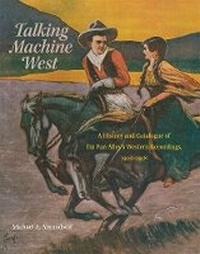
Talking Machine West
A History and Catalogue of Tin Pan Alley's Western Recordings, 1902-1918
Will be published approx. on 30. April 2017
Book
Hardback
208 pages
978-0-8061-5604-0 (ISBN)
Description
Many associate early western music with the likes of Roy Rogers and Gene Autry, but America's first western music craze predates these ""singing cowboys"" by decades. Written by Tin Pan Alley songsters in the era before radio, the first popular cowboy and Indian songs circulated as piano sheet music and as cylinder and disc recordings played on wind-up talking machines.
The colorful fantasies of western life depicted in these songs capitalized on popular fascination with the West stoked by Buffalo Bill's Wild West shows, Owen Wister's novel The Virginian, and Edwin S. Porter's film The Great Train Robbery. The talking machine music industry, centered in New York City, used state-of-the-art recording and printing technology to produce and advertise songs about the American West.
Talking Machine West brings together for the first time the variety of cowboy, cowgirl, and Indian music recorded and sold for mass consumption between 1902 and 1918. In the book's introductory chapters, Michael A. Amundson explains how this music reflected the nostalgic passing of the Indian and the frontier while incorporating modern ragtime music and the racial attitudes of Jim Crow America. Hardly Old West ditties, the songs gave voice to changing ideas about Indians and assimilation, cowboys, the frontier, the rise of the New Woman, and ethnic and racial equality.
In the book's second part, a chronological catalogue of fifty-four western recordings provides the full lyrics and history of each song and reproduces in full color the cover art of extant period sheet music. Each entry also describes the song's composer(s), lyricist(s), and sheet music illustrator and directs readers to online digitized recordings of each song.
Gorgeously illustrated throughout, this book is as entertaining as it is informative, offering the first comprehensive account of popular western recorded music in its earliest form.
The colorful fantasies of western life depicted in these songs capitalized on popular fascination with the West stoked by Buffalo Bill's Wild West shows, Owen Wister's novel The Virginian, and Edwin S. Porter's film The Great Train Robbery. The talking machine music industry, centered in New York City, used state-of-the-art recording and printing technology to produce and advertise songs about the American West.
Talking Machine West brings together for the first time the variety of cowboy, cowgirl, and Indian music recorded and sold for mass consumption between 1902 and 1918. In the book's introductory chapters, Michael A. Amundson explains how this music reflected the nostalgic passing of the Indian and the frontier while incorporating modern ragtime music and the racial attitudes of Jim Crow America. Hardly Old West ditties, the songs gave voice to changing ideas about Indians and assimilation, cowboys, the frontier, the rise of the New Woman, and ethnic and racial equality.
In the book's second part, a chronological catalogue of fifty-four western recordings provides the full lyrics and history of each song and reproduces in full color the cover art of extant period sheet music. Each entry also describes the song's composer(s), lyricist(s), and sheet music illustrator and directs readers to online digitized recordings of each song.
Gorgeously illustrated throughout, this book is as entertaining as it is informative, offering the first comprehensive account of popular western recorded music in its earliest form.
Reviews / Votes
Michael Amundson has filled a gap in the history of western American music by illuminating the era before sound recordings, live performances, and motion pictures converged with the new medium of radio broadcasting. Talking Machine West examines cowboy and cowgirl songs, tunes written about western Native Americans, and commemorative recordings, all produced and sold for mass consumption between 1902 and 1918.""Michael Duchemin
author of New Deal Cowboy: Gene Autry and Public Diplomacy
""[T]his book is essential to anyone interested in American popular music and culture."" - Western Historical Quarterly
More details
Series
Language
English
Place of publication
Oklahoma
United States
Target group
Professional and scholarly
Illustrations
70 colour and 3 black & white illustrations
Dimensions
Height: 279 mm
Width: 216 mm
Thickness: 26 mm
Weight
1447 gr
ISBN-13
978-0-8061-5604-0 (9780806156040)
Copyright in bibliographic data and cover images is held by Nielsen Book Services Limited or by the publishers or by their respective licensors: all rights reserved.
Schweitzer Classification
Person
Michael A. Amundson is Professor of History at Northern Arizona University, Flagstaff. His publications include Wyoming Revisited: Rephotographing the Scenes of Joseph E. Stimson and Yellowcake Towns: Uranium Mining Communities in the American West.