

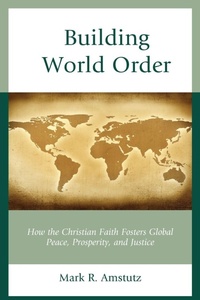
Building World Order
How the Christian Faith Fosters Global Peace, Prosperity, and Justice
Published on 1. April 2025
Book
Paperback/Softback
208 pages
979-8-8818-0563-0 (ISBN)
Description
International relations theorist Amstutz describes how values and perspectives from Christianity can help advance a more humane global order. After highlighting key features of the nation-state and of global society, he illustrates the role of Christian values in international relations with case studies exploring three contemporary global problems-migration, development, and climate change. Amstutz contends that a Christian worldview, focused on the dignity and rights of the individual, as well as an emphasis on the common good, can contribute to peace, prosperity, and justice in the international community.
The topic of global order is now more important than ever, given that the rules-based global order established at the end of World War II is under great stress-as witnessed in current wars in Gaza and Ukraine, and the emergence of far-right regimes in Hungary, Turkey, and perhaps even France. Despite significant improvement in living conditions worldwide, the international community continues to face many global problems, including failing states, domestic and interstate violence, persistent poverty, growth in refugees, mass migration, climate change, and global economic instability. Most importantly, the contemporary liberal order is facing major opposition from authoritarian states. The contemporary challenge to the liberal order gives rise to urgent questions: Will the liberal global order be replaced by a more chaotic power-based order? Is there a better way to organize the world than the existing UN-based nation-state system? How can the liberal international system be renewed? Can fragile states be strengthened? What contribution can a Christian perspective bring to the task of renewing global order?
Amstutz argues that the advance of international justice and global order needs to be based on the nation-state, the basic building block of our contemporary international community. Most initiatives to improve the international community are rooted in political idealism or utopian thought and presume a shift from state sovereignty towards world governance. This study, by contrast, assumes that any improvement in world order will necessarily depend on the ongoing role of the sovereign state. In advancing global peace and prosperity, three tasks are vital: first, strengthen weak, fragile states; second, increase the number of constitutional, democratic states; and third, strengthen international cooperation in addressing shared global problems.
Christian values and perspectives, Amstutz claims, can contribute to a better world by helping to structure the moral analysis of issues and by inspiring action that advances the common good.
The topic of global order is now more important than ever, given that the rules-based global order established at the end of World War II is under great stress-as witnessed in current wars in Gaza and Ukraine, and the emergence of far-right regimes in Hungary, Turkey, and perhaps even France. Despite significant improvement in living conditions worldwide, the international community continues to face many global problems, including failing states, domestic and interstate violence, persistent poverty, growth in refugees, mass migration, climate change, and global economic instability. Most importantly, the contemporary liberal order is facing major opposition from authoritarian states. The contemporary challenge to the liberal order gives rise to urgent questions: Will the liberal global order be replaced by a more chaotic power-based order? Is there a better way to organize the world than the existing UN-based nation-state system? How can the liberal international system be renewed? Can fragile states be strengthened? What contribution can a Christian perspective bring to the task of renewing global order?
Amstutz argues that the advance of international justice and global order needs to be based on the nation-state, the basic building block of our contemporary international community. Most initiatives to improve the international community are rooted in political idealism or utopian thought and presume a shift from state sovereignty towards world governance. This study, by contrast, assumes that any improvement in world order will necessarily depend on the ongoing role of the sovereign state. In advancing global peace and prosperity, three tasks are vital: first, strengthen weak, fragile states; second, increase the number of constitutional, democratic states; and third, strengthen international cooperation in addressing shared global problems.
Christian values and perspectives, Amstutz claims, can contribute to a better world by helping to structure the moral analysis of issues and by inspiring action that advances the common good.
More details
Language
English
Place of publication
United States
Publishing group
Bloomsbury Publishing Plc
Target group
Professional and scholarly
Dimensions
Height: 229 mm
Width: 152 mm
Thickness: 13 mm
Weight
361 gr
ISBN-13
979-8-8818-0563-0 (9798881805630)
Copyright in bibliographic data and cover images is held by Nielsen Book Services Limited or by the publishers or by their respective licensors: all rights reserved.
Schweitzer Classification
Other editions
Additional editions
Mark R. Amstutz
Building World Order
How the Christian Faith Fosters Global Peace, Prosperity, and Justice
E-Book
04/2025
1st Edition
Rowman & Littlefield Publishers
€30.99
Available for download
Mark R. Amstutz
Building World Order
How the Christian Faith Fosters Global Peace, Prosperity, and Justice
E-Book
04/2025
1st Edition
Rowman & Littlefield Publishers
€30.99
Available for download
Person
Mark R. Amstutz is Professor Emeritus of Political Science at Wheaton College (IL). One of the country's leading commentators on the role of religion in International Affairs, he is the author of seven books, including: Rules of the Game: A Primer on International Affairs (2007); Evangelicals and American Foreign Policy (2013), Just Immigration: American Policy in Christian Perspective (2017) and International Ethics: Concepts, Theories, and Cases in Global Politics, 5th edition (Rowman & Littlefield, 2018).