

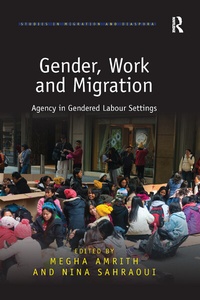
Gender, Work and Migration
Agency in Gendered Labour Settings
1st Edition
Published on 20. December 2019
Book
Paperback/Softback
206 pages
978-0-367-88634-9 (ISBN)
Description
While the feminisation of transnational migrant labour is now a firmly ingrained feature of the contemporary global economy, the specific experiences and understandings of labour in a range of gendered sectors of global and regional labour markets still require comparative and ethnographic attention. This book adopts a particular focus on migrants employed in sectors of the economy that are typically regarded as marginal or precarious - domestic work and care work in private homes and institutional settings, cleaning work in hospitals, call centre labour, informal trade - with the goal of understanding the aspirations and mobilities of migrants and their families across generations in relation to questions of gender and labour. Bringing together rich, fieldwork-based case studies on the experiences of migrants from the Philippines, Bolivia, Ecuador, Zimbabwe, Mozambique, Mauritius, Brazil and India, among others, who live and work in countries within Europe, Asia, the Middle East and South America, Gender, Work and Migration goes beyond a unique focus on migration to explore the implications of gendered labour patterns for migrants' empowerment and experiences of social mobility and immobility, their transnational involvement, and wider familial and social relationships.
More details
Series
Language
English
Place of publication
London
United Kingdom
Publishing group
Taylor & Francis Ltd
Target group
College/higher education
Postgraduate and Undergraduate
Dimensions
Height: 234 mm
Width: 156 mm
ISBN-13
978-0-367-88634-9 (9780367886349)
Copyright in bibliographic data and cover images is held by Nielsen Book Services Limited or by the publishers or by their respective licensors: all rights reserved.
Schweitzer Classification
Other editions
Additional editions
Book
10/2019
1st Edition
Routledge
€65.10
Shipment within 15-20 days
Book
03/2018
1st Edition
Routledge
€206.20
Shipment within 15-20 days
E-Book
03/2018
Routledge
€52.49
Available for download
E-Book
03/2018
Routledge
€52.49
Available for download
Persons
Megha Amrith is Research Group Leader at the Max Planck Institute for the Study of Religious and Ethnic Diversity. She holds a PhD in social anthropology from the University of Cambridge and has research interests in migration, cultural diversity, citizenship, labour, care and civil society activism. She previously worked as a research fellow at the United Nations University Institute on Globalization, Culture and Mobility (UNU-GCM). She has conducted research in different parts of the world on the experiences of female migrant workers in domestic and care work sectors, and as well as on migration and social inclusion in cities. She is the author of the monograph Caring for Strangers: Filipino Medical Workers in Asia (NIAS Press, 2017).
Nina Sahraoui is currently Research Associate at the European University Institute within the project EU Border Care. This project, funded by the European Research Council (ERC), is a comparative study of the politics of maternity care among undocumented migrants on the peripheries of the European Union. Nina has completed a three-year Marie Sklodowska-Curie Fellowship at London Metropolitan University. Her doctoral research focused on migrant workers' experiences in older-age care in London, Paris and Madrid, and her research interests revolve around a gendered political-economy analysis of the articulation of employment, care and migration regimes. She worked for two years as project officer in the Rabat School of Governance and Economics in Morocco. Nina has previously conducted research on diasporic identities, transnational mobilization and the migration-development nexus, notably in relation to the Moroccan case.
Nina Sahraoui is currently Research Associate at the European University Institute within the project EU Border Care. This project, funded by the European Research Council (ERC), is a comparative study of the politics of maternity care among undocumented migrants on the peripheries of the European Union. Nina has completed a three-year Marie Sklodowska-Curie Fellowship at London Metropolitan University. Her doctoral research focused on migrant workers' experiences in older-age care in London, Paris and Madrid, and her research interests revolve around a gendered political-economy analysis of the articulation of employment, care and migration regimes. She worked for two years as project officer in the Rabat School of Governance and Economics in Morocco. Nina has previously conducted research on diasporic identities, transnational mobilization and the migration-development nexus, notably in relation to the Moroccan case.
Content
List of figures and tables; Series editor's preface; Acknowledgments; Notes on contributors; Introduction (Megha Amrith and Nina Sahraoui); Part I: Migrant workers in feminised sectors: Meanings of work; 1. Emotional labour in the care industry: Workers' best asset or biggest threat? (Nina Sahraoui); 2. 'Here, we don't only receive orders': (Dis)Empowering care labour in Madrid and Paris (Paloma More); 3. Cleanliness, affect and social order: On agency and its ambivalences in the context of cleaning work (Kaethe von Bose); Part II: Migrant agency, mobilisations and resilience in precarious contexts; 4. Dignity of labour: Activism among Filipina domestic workers in Singapore and Barcelona (Megha Amrith); 5. Migrant women in trade unions: Domestic service activism in France (Colette Le Petitcorps); 6. Gender, mobility and precarity: The experiences of migrant African women in Cape Town, South Africa (Belinda Dodson); Part III: Transforming gender relations; 7. Gender roles and relations within Bolivian migrant networks: Ambivalent transgressions, regressions and new autonomies (Maria Jose Oomen Liebers and Sarah Kunz); 8. Two generations of women living in Sao Paulo's comunidades: Changing education and employment patterns for immigrant mothers and Sao Paulo-born daughters (Simone Buechler); 9. Precarity, gender capital and structures of (dis)empowerment in the neoliberal service economy (Patricia Alves de Matos); 10. Gulf migration and changing patterns of gender identities in a South Indian Muslim community (Holly M. Hapke and Devan Ayyankeril); Conclusion (Megha Amrith and Nina Sahraoui); Index