

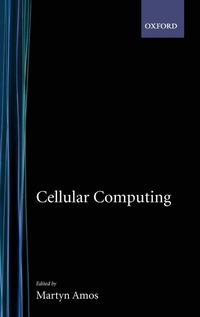
Cellular Computing
Published on 19. August 2004
Book
Hardback
240 pages
978-0-19-515539-6 (ISBN)
Description
The completion of the first draft of the human genome has led to an explosion of interest in genetics and molecular biology. The view of the genome as a network of interacting computational components is well-established, but researchers are now trying to reverse the analogy, by using living organisms to construct logic circuits. The potential applications for such technologies is huge, ranging from bio-sensors, through industrial applications to drug delivery and diagnostics. This book would be the first to deal with the implementation of this technology, describing several working experimental demonstrations using cells as components of logic circuits, building toward computers incorporating biological components in their functioning.
More details
Series
Language
English
Place of publication
New York
United States
Target group
Professional and scholarly
Illustrations
numerous halftones & line drawings
Dimensions
Height: 240 mm
Width: 161 mm
Thickness: 18 mm
Weight
529 gr
ISBN-13
978-0-19-515539-6 (9780195155396)
Copyright in bibliographic data and cover images is held by Nielsen Book Services Limited or by the publishers or by their respective licensors: all rights reserved.
Schweitzer Classification
Other editions
Additional editions
Person
Content
Contributors
Theoretical and Engineering Principles
1: Martyn Amos and Gerald Owenson: An Introduction to Cellular Computing
2: Ray Paton, Michael Fisher, Grant Malcolm, and Koichiro Matsuno: Proteins and Information Processing
3: Michael A. Lones and Andy M. Tyrell: Enzyme Genetic Programming
4: Ron Weiss, Thomas F. Knight Jr., and Gerald Sussman: Genetic Process Engineering
5: Michael L. Simpson, Gary S. Sayler, James T. Fleming, John Sanseverino, and Chris D. Cox: The Device Science of Whole Cells as Components In Microscale and Nanoscale Systems
Laboratory Experiments
6: Kenichi Wakabayashi and Masayuki Yamamura: The Enterococcus faecalis Information Gate
7: Ron Weiss, Thomas F. Knight Jr., and Gerald Sussman: Cellular Computation and Communication Using Engineered Genetic Regulatory Networks
8: Michael L. Simpson, Timothy E. McKnight, Michael A. Guillorn, Vladimir I. Merkulov, Gary S. Sayler, and Anatoli Melechko: The Biology of Integration of Cells into Microscale and Nanoscale Systems
Computation in Ciliates
9: David M. Prescott and Grzegorz Rozenberg: Encrypted Genes and Their Assembly in Ciliates
10: Lila Kari and Laura F. Landweber: Biocomputation in Cities
Index
Theoretical and Engineering Principles
1: Martyn Amos and Gerald Owenson: An Introduction to Cellular Computing
2: Ray Paton, Michael Fisher, Grant Malcolm, and Koichiro Matsuno: Proteins and Information Processing
3: Michael A. Lones and Andy M. Tyrell: Enzyme Genetic Programming
4: Ron Weiss, Thomas F. Knight Jr., and Gerald Sussman: Genetic Process Engineering
5: Michael L. Simpson, Gary S. Sayler, James T. Fleming, John Sanseverino, and Chris D. Cox: The Device Science of Whole Cells as Components In Microscale and Nanoscale Systems
Laboratory Experiments
6: Kenichi Wakabayashi and Masayuki Yamamura: The Enterococcus faecalis Information Gate
7: Ron Weiss, Thomas F. Knight Jr., and Gerald Sussman: Cellular Computation and Communication Using Engineered Genetic Regulatory Networks
8: Michael L. Simpson, Timothy E. McKnight, Michael A. Guillorn, Vladimir I. Merkulov, Gary S. Sayler, and Anatoli Melechko: The Biology of Integration of Cells into Microscale and Nanoscale Systems
Computation in Ciliates
9: David M. Prescott and Grzegorz Rozenberg: Encrypted Genes and Their Assembly in Ciliates
10: Lila Kari and Laura F. Landweber: Biocomputation in Cities
Index