

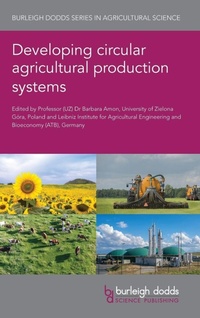
Developing Circular Agricultural Production Systems
Published on 9. January 2024
Book
Hardback
480 pages
978-1-80146-256-3 (ISBN)
Description
"The book contains valuable chapters that provide a useful introduction to how circular economy concepts apply to agricultural systems, supplemented with more in-depth descriptions and analyses of important technologies which may help moving towards improved circularity." (Book Review Published in the Journal of Circular Economy - Dr A. G. T. Schut and Dr W. J. Vonk, Wageningen University, The Netherlands)
With the agricultural sector pledging to improve its sustainability, there is an urgent need to move away from linear food production models which rely on significant raw material inputs and generate large amounts of residual waste.
Developing circular agricultural production systems reviews the emergence of circular agriculture as an approach to improving the sustainability of the agricultural sector. The book addresses recent advances in understanding and developing closed-loop systems to optimise crop nutrient cycles and resource use, as well as ways agricultural wastes can be recycled back into agricultural production or used as feedstock to produce a range of bio-based materials.
With its comprehensive coverage, the book showcases how to develop circular agricultural production systems, from using crop residues as livestock feed, to producing biogas from livestock manure and manufacturing bio-plastics from agricultural waste.
With the agricultural sector pledging to improve its sustainability, there is an urgent need to move away from linear food production models which rely on significant raw material inputs and generate large amounts of residual waste.
Developing circular agricultural production systems reviews the emergence of circular agriculture as an approach to improving the sustainability of the agricultural sector. The book addresses recent advances in understanding and developing closed-loop systems to optimise crop nutrient cycles and resource use, as well as ways agricultural wastes can be recycled back into agricultural production or used as feedstock to produce a range of bio-based materials.
With its comprehensive coverage, the book showcases how to develop circular agricultural production systems, from using crop residues as livestock feed, to producing biogas from livestock manure and manufacturing bio-plastics from agricultural waste.
Reviews / Votes
"The book contains valuable chapters that provide a useful introduction to how circular economy concepts apply to agricultural systems, supplemented with more in-depth descriptions and analyses of important technologies which may help moving towards improved circularity." (Book Review Published in the Journal of Circular Economy - Dr A. G. T. Schut and Dr W. J. Vonk, Wageningen University, The Netherlands)More details
Series
Language
English
Place of publication
Cambridge
United Kingdom
Target group
College/higher education
Professional and scholarly
Academic researchers involved in the agricultural and environmental sciences, as well as government and private sector agencies supporting sustainable agriculture and the UN's Sustainable Development Goals (SDGs)
Product notice
Paper over boards
Illustrations
Color tables, photos and figures
Dimensions
Height: 235 mm
Width: 157 mm
Thickness: 30 mm
Weight
843 gr
ISBN-13
978-1-80146-256-3 (9781801462563)
DOI
10.19103/AS.2023.0120
Copyright in bibliographic data and cover images is held by Nielsen Book Services Limited or by the publishers or by their respective licensors: all rights reserved.
Schweitzer Classification
Other editions
Additional editions
Barbara Amon
Developing Circular Agricultural Production Systems
E-Book
01/2024
1st Edition
Burleigh Dodds Science Publishing Limited
€191.99
Available for download
Persons
Professor (UZ) Dr Barbara Amon is an Associate Professor for Environmental Engineering and Agricultural Engineering at the University of Zielona Gora, Poland and a Senior Research Scientist and Board Representative for Research at the Leibniz Institute for Agricultural Engineering and Bioeconomy (ATB), Germany. Professor Amon sits on many panels, including the Intergovernmental Panel on Climate Change (IPCC), UNECE, UNEP and the FAO LEAP Partnership.
Dr Victor Riau currently works at the Sustainability in Biosystems program of the Institute of Agri-food Research and Technology (IRTA). Dr Riau's research is focused on chemical and environmental engineering, organic waste (water) treatment and valorisation, biogas production, nutrient removal and recovery and emission characterisation and mitigation Cristina Prieto (Dr.) graduated in Chemical Engineering (2010), at the University of Santiago de Compostela (Spain), received a MSc in Industrial Processes Engineering, and a PhD in Chemical Engineering at the University Complutense of Madrid (Spain). Currently, she is a postdoctoral researcher at the Novel Materials and Nanotechnology Group (Spanish Council of Scientific Research). She has received the Extraordinary Doctoral Thesis Award, the Flucomp Best Thesis Award, the UCM University Entrepreneurship Award, the V Catedra Agrobank Award, as well as several awards for the quality of her scientific communications. She has published more than 45 scientific papers in peer-reviewed journals, 3 licensed patents, 3 utility models, 9 chapters, 1 book, and more than 50 abstracts in international conferences. Her expertise involves emerging and conventional encapsulation technologies with application in the food and pharmaceutical industries.
Dr Victor Riau currently works at the Sustainability in Biosystems program of the Institute of Agri-food Research and Technology (IRTA). Dr Riau's research is focused on chemical and environmental engineering, organic waste (water) treatment and valorisation, biogas production, nutrient removal and recovery and emission characterisation and mitigation Cristina Prieto (Dr.) graduated in Chemical Engineering (2010), at the University of Santiago de Compostela (Spain), received a MSc in Industrial Processes Engineering, and a PhD in Chemical Engineering at the University Complutense of Madrid (Spain). Currently, she is a postdoctoral researcher at the Novel Materials and Nanotechnology Group (Spanish Council of Scientific Research). She has received the Extraordinary Doctoral Thesis Award, the Flucomp Best Thesis Award, the UCM University Entrepreneurship Award, the V Catedra Agrobank Award, as well as several awards for the quality of her scientific communications. She has published more than 45 scientific papers in peer-reviewed journals, 3 licensed patents, 3 utility models, 9 chapters, 1 book, and more than 50 abstracts in international conferences. Her expertise involves emerging and conventional encapsulation technologies with application in the food and pharmaceutical industries.
Editor
Leibniz Institute for Agricultural Engineering and Bioeconomy (ATB) (Germany)
Contributions
Institute for Technology Assessment and Systems Analysis (ITAS), Karlsruhe Institute of Technology (KIT) (Germany)
Wageningen University and Research (Netherlands)
University of Kiel (Germany)
University of Kiel (Germany)
University of Kiel (Germany)
Agricultural University of Athens
Agricultural University of Athens
University of New Hampshire
University of New Hampshire
Content
Part 1 General issues
1. Circular, closed-loop agricultural systems: key principles and challenges: Rolf Meyer, Institute for Technology Assessment and Systems Analysis (ITAS), Karlsruhe Institute of Technology (KIT), Germany;
2. Understanding and developing closed-loop nutrient cycles in crop production: Theun Vellinga, Wageningen University and Research, The Netherlands;
3. Closed-loop combined crop-livestock farming systems: Friedhelm Taube, John Kormla Nyameasem and Friederike Fenger, University of Kiel, Germany;
4. Closed-loop precision farming technologies to optimize resource use: C. Maraveas and T. Bartzanas, Agricultural University of Athens, Greece;
Part 2 Re-using agricultural and other wastes
5. Using crop residues/by-products as livestock feed in a circular economy: Andre F. Brito and Kleves V. Almeida, University of New Hampshire, USA; and Luiz H. P. Silva, Western Kentucky University, USA;
6. Optimizing slurry management: David Fangueiro, LEAF-Instituto Superior de Agronomia-ULisboa, Portugal; Jihane Elmahdi, Wageningen University and Research, The Netherlands; Jared Nyang'au, Aarhus University, Denmark; Stamatis Chrysanthopoulos, LEAF-Instituto Superior de Agronomia-ULisboa, Portugal; Jerke De Vries, Wageningen University and Research, The Netherlands; and Peter Sorensen, Aarhus University, Denmark;
7. Optimizing livestock manure as a biofertilizer and bioenergy source: V. Riau, L. Morey, R. Caceres, M. Cerrillo and A. Bonmati, Institute of Agrifood Research and Technology (IRTA), Spain; and A. Robles, BETA Tech Center (UVIC-UCC), Spain;
8. Safe and sustainable use of bio-based fertilizers in agricultural production systems: April Leytem, Robert Dungan, Mindy Spiehs and Dan Miller, United States Department of Agriculture, USA;
Part 3 Co-products
9. Producing biogas from livestock manure and agricultural biomass: R. Fragoso, University of Lisbon, Portugal; D. Hidalgo, CARTIF Technology Center - Circular Economy Area, Spain; and M. Paterson, Kuratorium fuer Technik und Bauwesen in der Landwirtschaft e.V. (KTBL), Germany;
10. Multi-feedstock biorefineries for converting agricultural wastes and microalgae into co-products: Butch Bataller, University of the Philippines at Los Banos (UPLB), The Philippines; and Sergio Capareda, Texas A&M University, USA;
11. Developing bioplastics from agro-industrial wastes for applications in food packaging: Angela Marchetti, Gaia Salvatori and Lionel Tayou Nguemna, Sapienza University of Rome, Italy; Mattia Grumi, Ahmet Ozan Basar, Maria Pardo-Figuerez, Jose Maria Lagaron and Cristina Prieto, Institute of Agrochemistry and Food Technology (IATA), Spain; Chiara Marcoaldi, Sapienza University of Rome, Italy and Institute of Agrochemistry and Food Technology (IATA), Spain; Marianna Villano and Mauro Majone, Research Center for Applied Sciences to the Safeguard of Environment and Cultural Heritage (CIABC) and Sapienza University of Rome, Italy; and David Bolzonella, University of Verona, Italy;
12. Developing polyphenols from agricultural wastes: J. Echave, M. Fraga-Corral, S. Seyyedi-Mansour, L. Cassani, P. Garcia-Oliveira, Hui Cao, J. Simal-Gandara and M. A. Prieto, University of Vigo, Spain; and Jianbo Xiao, University of Vigo, Spain and Jiangsu University, China;
Part 4 Case studies
13. Developing closed-loop dairy value chains and tools to support decision-makers: Jack B. Hetherington, University of Adelaide/CSIRO Agriculture and Food/Fight Food Waste Cooperative Research Centre, Australia; Pablo Juliano, CSIRO Agriculture and Food, Australia; and Rodolfo Garcia-Flores, CSIRO Data61, Australia;
14. Aquaponics: challenges and opportunities for commercial application: Lorenzo Rossi, Martina Puccinelli, Ilaria Marchioni, Luca Incrocci, Baldassare Fronte, Carlo Bibbiani and Alberto Pardossi, University of Pisa, Italy;
1. Circular, closed-loop agricultural systems: key principles and challenges: Rolf Meyer, Institute for Technology Assessment and Systems Analysis (ITAS), Karlsruhe Institute of Technology (KIT), Germany;
2. Understanding and developing closed-loop nutrient cycles in crop production: Theun Vellinga, Wageningen University and Research, The Netherlands;
3. Closed-loop combined crop-livestock farming systems: Friedhelm Taube, John Kormla Nyameasem and Friederike Fenger, University of Kiel, Germany;
4. Closed-loop precision farming technologies to optimize resource use: C. Maraveas and T. Bartzanas, Agricultural University of Athens, Greece;
Part 2 Re-using agricultural and other wastes
5. Using crop residues/by-products as livestock feed in a circular economy: Andre F. Brito and Kleves V. Almeida, University of New Hampshire, USA; and Luiz H. P. Silva, Western Kentucky University, USA;
6. Optimizing slurry management: David Fangueiro, LEAF-Instituto Superior de Agronomia-ULisboa, Portugal; Jihane Elmahdi, Wageningen University and Research, The Netherlands; Jared Nyang'au, Aarhus University, Denmark; Stamatis Chrysanthopoulos, LEAF-Instituto Superior de Agronomia-ULisboa, Portugal; Jerke De Vries, Wageningen University and Research, The Netherlands; and Peter Sorensen, Aarhus University, Denmark;
7. Optimizing livestock manure as a biofertilizer and bioenergy source: V. Riau, L. Morey, R. Caceres, M. Cerrillo and A. Bonmati, Institute of Agrifood Research and Technology (IRTA), Spain; and A. Robles, BETA Tech Center (UVIC-UCC), Spain;
8. Safe and sustainable use of bio-based fertilizers in agricultural production systems: April Leytem, Robert Dungan, Mindy Spiehs and Dan Miller, United States Department of Agriculture, USA;
Part 3 Co-products
9. Producing biogas from livestock manure and agricultural biomass: R. Fragoso, University of Lisbon, Portugal; D. Hidalgo, CARTIF Technology Center - Circular Economy Area, Spain; and M. Paterson, Kuratorium fuer Technik und Bauwesen in der Landwirtschaft e.V. (KTBL), Germany;
10. Multi-feedstock biorefineries for converting agricultural wastes and microalgae into co-products: Butch Bataller, University of the Philippines at Los Banos (UPLB), The Philippines; and Sergio Capareda, Texas A&M University, USA;
11. Developing bioplastics from agro-industrial wastes for applications in food packaging: Angela Marchetti, Gaia Salvatori and Lionel Tayou Nguemna, Sapienza University of Rome, Italy; Mattia Grumi, Ahmet Ozan Basar, Maria Pardo-Figuerez, Jose Maria Lagaron and Cristina Prieto, Institute of Agrochemistry and Food Technology (IATA), Spain; Chiara Marcoaldi, Sapienza University of Rome, Italy and Institute of Agrochemistry and Food Technology (IATA), Spain; Marianna Villano and Mauro Majone, Research Center for Applied Sciences to the Safeguard of Environment and Cultural Heritage (CIABC) and Sapienza University of Rome, Italy; and David Bolzonella, University of Verona, Italy;
12. Developing polyphenols from agricultural wastes: J. Echave, M. Fraga-Corral, S. Seyyedi-Mansour, L. Cassani, P. Garcia-Oliveira, Hui Cao, J. Simal-Gandara and M. A. Prieto, University of Vigo, Spain; and Jianbo Xiao, University of Vigo, Spain and Jiangsu University, China;
Part 4 Case studies
13. Developing closed-loop dairy value chains and tools to support decision-makers: Jack B. Hetherington, University of Adelaide/CSIRO Agriculture and Food/Fight Food Waste Cooperative Research Centre, Australia; Pablo Juliano, CSIRO Agriculture and Food, Australia; and Rodolfo Garcia-Flores, CSIRO Data61, Australia;
14. Aquaponics: challenges and opportunities for commercial application: Lorenzo Rossi, Martina Puccinelli, Ilaria Marchioni, Luca Incrocci, Baldassare Fronte, Carlo Bibbiani and Alberto Pardossi, University of Pisa, Italy;