

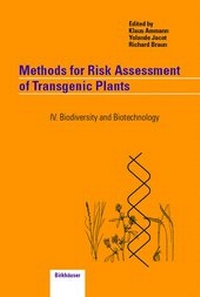
Methods for Risk Assessment of Transgenic Plants
IV. Biodiversity and Biotechnology
Published on 20. June 2003
Book
Hardback
XV, 177 pages
978-3-7643-6657-5 (ISBN)
Description
For centuries, TK has been used almost exclusively by its creators, that is, indigenous and local communities. Access to, use of and handing down of TK has been regulated by local laws, customs and tmditions. Some TK has been freely accessible by all members of an indigenous or local community and has been freely exchanged with other communities; other TK has only been known to particular individuals within these communities such as shamans, and has been handed down only to particular individuals of thc next generation. Over many generations, indigenous and local communities have accumulated a great deal of TK which has generally been adapted, developed and improved by the generations that followed. For a long time, Western anthropologists and other scientists have generally been able to freely access TK and have documented it in their works. Still, this TK was only seldom used outside the indigenous and local communities that created it. More recently, however, Western scientists have become aware that TK is neither outdated nor valueless knowledge, but, instead, 1 can be useful to solve some of the problems facing today's world. Modem science, for example, has shown an increased interest in some fornls ofTK as knowledge that can be used in 4 research and development (R&D) activities and be integrated in modem innovations. This holds especially true for TK regarding genetic resources, which has been integrated in modem 6 phannaceuticals,s agro-chemicals and seed.
More details
Edition
2003
Language
English
Place of publication
Basel
Switzerland
Publishing group
Springer Basel
Target group
College/higher education
Professional and scholarly
Research
Illustrations
XV, 177 p.
Dimensions
Height: 23.5 cm
Width: 15.5 cm
Weight
580 gr
ISBN-13
978-3-7643-6657-5 (9783764366575)
DOI
10.1007/978-3-0348-8033-6
Schweitzer Classification
Other editions
Additional editions
Klaus Ammann | Yolande Jacot | Richard Braun
Methods for Risk Assessment of Transgenic Plants
IV. Biodiversity and Biotechnology
E-Book
12/2012
Birkhäuser
€96.29
Available for download
Klaus Ammann | Yolande Jacot | Richard Braun
Methods for Risk Assessment of Transgenic Plants
IV. Biodiversity and Biotechnology
Book
11/2012
Birkhäuser
€106.99
Shipment within 10-15 days
Content
Introduction: Biodiversity - the impact of biotechnology (Richard Braun and Klaus Ammann).- Session 1: Impact of agricultural biotechnology on ecosystems.- Widening perspectives on biodiversity (Anatole F. Krattiger). Horizontal gene flow (Sir John E. Beringer). Vertical gene flow (Klaus Ammann). Genetically engineered crops and sustainable agriculture (Hans R. Herren). Technology, sustainable agriculture and biodiversity: the socio-economics of technology transfers (Willy de Greef).- Session 2: Social, ethical and legal issues.- The cultural implications of biodiversity and biotechnology: an underdeveloped area in the public understanding field? (Jill Turner). The role of communication in ecological assessments of genetically modified crops (Thomas E. Nickson). Intellectual property rights and traditional knowledge: proposals for action (Susette Biber-Klemm). Intellectual property rights and traditional knowledge: background, terminology and issues arising (Martin A. Girsberger). The Cartagena Protocol on Biosafety of the Convention on Biological Diversity: overview and future development (Beat Nobs, Robert Lamb and François Pythoud).- Session 3: Impact of biotechnology on conservation.- The conservation of genetic diversity: gene flow from agriculture (Alan Gray, Roger Daniels, Alan Raybould, Ian Cooper, Lindsay Maskell, Denise Pallet, Mary-Lou Edwards, Milo Thurston and Matthew Alexander). Problems of plant conservation in agricultural landscapes: can biotechnology help or hinder? (Brian Johnson). Conservation and molecular methods (Hans C.M. den Nijs). Conservation strategies, plant breeding, wild species and land races (Vernon Heywood).- Session 4: Conclusions.- Discussion: The way ahead (Klaus Ammann).- Acknowledgements.- List of contributors.- Subject index