

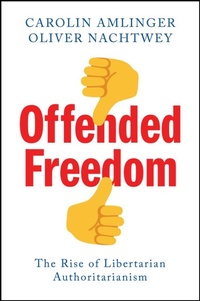
Offended Freedom
The Rise of Libertarian Authoritarianism
1st Edition
Published on 29. November 2024
Book
Hardback
336 pages
978-1-5095-6084-4 (ISBN)
Description
Today, a new kind of freedom fighter has emerged in our midst: liberal and open-minded, these individuals champion liberty and resent the imposition of more and more rules and exhortations that constrain their freedom. They are angry, disgruntled, offended. Why should they have to wear a face mask, get vaccinated or follow new rules on diversity and equality? They should be free to choose. They do not long for a glorified past or the strong arm of the state but argue instead for individual freedoms at all costs.
Carolin Amlinger and Oliver Nachtwey see this new freedom fighter as symptomatic of the rise of a new political current in Western societies - what they call 'libertarian authoritarianism'. The rise of libertarian authoritarianism is a consequence of the promise of freedom in late modernity: the individual is supposed to be free and self-reliant, but in reality many people feel powerless in the face of an increasingly complex world, an experience that manifests itself in resentment, anger and hostility towards democracy.
Drawing on numerous case studies, the authors paint a vivid portrait of this new social figure of our time, showing how the unbridled pursuit of individual freedom can turn into authoritarian behaviour towards others, threatening the very basis of a free and equal society.
Carolin Amlinger and Oliver Nachtwey see this new freedom fighter as symptomatic of the rise of a new political current in Western societies - what they call 'libertarian authoritarianism'. The rise of libertarian authoritarianism is a consequence of the promise of freedom in late modernity: the individual is supposed to be free and self-reliant, but in reality many people feel powerless in the face of an increasingly complex world, an experience that manifests itself in resentment, anger and hostility towards democracy.
Drawing on numerous case studies, the authors paint a vivid portrait of this new social figure of our time, showing how the unbridled pursuit of individual freedom can turn into authoritarian behaviour towards others, threatening the very basis of a free and equal society.
Reviews / Votes
"This is a truly remarkable work. The authors expand an initial interest in anti-vax protesters into a highly insightful and comprehensive study of almost all that is strange and paradoxical about the contemporary world. They trace the way in which the Enlightenment idea of freedom as something expansive and life-affirming has become distorted into the anti-social, paranoid idea of the sovereign individual fighting against everyone around them."Colin Crouch, University of Warwick
"In this brilliant study, Amlinger and Nachtwey have merged an impressive empirical undertaking with considerable theoretical boldness. Their explication of "libertarian authoritarianism" makes new sense of our puzzling historical moment, and will change the way you think about contemporary politics in many countries."
Adrian Daub, Stanford University
More details
Language
English
Place of publication
Oxford
United Kingdom
Publishing group
John Wiley and Sons Ltd
Target group
Professional and scholarly
Product notice
sewn/stitched
Cloth over boards
Dimensions
Height: 232 mm
Width: 161 mm
Thickness: 30 mm
Weight
608 gr
ISBN-13
978-1-5095-6084-4 (9781509560844)
Copyright in bibliographic data and cover images is held by Nielsen Book Services Limited or by the publishers or by their respective licensors: all rights reserved.
Schweitzer Classification
Other editions
Additional editions
E-Book
12/2024
1st Edition
Wiley
€20.99
Available for download
Book
11/2024
1st Edition
Polity Press
€24.00
Shipment within 15-20 days
Persons
Carolin Amlinger is a sociologist and Research Associate at the University of Basel.
Oliver Nachtwey is Professor of Sociology at the University of Basel.
Oliver Nachtwey is Professor of Sociology at the University of Basel.
Content
Acknowledgements
Introduction
Chapter 1. Aporias of Enlightenment: the Critical Theory of freedom
Chapter 2. Freedom in dependence
Chapter 3. The order of disorder: social change and regressive modernisation
Chapter 4. Social aggrievement: on the social character of aversive emotions
Chapter 5. Libertarian authoritarianism: a movement for a reified freedom
Chapter 6. The demise of the truth seekers: fallen intellectuals
Chapter 7. The re-enchantment of the world: "diagonalist" protests
Chapter 8. Subversion as a destructive principle: regressive rebels
Conclusion
Introduction
Chapter 1. Aporias of Enlightenment: the Critical Theory of freedom
Chapter 2. Freedom in dependence
Chapter 3. The order of disorder: social change and regressive modernisation
Chapter 4. Social aggrievement: on the social character of aversive emotions
Chapter 5. Libertarian authoritarianism: a movement for a reified freedom
Chapter 6. The demise of the truth seekers: fallen intellectuals
Chapter 7. The re-enchantment of the world: "diagonalist" protests
Chapter 8. Subversion as a destructive principle: regressive rebels
Conclusion