

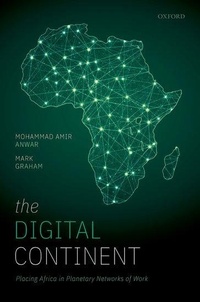
The Digital Continent
Placing Africa in Planetary Networks of Work
Published on 3. February 2022
Book
Hardback
286 pages
978-0-19-884080-0 (ISBN)
Description
This is an open access title available under the terms of a CC BY-NC-ND 4.0 International licence. It is free to read at Oxford Scholarship Online and offered as a free PDF download from OUP and selected open access locations.
As recently as the early 2010s, there were more internet users in countries like France or Germany than in all of Africa put together. But much changed in that decade, and 2018 marked the first year in human history in which a majority of the world's population is now connected to the internet. This mass connectivity means that we have an internet that no longer connects only the world's wealthy. Workers from Lagos to Johannesburg to Nairobi, and everywhere in between, can now apply for and carry out jobs coming from clients who themselves can be located anywhere in the world. Digital outsourcing firms can now also set up operations in the most unlikely of places in order to tap into hitherto disconnected labour forces. With CEOs in the Global North proclaiming that location is a concern of the past, and governments and civil society in Africa promising to create millions of jobs on the continent, The Digital Continent investigates what this new world of digital work means to the lives of African workers. Anwar and Graham draw on a five-year-long field study in South Africa, Kenya, Nigeria, Ghana, and Uganda, and over 200 interviews conducted with participants including gig workers, call and contact centre workers, small self-employed freelancers, business owners, government officials, labour union officials, and industry experts. Focusing on both platform-based remote work and call and contact centre work, the book examines the job quality implications of digital work for the lives and livelihoods of African workers.
As recently as the early 2010s, there were more internet users in countries like France or Germany than in all of Africa put together. But much changed in that decade, and 2018 marked the first year in human history in which a majority of the world's population is now connected to the internet. This mass connectivity means that we have an internet that no longer connects only the world's wealthy. Workers from Lagos to Johannesburg to Nairobi, and everywhere in between, can now apply for and carry out jobs coming from clients who themselves can be located anywhere in the world. Digital outsourcing firms can now also set up operations in the most unlikely of places in order to tap into hitherto disconnected labour forces. With CEOs in the Global North proclaiming that location is a concern of the past, and governments and civil society in Africa promising to create millions of jobs on the continent, The Digital Continent investigates what this new world of digital work means to the lives of African workers. Anwar and Graham draw on a five-year-long field study in South Africa, Kenya, Nigeria, Ghana, and Uganda, and over 200 interviews conducted with participants including gig workers, call and contact centre workers, small self-employed freelancers, business owners, government officials, labour union officials, and industry experts. Focusing on both platform-based remote work and call and contact centre work, the book examines the job quality implications of digital work for the lives and livelihoods of African workers.
Reviews / Votes
The Digital Continent is an extremely interesting and important book * Padraig Carmody, Trinity College Dublin, Global Labour Journal *More details
Language
English
Place of publication
Oxford
United Kingdom
Product notice
sewn/stitched
Cloth over boards
Illustrations
30 black-and-white illustrations
Dimensions
Height: 224 mm
Width: 157 mm
Thickness: 23 mm
Weight
567 gr
ISBN-13
978-0-19-884080-0 (9780198840800)
Copyright in bibliographic data and cover images is held by Nielsen Book Services Limited or by the publishers or by their respective licensors: all rights reserved.
Schweitzer Classification
Other editions
Additional editions
E-Book
02/2022
1st Edition
OUP eBook
€85.99
Available for download
E-Book
02/2022
1st Edition
OUP eBook
€82.49
Available for download
Persons
Mohammad Amir Anwar is a Lecturer in African Studies and International Development at the University of Edinburgh. His work deals with the developmental impacts of globalization, looking behind the scenes at human labour in digital capitalism, the future of work and workers, the global gig economy, and labour movements in Africa. He is also a Research Associate at the Oxford Internet Institute, University of Oxford, and the School of Tourism and Hospitality, University of Johannesburg.
Mark Graham is Professor of Internet Geography at the Oxford Internet Institute, a Fellow at the Alan Turing Institute, a Senior Research Fellow at Green Templeton College, a Research Affiliate in the University of Oxford's School of Geography and the Environment, a Research Associate at the Centre for Information Technology and National Development in Africa at the University of Cape Town, and a Visiting Researcher at Wissenschaftszentrum Berlin fuer Sozialforschung.
Mark Graham is Professor of Internet Geography at the Oxford Internet Institute, a Fellow at the Alan Turing Institute, a Senior Research Fellow at Green Templeton College, a Research Affiliate in the University of Oxford's School of Geography and the Environment, a Research Associate at the Centre for Information Technology and National Development in Africa at the University of Cape Town, and a Visiting Researcher at Wissenschaftszentrum Berlin fuer Sozialforschung.
Content
- Prologue: Making Visible the Invisible
- 1: Hopes and Realities of the Digital
- 2: Africa's New Digital Connectivity and Economic Change
- 3: Economic Geographies of Digital Work in Africa
- 4: Human Labour in the World of Digital Work
- 5: Digital Taylorism: Freedom, Flexibility, Precarity, and Vulnerability
- 6: Resilience, Reworking, and Resistance: Hidden Transcripts of the Gig Economy
- 7: Futures of Work: Making a Fairer World for Labour
- Appendix: Fieldwork Overview