

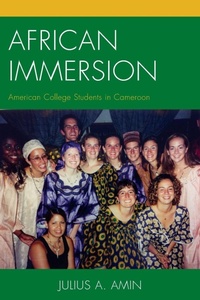
African Immersion
American College Students in Cameroon
Published on 23. May 2016
Book
Paperback/Softback
276 pages
978-1-4985-0239-9 (ISBN)
Description
Based on previously unused primary sources including extensive interviews in Cameroon, personal journals, diaries, responses to questionnaires, and a variety of secondary sources, this study is a critical analysis of US study abroad programs in Africa. Using the University of Dayton Cameroon Immersion program as a case study, the work examines different aspects of experiential learning including selection, orientation, activities of US college students in Cameroon, post-immersion meetings, and impact of program. The nation of Cameroon and University of Dayton are uniquely ideal for the study as Cameroon is considered "Africa in miniature" and serves as a window to understanding many of Africa's political, economic, cultural, and social complexities. Located in the American Midwest, the University of Dayton, while unique, shares many similarities with other American universities.
The study expands the boundaries of scholarship on study abroad. By comparing the impact of the African experience on students to that of Returned Peace Corps Volunteers who served in that continent, the study opens up avenues for comparative analyses. Africa is vital to the global community and, with its complex political, economic, cultural, and social systems, offers important lessons to understanding students' ability to adapt to change in a rapidly changing global environment.
The study expands the boundaries of scholarship on study abroad. By comparing the impact of the African experience on students to that of Returned Peace Corps Volunteers who served in that continent, the study opens up avenues for comparative analyses. Africa is vital to the global community and, with its complex political, economic, cultural, and social systems, offers important lessons to understanding students' ability to adapt to change in a rapidly changing global environment.
Reviews / Votes
Education for global citizenship and experiential learning are today trumpeted as among the defining goals of a college education, making all the more self-evident the value of study abroad programs as part of the undergraduate experience. Based on a detailed study of University of Dayton's study abroad programme in Cameroon, Amin, a Professor of History at the university and faculty leader for the Cameroon program for many years, provides a nuanced and honest analysis of the benefits and challenges of study abroad programs. College administrators as well as students involved in or contemplating study abroad programs in Africa and elsewhere will profit from his effort. -- Dickson Eyoh, University of Toronto The publication of Julius Amin's African Immersion: American College Students in Cameroon takes the emergent scholarly research on study abroad programs to an altogether different level.... The ten-chapter book with three appendices proffers some profound meanings and relevance of the study abroad concept, drawn not only from the author's expertise but also other scholars and think-tank groups.... Amin's book has the potential of being very useful for the orientation sessions of the good number of Study Abroad Programs all across U.S. campuses, as well as for student participants, their parents and friends, who may have any qualms regarding such travels to various destinations. Additionally, those who have completed the program in Africa as well as other destinations elsewhere may want to read it for comparative purposes or just to indulge in reminiscences. Finally, the book also provides useful information for the general reader. The forthrightness with which Amin discussed the strengths and shortcomings of the immersion program is as commendable as it is insightful. * Journal of Global South Studies * 'Original, Vivid, and Masterful.' Julius Amin's African Immersion: American College Students in Cameroon is a must read. Although the book's focus is on the experiences of the University of Dayton's Study Abroad program in Cameroon, it has important lessons for students and faculty involved in Study Abroad program across the world. Julius Amin tells it as he sees it, with nothing to shove under the rug. -- Moses K. TesiMore details
Language
English
Place of publication
United States
Publishing group
Bloomsbury Publishing Plc
Target group
Professional and scholarly
Illustrations
11 charts;
Dimensions
Height: 229 mm
Width: 152 mm
Thickness: 14 mm
Weight
390 gr
ISBN-13
978-1-4985-0239-9 (9781498502399)
Copyright in bibliographic data and cover images is held by Nielsen Book Services Limited or by the publishers or by their respective licensors: all rights reserved.
Schweitzer Classification
Other editions
Additional editions
E-Book
12/2014
1st Edition
Bloomsbury eBooks US
€49.99
Available for download
Person
Julius A. Amin is professor of history at the University of Dayton.
Content
Chapter One: Introduction: Setting the Context
Chapter Two: Antecedents of Cameroon Immersion
Chapter Three: Paul Biya's Cameroon: Overview, Debacles, and Attractions
Chapter Four: Recruitment, In-Country Preparation, and Orientation
Chapter Five: Cameroon! Here We Come
Chapter Six: Living in Cameroon
Chapter Seven: Confronting Race, Elitism, and Privilege in Cameroon
Chapter Eight: Cameroonians Evaluate Immersion
Chapter Nine: Making a Difference
Chapter Ten: Conclusion
Appendix I:Names and countries of Immersion participants (excluding Cameroon) from 1982-2001
Appendix II: Immersion participants and years in Cameroon, 1995-2014
Appendix III: Questionnaire sent to former Cameroon Immersion Participants
Chapter Two: Antecedents of Cameroon Immersion
Chapter Three: Paul Biya's Cameroon: Overview, Debacles, and Attractions
Chapter Four: Recruitment, In-Country Preparation, and Orientation
Chapter Five: Cameroon! Here We Come
Chapter Six: Living in Cameroon
Chapter Seven: Confronting Race, Elitism, and Privilege in Cameroon
Chapter Eight: Cameroonians Evaluate Immersion
Chapter Nine: Making a Difference
Chapter Ten: Conclusion
Appendix I:Names and countries of Immersion participants (excluding Cameroon) from 1982-2001
Appendix II: Immersion participants and years in Cameroon, 1995-2014
Appendix III: Questionnaire sent to former Cameroon Immersion Participants