

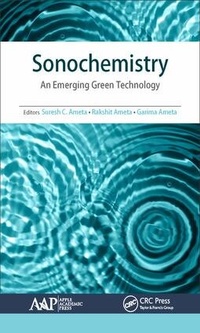
Sonochemistry
An Emerging Green Technology
1st Edition
Will be published approx. on 24. July 2018
Book
Hardback
388 pages
978-1-77188-629-1 (ISBN)
Description
Traditionally heat and light are thought as energy sources to drive a particular chemical reaction, but now ultrasound is a promising energy source for this purpose. The collapse of a bubble generates a wide range of high temperatures and pressures, and therefore, use of ultrasound has a considerable potential in chemical and allied sciences. Ultrasound-assisted reactions are green and economically viable alternatives to conventional techniques. This new volume presents a complete picture of ultrasound-assisted reactions and technologies that can be used in organic synthesis, polymer synthesis and degradation, nanomaterials, wastewater treatment, food ingredients and products, pharmaceutical applications, bioenergy applications, and more. This volume aims to shed light on the diversified applications of ultrasound and its significant role as a green chemical pathway.
Sonochemistry deals with the effect of ultrasonic waves on chemical systems. It has green value because of non-hazardous acoustic radiation and is therefore duly recognized as a green chemistry by synthetic chemists as well as environmentalists. There is no direct interaction of ultrasound with molecular species, but the observed chemical and physical effects of ultrasound are due to the cavitational collapse, which produces drastic conditions of temperature and pressure locally. It induces the formation of various chemical species, which cannot be easily attained under conventional conditions. Sometimes, these species are responsible for driving towards an unusual reactivity in molecular entities.
This book, Sonochemistry: An Emerging Green Technology, provides the complete development of sonochemistry, starting with an introduction and basic concepts of sonochemistry and proceeding on to different types of sonochemical reactions, instrumentation, use of ultrasound in driving particular chemical reactions, and its applications in various fields, such as polymer synthesis, decontamination of water and wastewater, preparation of nanomaterials, food technology, pharmaceutical sciences, etc.
The book also briefly discusses some areas that utilize ultrasounds of different frequencies. These include food products and their processing; anaerobic digestion of waste; and medical applications such as ultrasonography, sonodynamic therapy, drug delivery, etc. Sonochemistry will be successfully used on an industrial scale in pharmaceutical drugs, polymers, nanomaterials, food technology, material science, biogas production, etc. in years to come and will be an established green chemical technology of the future.
Sonochemistry deals with the effect of ultrasonic waves on chemical systems. It has green value because of non-hazardous acoustic radiation and is therefore duly recognized as a green chemistry by synthetic chemists as well as environmentalists. There is no direct interaction of ultrasound with molecular species, but the observed chemical and physical effects of ultrasound are due to the cavitational collapse, which produces drastic conditions of temperature and pressure locally. It induces the formation of various chemical species, which cannot be easily attained under conventional conditions. Sometimes, these species are responsible for driving towards an unusual reactivity in molecular entities.
This book, Sonochemistry: An Emerging Green Technology, provides the complete development of sonochemistry, starting with an introduction and basic concepts of sonochemistry and proceeding on to different types of sonochemical reactions, instrumentation, use of ultrasound in driving particular chemical reactions, and its applications in various fields, such as polymer synthesis, decontamination of water and wastewater, preparation of nanomaterials, food technology, pharmaceutical sciences, etc.
The book also briefly discusses some areas that utilize ultrasounds of different frequencies. These include food products and their processing; anaerobic digestion of waste; and medical applications such as ultrasonography, sonodynamic therapy, drug delivery, etc. Sonochemistry will be successfully used on an industrial scale in pharmaceutical drugs, polymers, nanomaterials, food technology, material science, biogas production, etc. in years to come and will be an established green chemical technology of the future.
More details
Language
English
Place of publication
Oakville
Canada
Target group
College/higher education
Professional and scholarly
Illustrations
42 s/w Abbildungen, 6 farbige Abbildungen, 11 s/w Tabellen
11 Tables, black and white; 6 Illustrations, color; 42 Illustrations, black and white
Dimensions
Height: 229 mm
Width: 152 mm
Weight
800 gr
ISBN-13
978-1-77188-629-1 (9781771886291)
Copyright in bibliographic data and cover images is held by Nielsen Book Services Limited or by the publishers or by their respective licensors: all rights reserved.
Schweitzer Classification
Other editions
Additional editions
Book
03/2021
1st Edition
Apple Academic Press Inc.
€137.20
Shipment within 3-4 weeks
E-Book
06/2018
1st Edition
Apple Academic Press Inc.
€164.99
Available for download
E-Book
06/2018
1st Edition
Apple Academic Press Inc.
€164.99
Available for download
Persons
Suresh C. Ameta, Rakshit Ameta, Garima Ameta
Content
Introduction. Basic Concepts. Instrumentation. Organic Synthesis. Inorganic, Coordination and Organometallic Compounds. Nanomaterials. Polymers. Wastewater Treatment. Food Technology. Anaerobic Digestion. Medical Applications. Industrial Applications. Sonochemistry: A Versatile Approach.