

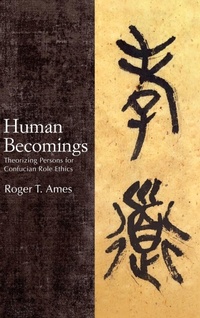
Human Becomings
Theorizing Persons for Confucian Role Ethics
Published on 1. December 2020
Book
Hardback
446 pages
978-1-4384-8079-4 (ISBN)
Description
Offers an in-depth exposition of the Confucian conception of persons as the starting point of Confucian ethics.
2021 CHOICE Outstanding Academic Title
In Human Becomings, Roger T. Ames argues that the appropriateness of categorizing Confucian ethics as role ethics turns largely on the conception of person that is presupposed within the interpretive context of classical Chinese philosophy. By beginning with first self-consciously and critically theorizing the Confucian conception of persons as the starting point of Confucian ethics, Ames posits that the ultimate goal will be to take the Confucian tradition on its own terms and to let it speak with its own voice without overwriting it with cultural importances not its own. He argues that perhaps the most important contribution Confucian philosophy can make to contemporary ethical, social, and political discourse is the conception of focus-field, relationally constituted persons as a robust alternative to the ideology of individualism with single actors playing to win.
2021 CHOICE Outstanding Academic Title
In Human Becomings, Roger T. Ames argues that the appropriateness of categorizing Confucian ethics as role ethics turns largely on the conception of person that is presupposed within the interpretive context of classical Chinese philosophy. By beginning with first self-consciously and critically theorizing the Confucian conception of persons as the starting point of Confucian ethics, Ames posits that the ultimate goal will be to take the Confucian tradition on its own terms and to let it speak with its own voice without overwriting it with cultural importances not its own. He argues that perhaps the most important contribution Confucian philosophy can make to contemporary ethical, social, and political discourse is the conception of focus-field, relationally constituted persons as a robust alternative to the ideology of individualism with single actors playing to win.
Reviews / Votes
"Rich in concepts, ideas, and references from both the Eastern and Western traditions, this volume is sure to have an enormous impact on the field ... Highly recommended." - CHOICEMore details
Series
Language
English
Place of publication
Albany, NY
United States
Target group
Professional and scholarly
US School Grade: College Graduate Student and over
Dimensions
Height: 235 mm
Width: 157 mm
Thickness: 31 mm
Weight
873 gr
ISBN-13
978-1-4384-8079-4 (9781438480794)
Copyright in bibliographic data and cover images is held by Nielsen Book Services Limited or by the publishers or by their respective licensors: all rights reserved.
Schweitzer Classification
Other editions
Additional editions
E-Book
12/2020
1st Edition
De Gruyter
from
€91.99
Available for download
Person
Roger T. Ames is Humanities Chair Professor in the Department of Philosophy at Peking University and Professor Emeritus of Philosophy at the University of Hawai'i. His many books include Confucian Role Ethics: A Vocabulary; Confucian Cultures of Authority (coedited with Peter D. Hershock); and Xu Bing and Contemporary Chinese Art: Cultural and Philosophical Reflections (coedited with Hsingyuan Tsao), all published by SUNY Press.
Content
Preface
Introduction
1. The Question of Which Questions to Ask
2. How Do the Confucian Canons Say "Role Ethics"?
3. A Narrative Conception of Human Nature
4. Holography and the Focus-Field Conception of Persons
5. Relational Autonomy and Thick Choices
6. Holism, Democracy, and the Optimizing of the Human Experience
7. From Human "Becomings" to a Process Cosmology
Epilogue: Why Theorize Confucian Persons for a Changing World Cultural Order?
Bibliography
Index
Introduction
1. The Question of Which Questions to Ask
2. How Do the Confucian Canons Say "Role Ethics"?
3. A Narrative Conception of Human Nature
4. Holography and the Focus-Field Conception of Persons
5. Relational Autonomy and Thick Choices
6. Holism, Democracy, and the Optimizing of the Human Experience
7. From Human "Becomings" to a Process Cosmology
Epilogue: Why Theorize Confucian Persons for a Changing World Cultural Order?
Bibliography
Index