

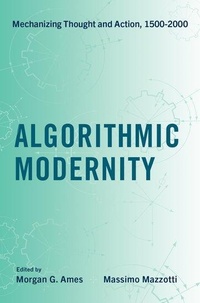
Algorithmic Modernity
Mechanizing Thought and Action, 1500-2000
Published on 12. April 2023
Book
Hardback
312 pages
978-0-19-750242-6 (ISBN)
Description
Algorithms have been transforming human society long before the advent of computing. Yet they continue to exist in relative invisibility despite their presence behind many of our modern social interactions. The rhetoric of algorithmic neutrality is more alive than ever, and algorithms are often depicted as obvious and unproblematic-without context and without history.
Algorithmic Modernity draws together the history of mathematics and intellectual history to convey the enduring global history of the algorithm as a computational tool, epistemic ideal, and rhetorical figure alongside the ascendance of modernity. Through historical reconstructions of relevant thinkers and cultural phenomena over the last five hundred years, this collection of essays reveals how algorithms became the standard method for solving problems from the early inclusion of algorithms in Newton's formation of calculus to their later influence in the New Deal economy. Together, these essays create an informed history for readers interested in the social and cultural implications of today's pervasive digital algorithm.
Featuring experts in mathematics, history, and computing, Algorithmic Modernity presents a multi-faceted exploration of the genealogy of algorithmic thinking in modern times.
Algorithmic Modernity draws together the history of mathematics and intellectual history to convey the enduring global history of the algorithm as a computational tool, epistemic ideal, and rhetorical figure alongside the ascendance of modernity. Through historical reconstructions of relevant thinkers and cultural phenomena over the last five hundred years, this collection of essays reveals how algorithms became the standard method for solving problems from the early inclusion of algorithms in Newton's formation of calculus to their later influence in the New Deal economy. Together, these essays create an informed history for readers interested in the social and cultural implications of today's pervasive digital algorithm.
Featuring experts in mathematics, history, and computing, Algorithmic Modernity presents a multi-faceted exploration of the genealogy of algorithmic thinking in modern times.
Reviews / Votes
Algorithms are both centuries old and central to today's hopes and fears. In this compelling book, ten first-rate historians of science and mathematics trace the genealogy of algorithmic practices and ideas that play a crucial role in the modern world. * Donald MacKenzie, University of Edinburgh *More details
Language
English
Place of publication
New York
United States
Target group
Professional and scholarly
Product notice
sewn/stitched
Cloth over boards
Dimensions
Height: 237 mm
Width: 162 mm
Thickness: 25 mm
Weight
581 gr
ISBN-13
978-0-19-750242-6 (9780197502426)
Copyright in bibliographic data and cover images is held by Nielsen Book Services Limited or by the publishers or by their respective licensors: all rights reserved.
Schweitzer Classification
Other editions
Additional editions
E-Book
03/2023
OUP eBook
€38.49
Available for download
E-Book
03/2023
OUP eBook
€38.49
Available for download
Persons
Morgan G. Ames, PhD, is Assistant Professor of Practice in the School of Information and Associate Director of Research for the Center for Science, Technology, Medicine and Society at the University of California, Berkeley. Dr. Ames researches the ideological origins of inequality in the technology world, with a focus on utopianism, childhood, and learning. Her first book, The Charisma Machine: The Life, Death, and Legacy of One Laptop per Child (MIT Press, 2019), won the 2020 Best Information Science Book Award, the 2020 Sally Hacker Prize, and the 2021 Computer History Museum Prize.
Massimo Mazzotti, PhD, is Thomas M. Siebel Professor of the History of Science and Director of the Center for Science, Technology, Medicine, and Society at the University of California, Berkeley. Dr. Mazzotti has published on the gendering of mathematics, mathematics and religion, Enlightenment science, and the politics of various processes of quantification, standardization, and mechanization. His
current projects explore the political dimension of mathematical reasoning in revolutionary Europe; the intersection of technology, design, and social planning in post-war Italy; and the social life of algorithms.
Massimo Mazzotti, PhD, is Thomas M. Siebel Professor of the History of Science and Director of the Center for Science, Technology, Medicine, and Society at the University of California, Berkeley. Dr. Mazzotti has published on the gendering of mathematics, mathematics and religion, Enlightenment science, and the politics of various processes of quantification, standardization, and mechanization. His
current projects explore the political dimension of mathematical reasoning in revolutionary Europe; the intersection of technology, design, and social planning in post-war Italy; and the social life of algorithms.
Editor
Associate Director of Research for the Center for Science, Technology, Medicine and SocietyAssociate Director of Research for the Center for Science, Technology, Medicine and Society, University of California, Berkeley
Professor of the History of ScienceProfessor of the History of Science, University of California, Berkeley
Content
Introduction
Morgan G. Ames and Massimo Mazzotti
Chapter 1: Algorithm and Demonstration in the Sixteenth-Century Ars Magna
Abram Kaplan
Chapter 2: "Some call it Arsmetrike, and some Awgryme": Misprision and Precision in Algorithmic Thinking and Learning in 1543 and Beyond
Michael J. Barany
Chapter 3: The Orderly Universe: How the Calculus Became an Algorithm
Amir Alexander
Chapter 4: The Algorithmic Enlightenment
J.B. Shank
Chapter 5: Capitalism by Algorithm: Numbers for the Innumerate in the 18th and 19th Century Atlantic World
Caitlin C. Rosenthal
Chapter 6: Material Mathematics: British Algebra as Algorithmic Mathematics
Kevin Lambert
Chapter 7: "For Computing is Our Duty": Algorithmic Workers, Servants, and Women at the Harvard Observatory
Andrew Fiss
Chapter 8: Seeds of Control: Sugar Beets, Control Algorithms, and New Deal Data Politics
Theodora Dryer
Chapter 9: Inference Rituals: Algorithms and the History of Statistics
Christopher J. Phillips
Chapter 10: Decision Trees, Random Forests, and the Genealogy of the Black Box
Matthew L. Jones
Index
Morgan G. Ames and Massimo Mazzotti
Chapter 1: Algorithm and Demonstration in the Sixteenth-Century Ars Magna
Abram Kaplan
Chapter 2: "Some call it Arsmetrike, and some Awgryme": Misprision and Precision in Algorithmic Thinking and Learning in 1543 and Beyond
Michael J. Barany
Chapter 3: The Orderly Universe: How the Calculus Became an Algorithm
Amir Alexander
Chapter 4: The Algorithmic Enlightenment
J.B. Shank
Chapter 5: Capitalism by Algorithm: Numbers for the Innumerate in the 18th and 19th Century Atlantic World
Caitlin C. Rosenthal
Chapter 6: Material Mathematics: British Algebra as Algorithmic Mathematics
Kevin Lambert
Chapter 7: "For Computing is Our Duty": Algorithmic Workers, Servants, and Women at the Harvard Observatory
Andrew Fiss
Chapter 8: Seeds of Control: Sugar Beets, Control Algorithms, and New Deal Data Politics
Theodora Dryer
Chapter 9: Inference Rituals: Algorithms and the History of Statistics
Christopher J. Phillips
Chapter 10: Decision Trees, Random Forests, and the Genealogy of the Black Box
Matthew L. Jones
Index