

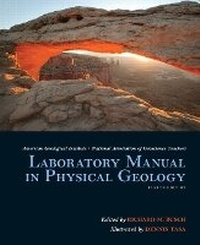
Laboratory Manual in Physical Geology
8th Edition
Published on 14. February 2008
Book
Spiral bound
336 pages
978-0-13-600771-5 (ISBN)
Description
Revised throughout for enhanced clarity and accuracy - and with a greater emphasis on the process of science - this user-friendly, best-selling laboratory manual examines the basic principles of geology and their applications to everyday life. Students are encouraged to view these principles in terms of natural resources, natural hazards, and human risks. This trusted resource features contributions from highly regarded geologists and geoscience educators, with an exceptional illustration program by Dennis Tasa.
More details
Edition
8th edition
Language
English
Place of publication
United States
Publishing group
Pearson Education (US)
Target group
Professional and scholarly
Dimensions
Height: 226 mm
Width: 274 mm
Thickness: 18 mm
Weight
1054 gr
ISBN-13
978-0-13-600771-5 (9780136007715)
Copyright in bibliographic data and cover images is held by Nielsen Book Services Limited or by the publishers or by their respective licensors: all rights reserved.
Schweitzer Classification
Other editions
New editions
AGI American Geological Institute | .. .. NAGT - National Association of Geoscience Teachers | Richard M. Busch
Laboratory Manual in Physical Geology
International Edition
Book
03/2011
9th Edition
Pearson
€80.59
Article exhausted; check for reprint
Previous edition
AGI American Geological Institute | .. .. NAGT - National Association of Geoscience Teachers | Richard M. Busch
Laboratory Manual in Physical Geology
Book
10/2005
7th Edition
Pearson
€19.83
Article exhausted; check for reprint
Content
Laboratory 1: Exploring and Measuring Earth Materials and Processes
Laboratory 2: Plate Tectonics and the Origin or Magma Laboratory 3: Mineral Properties, Uses, and Identification
Laboratory 4: Exploring Rocks and a Rock Cycle Model
Laboratory 5: Igneous Rocks and Volcanic Hazards
Laboratory 6: Sedimentary Rocks, Processes, and Environments
Laboratory 7: Metamorphic Rocks, Processes, and Resources
Laboratory 8: Dating of Rocks, Fossils, and Geologic Events
Laboratory 9: Topographic Maps and Aerial Photographs
Laboratory 10: Geologic Structures, Maps, and Block Diagrams
Laboratory 11: Stream Processes, Landscapes, Mass Wastage, and Flood Hazards
Laboratory 12: Groundwater Processes, Resources, and Risks
Laboratory 13: Glacial Processes, Landforms, and Indicators of Climate Change
Laboratory 14: Dryland Landforms, Hazards, and Risks
Laboratory 15: Coastal Processes, Landforms, Hazards, and Risks
Laboratory 16: Earthquake Hazards and Human Risks
Laboratory 2: Plate Tectonics and the Origin or Magma Laboratory 3: Mineral Properties, Uses, and Identification
Laboratory 4: Exploring Rocks and a Rock Cycle Model
Laboratory 5: Igneous Rocks and Volcanic Hazards
Laboratory 6: Sedimentary Rocks, Processes, and Environments
Laboratory 7: Metamorphic Rocks, Processes, and Resources
Laboratory 8: Dating of Rocks, Fossils, and Geologic Events
Laboratory 9: Topographic Maps and Aerial Photographs
Laboratory 10: Geologic Structures, Maps, and Block Diagrams
Laboratory 11: Stream Processes, Landscapes, Mass Wastage, and Flood Hazards
Laboratory 12: Groundwater Processes, Resources, and Risks
Laboratory 13: Glacial Processes, Landforms, and Indicators of Climate Change
Laboratory 14: Dryland Landforms, Hazards, and Risks
Laboratory 15: Coastal Processes, Landforms, Hazards, and Risks
Laboratory 16: Earthquake Hazards and Human Risks