

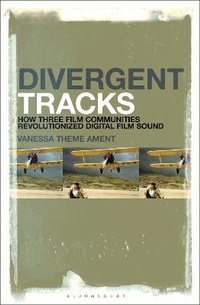
Divergent Tracks
How Three Film Communities Revolutionized Digital Film Sound
Published on 20. May 2021
Book
Hardback
176 pages
978-1-5013-5922-4 (ISBN)
Description
By examining three case studies of award-winning soundtracks from cult films-Barton Fink (1991), Bram Stoker's Dracula (1992), and The English Patient (1996)-it becomes clear that major American film communities, when confronted with the initial technological changes of the 1990s, experienced similar challenges with the inelegant transition from analogue to digital. However, their cultural and structural labor differences governed different results.
Vanessa Ament, author of The Foley Grail (2009), rather than defining the 1990s as an era of technological determinism-a superficial reading-it is best understood as one in which sound professionals became more viable as artists, collaborated in sound design authorship, and influenced this digital transition to better accommodate their needs and desires in their work.
Vanessa Ament, author of The Foley Grail (2009), rather than defining the 1990s as an era of technological determinism-a superficial reading-it is best understood as one in which sound professionals became more viable as artists, collaborated in sound design authorship, and influenced this digital transition to better accommodate their needs and desires in their work.
Reviews / Votes
Divergent Tracks reveals a first-hand account of the behind-the-scene world of postproduction film sound in the 1990s, a key moment when industry professionals grappled with the disruptive transition from analogue to digital technologies. In her masterful account, Dr. Ament rigorously details how three geographically distinct film communities each made critical contributions to the development of digital film sound and how their innovative practices changed the way we listen to the movies. I anticipate that Dr. Ament's book will change how we also regard the role of sound designers and their post-production teams by helping us all better recognize their major contributions to the craft of moviemaking as creative professionals in their own right. * Richard Lawrence Edwards, Director for the Center for Teaching & Learning, University of California, Riverside, USA *More details
Language
English
Place of publication
New York
United States
Publishing group
Bloomsbury Publishing Plc
Target group
College/higher education
Illustrations
27 colour illus
Dimensions
Height: 159 mm
Width: 238 mm
Thickness: 15 mm
Weight
472 gr
ISBN-13
978-1-5013-5922-4 (9781501359224)
Copyright in bibliographic data and cover images is held by Nielsen Book Services Limited or by the publishers or by their respective licensors: all rights reserved.
Schweitzer Classification
Other editions
Additional editions
E-Book
04/2021
1st Edition
Bloomsbury Academic USA
€35.49
Available for download
Person
"VANESSA THEME AMENT is the former Endowed Chair of Telecommunications at Ball State University, USA. She has worked as a Foley artist on such films as Die Hard, and produced the documentary Amplified: A Conversation with Women in American Film Sound, and is the author of The Foley Grail (3rd edition, 2021)"
Content
1. Sound Design as Cultural Artifact
2. Geographical Cultures and Technological Tendencies
3. "Viscous was the Word of the Day": The Interiority of Barton Fink
4. "How Would you Like to Work on a Monster Movie?": The Expressionism of Bram Stoker's Dracula
5. "The Sound of the Desert is Tape Hiss": A Study in Contrasts in The English Patient
6. Conclusion: Reassessing Sound Design as a Collective Endeavor
Bibliography
Index
2. Geographical Cultures and Technological Tendencies
3. "Viscous was the Word of the Day": The Interiority of Barton Fink
4. "How Would you Like to Work on a Monster Movie?": The Expressionism of Bram Stoker's Dracula
5. "The Sound of the Desert is Tape Hiss": A Study in Contrasts in The English Patient
6. Conclusion: Reassessing Sound Design as a Collective Endeavor
Bibliography
Index