

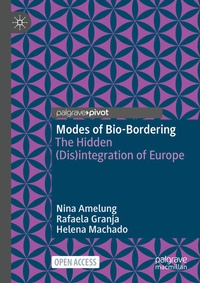
Modes of Bio-Bordering
The Hidden (Dis)integration of Europe
Published on 1. November 2021
Book
Paperback/Softback
XI, 151 pages
978-981-15-8185-4 (ISBN)
Description
This open access book explores how biometric data is increasingly flowing across borders in order to limit, control and contain the mobility of selected people, namely criminalized populations. It introduces the concept of bio-bordering, using it to capture reverse patterns of bordering and ordering practices linked to transnational biometric data exchange regimes. The concept is useful to reconstruct how the territorial foundations of national state autonomy are partially reclaimed and, at the same time, partially purposefully suspended. The book focuses on the Prüm system, which facilitates the mandatory exchange of forensic DNA data amongst EU Member States. The Prüm system is an underexplored phenomenon, representing diverse instances of bio-bordering and providing a complex picture of the hidden (dis)integration of Europe. Particular legal, scientific, technical and political dimensions related to the governance and uses of biometric technologies in Germany, the Netherlands,Poland, Portugal and the United Kingdom are specifically explored to demonstrate both similar and distinct patterns.
Reviews / Votes
"This book is an extremely innovative comparative analysis between different national approaches to bio-bordering in the EU from a sociological and criminological perspective. It provides not only very valuable insights into the history and working of biometric databases in the EU, but also into the legal, political and policing systems of four EU Member States and the United Kingdom. The book impressively highlights EU blindness to national systems but also possibilities for harmonisation by science." (Dr Saskia Hufnagel, Queen Mary University of London, Senior Lecturer in Criminal Law)"Borders do much more than delineate states, territories and populations. By exploring the development of DNA databases in Europe, this adventurous book carefully constructs the concept of bio-bordering. This book convincingly adds a next chapter to our understanding of borders and the connections and disconnections they make between political bodies, human bodies and technologies."(Prof Dr Huub Dijstelbloem, University of Amsterdam, Department of Philosophy)
"This book marks a significant development of a field of study that has emerged since the end of last century. Building upon prior studies of bordering and surveillance, this book marks a new milestone, providing an important new lens for understanding forensic genetics and trans-national law enforcement-which has so far remained relatively under-reported, and certainly under-theorised." (Dr Carole McCartney, Professor of Law & Criminal Justice, Northumbria University)
More details
Edition
1st ed. 2021
Language
English
Place of publication
Singapore
Singapore
Target group
Professional and scholarly
Illustrations
2 s/w Abbildungen, 2 farbige Abbildungen
XI, 151 p. 4 illus., 2 illus. in color.
Dimensions
Height: 210 mm
Width: 148 mm
Thickness: 10 mm
Weight
221 gr
ISBN-13
978-981-15-8185-4 (9789811581854)
DOI
10.1007/978-981-15-8183-0
Schweitzer Classification
Other editions
Additional editions
Nina Amelung | Rafaela Granja | Helena Machado
Modes of Bio-Bordering
The Hidden (Dis)integration of Europe
Book
10/2020
Springer
€53.49
Shipment within 3-4 weeks
Persons
Nina Amelung, PhD, University of Minho, is a sociologist working in the project EXCHANGE, funded by European Research Council and led by Helena Machado. Her current research is on the democratic challenges of cross-border biometric data-exchange, and the making of publics in European crime, migration and border control regimes.
Rafaela Granja, PhD, University of Minho, is a sociologist working in the project EXCHANGE. Her current research explores the transnational exchange of DNA data and controversies associated with scientific and technological innovations in the forensic field. Her previous work has focused on reconfigurations of family relationships inside and outside prisons.
Helena Machado, Full Professor of Sociology, University of Minho, is a transdisciplinary researcher, engaging the social studies of science, bioethics, and sociological and criminological perspectives to explore how genetics creates acute challenges to citizenship, democracy and social control in contemporary societies.
Rafaela Granja, PhD, University of Minho, is a sociologist working in the project EXCHANGE. Her current research explores the transnational exchange of DNA data and controversies associated with scientific and technological innovations in the forensic field. Her previous work has focused on reconfigurations of family relationships inside and outside prisons.
Helena Machado, Full Professor of Sociology, University of Minho, is a transdisciplinary researcher, engaging the social studies of science, bioethics, and sociological and criminological perspectives to explore how genetics creates acute challenges to citizenship, democracy and social control in contemporary societies.
Content
Chapter 1 - Introduction.- Chapter 2 - A brief history of the evolution of forensic biometrics and biometric database systems crossing borders in EU law enforcement.- Chapter 3 - Biobordering as a concept.- Chapter 4 - Germany.- Chapter 5 - The Netherlands.- Chapter 6 - Poland.- Chapter 7 - Portugal.- Chapter 8 - The United Kingdom.- Chapter 9 - Conclusion.