

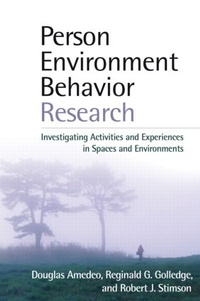
Person-Environment-Behavior Research
Investigating Activities and Experiences in Spaces and Environments
1st Edition
Published on 30. November 2008
Book
Hardback
389 pages
978-1-59385-871-1 (ISBN)
Description
Research into spatial influences on people's everyday activities and experiences presents many conceptual and methodological complexities. Written by leading authorities, this book provides a comprehensive framework for collecting and analyzing reliable person-environment-behavior data in real-world settings that rarely resemble the controlled conditions described in typical texts. An array of research designs are illustrated in chapter-length examples addressing such compelling issues as spatial patterns of voting behavior, ways in which disabilities affect people's travel and wayfinding, how natural and built environments evoke emotional responses, spatial factors in elementary teaching and learning, and more. A special chapter guides the student or beginning researcher to craft a successful research proposal.
Reviews / Votes
This book provides insightful coverage of the complexities inherent in studying the relationships between people, their everyday environments, and behavior. Key theories and findings from studies of physical space, sociospatial environments, and behavior are presented, as are a wide array of qualitative and quantitative methods. The volume offers an original approach to conducting and understanding research in this interdisciplinary field, making it a valuable contribution.--Daniel Stokols, PhD, Department of Psychology and Social Behavior, School of Social Ecology, University of California, IrvinePresents a wealth of valuable information for scholars of spatial behavior across disciplinary boundaries, from beginning to more advanced researchers. The volume's format is essential to its strength. The progression from methods and topics in the initial sections to concrete, successful applications in the latter sections is effective. Readers can easily locate and reference the parts of the book that will meet their particular needs.--Scott Bell, PhD, Population Studies Training Center, Brown University
This book should be a mandatory addition to the library of any person-environment-behavior researcher, and will be a welcome primer for graduate students facing serious research design for the first time. There is nothing else like it on the market, and the authors are giants in the field. Many examples from seminal research studies connect the concepts discussed to real-world practices. This book provides 'one-stop shopping' in a complex and challenging field. It will certainly be a useful graduate-level text.--Jon Malinowski, PhD, Department of Geography and Environmental Engineering, United States Military Academy
-
More details
Language
English
Place of publication
New York
United States
Target group
College/higher education
Dimensions
Height: 254 mm
Width: 178 mm
Weight
884 gr
ISBN-13
978-1-59385-871-1 (9781593858711)
Copyright in bibliographic data and cover images is held by Nielsen Book Services Limited or by the publishers or by their respective licensors: all rights reserved.
Schweitzer Classification
Other editions
Additional editions
Douglas Amedeo | Reginald G. Golledge | Robert J. Stimson
Person-Environment-Behavior Research
Investigating Activities and Experiences in Spaces and Environments
Book
11/2008
1st Edition
Guilford Publications
€76.94
Article exhausted; check different version
Persons
Douglas Amedeo is Professor in the Department of Anthropology and Geography at the University of Nebraska-Lincoln. He teaches courses in behavioral approaches to geographic issues and conducts research on the importance of space in environmental settings and affective responses to environments.
Reginald G. Golledge is Professor of Geography at the University of California, Santa Barbara. He teaches courses on spatial and environmental cognition and conducts research in the areas of cognitive mapping and wayfinding, analytical behavioral geography, and spatial behavior.
Robert J. Stimson is Professor of Geographical Sciences and Planning at the University of Queensland, Australia, and Director of the Urban and Regional Analysis Research Program, University of Queensland Social Research Center. He conducts research on human spatial behavior and urban and regional analysis, development, and planning.
Reginald G. Golledge is Professor of Geography at the University of California, Santa Barbara. He teaches courses on spatial and environmental cognition and conducts research in the areas of cognitive mapping and wayfinding, analytical behavioral geography, and spatial behavior.
Robert J. Stimson is Professor of Geographical Sciences and Planning at the University of Queensland, Australia, and Director of the Urban and Regional Analysis Research Program, University of Queensland Social Research Center. He conducts research on human spatial behavior and urban and regional analysis, development, and planning.
Content
1. An Overview of Spatial and/or Environmental Influences in Human Activities and Experiences
I. Comprehending Data Recording and Measurement to Generate Information in Scientific Inquiry
2. Data and Measurement to Generate Information
3. Collecting Data and Generating Information in a Scientific Mode
II. Collecting Data and Representing Information
4. The Purpose of Collecting and Matching Data and Analysis
5. Qualitative and Survey Approaches to Collecting Data and Generating Information
6. Collecting Information from Sampled Populations Using Probability and Nonprobability Designs
7. Extrapolating from Controlled Conditions to the Real World
III. Activities in Environments
8. Modeling Social-Environmental Factors Associated with Spatial Patterns of Voter Support for Political Parties
9. Intellectually Challenged People Interacting with Their Environment
10. Spatial Competence of Blind and Visually Impaired People When Performing Activities in Different Spaces
IV. Activities and Spaces
11. Decision Process and Choice in the Residential Relocation of Retirees
12. Sex Roles and the Gendering of Activities and Spaces
13. Spatial Structural Influences on Activities in an Elementary Classroom Environment
V. Experiences and Environments
14. Experiences in Everyday Environments
15. Aesthetic Experiences in Environments
VI. Experiences and Spaces
16. Deriving Metropolitanwide Spatial Patterns of Perceived Quality-of-Life Dimensions
17. Reflecting the Nature of Cognitive Spaces from Perceived Relations
18. Modeling Group Conservation Perspectives
VII. Planning Research: The Common Sense of a Research Proposal
19. Mapping a Strategic Plan for Research
I. Comprehending Data Recording and Measurement to Generate Information in Scientific Inquiry
2. Data and Measurement to Generate Information
3. Collecting Data and Generating Information in a Scientific Mode
II. Collecting Data and Representing Information
4. The Purpose of Collecting and Matching Data and Analysis
5. Qualitative and Survey Approaches to Collecting Data and Generating Information
6. Collecting Information from Sampled Populations Using Probability and Nonprobability Designs
7. Extrapolating from Controlled Conditions to the Real World
III. Activities in Environments
8. Modeling Social-Environmental Factors Associated with Spatial Patterns of Voter Support for Political Parties
9. Intellectually Challenged People Interacting with Their Environment
10. Spatial Competence of Blind and Visually Impaired People When Performing Activities in Different Spaces
IV. Activities and Spaces
11. Decision Process and Choice in the Residential Relocation of Retirees
12. Sex Roles and the Gendering of Activities and Spaces
13. Spatial Structural Influences on Activities in an Elementary Classroom Environment
V. Experiences and Environments
14. Experiences in Everyday Environments
15. Aesthetic Experiences in Environments
VI. Experiences and Spaces
16. Deriving Metropolitanwide Spatial Patterns of Perceived Quality-of-Life Dimensions
17. Reflecting the Nature of Cognitive Spaces from Perceived Relations
18. Modeling Group Conservation Perspectives
VII. Planning Research: The Common Sense of a Research Proposal
19. Mapping a Strategic Plan for Research