

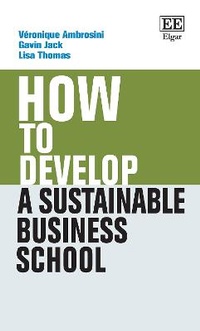
How to Develop a Sustainable Business School
Published on 17. January 2023
Book
Hardback
128 pages
978-1-80220-120-8 (ISBN)
Description
Tackling the pressing challenges that business schools face as they deliver the UN Sustainable Development Goals (SDGs), this How To guide provides rich insights into how to create and sustain the business schools of the future.
The SDGs are ubiquitous and this signals that business schools need to embark on an urgent paradigm shift to embed the SDGs into their research, education and operations. Taking an integrated approach to sustainability, this work provides rich insights into how business school leaders, academics, students and professional staff can create the business school of the future; one that has close collaborative relationships with its stakeholders, that is inclusive and advances responsible management education, and ultimately generates positive societal benefits. The authors consider the drivers for sustainability and the roles of accreditation and rankings' bodies, and how through their research, educational offerings and governance, business schools can develop new modus operandi to embed sustainability.
Accessible yet rigorous, the combination of theory with real-life examples in this research-based book will prove invaluable to leaders and managers in business schools as well as all those with an interest in shaping their agenda and activities, including students, scholars and all stakeholders interested in creating more sustainable futures.
The SDGs are ubiquitous and this signals that business schools need to embark on an urgent paradigm shift to embed the SDGs into their research, education and operations. Taking an integrated approach to sustainability, this work provides rich insights into how business school leaders, academics, students and professional staff can create the business school of the future; one that has close collaborative relationships with its stakeholders, that is inclusive and advances responsible management education, and ultimately generates positive societal benefits. The authors consider the drivers for sustainability and the roles of accreditation and rankings' bodies, and how through their research, educational offerings and governance, business schools can develop new modus operandi to embed sustainability.
Accessible yet rigorous, the combination of theory with real-life examples in this research-based book will prove invaluable to leaders and managers in business schools as well as all those with an interest in shaping their agenda and activities, including students, scholars and all stakeholders interested in creating more sustainable futures.
Reviews / Votes
'While business schools were heralded as the success story of 21st Century higher education, this book argues that a paradigm shift in governance is now required. Going beyond well-rehearsed criticisms of business schools and programmatic calls for incremental change, Ambrosini and colleagues argue that business school leaders must change the raison d'etre of their organisations to focus on sustainability. The authors' skilful marshalling of evidence and insight convinces of the need for transformation. Their deep appreciation of the institutional context surfaces many barriers to progress. For those who are brave enough to try to address these challenges, this book will provide an authoritative source of inspiration.' -- Martin Kitchener, Cardiff University, UKMore details
Series
Language
English
Place of publication
Cheltenham
United Kingdom
Target group
Professional and scholarly
Dimensions
Height: 216 mm
Width: 138 mm
ISBN-13
978-1-80220-120-8 (9781802201208)
Copyright in bibliographic data and cover images is held by Nielsen Book Services Limited or by the publishers or by their respective licensors: all rights reserved.
Schweitzer Classification
Persons
Veronique Ambrosini, Professor of Management, Monash University, Australia, Gavin Jack, Dean, Business School, University of Edinburgh, UK and Lisa Thomas, Professor of Strategy, Kedge Business School, France
Content
Contents: 1. Introduction: business school context and globalization 2. Stakeholder engagement 3. Responsible management and leadership education and learning 4. Research impact 5. Accreditations, rankings and business school governance 6. Equality/equity, diversity and inclusion 7. Reflection and conclusion References Index