

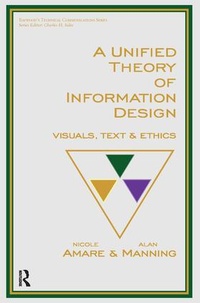
A Unified Theory of Information Design
Visuals, Text and Ethics
1st Edition
Published on 30. December 2013
Book
Paperback/Softback
215 pages
978-0-89503-779-4 (ISBN)
Description
Communicative visuals, including written text, have a diverse range of forms and purposes. In this volume, the authors show that it is possible to both describe and explain the major properties of diverse visual-communication forms and purposes within a common theoretical framework of information design and ethics. For those unaccustomed to thinking of written text as a visual form belonging to the same general class as other visual forms (colour, texture, shape, imagery, etc.), consider how a text's readability suffers if we remove all white space and punctuation, which can be identified as visual signals of the same subtype as grid lines and bullet points, dividing and calling attention to adjacent information. The authors identify deep connections between foundational visual design elements and the grammar of language itself.
No physicist or chemist today questions the value of a single theory that describes and explains a wide variety of phenomena, but oddly enough, the authors have frequently been asked why they are interested in advancing a unified theory of visual communication. The simplest answer is: to treat visual communication as a science, and seeking unified theories is just what science does. In more practical terms, a unified approach to visual communication allows us to teach visual design students relatively few things that will enable them to do relatively many things.
No physicist or chemist today questions the value of a single theory that describes and explains a wide variety of phenomena, but oddly enough, the authors have frequently been asked why they are interested in advancing a unified theory of visual communication. The simplest answer is: to treat visual communication as a science, and seeking unified theories is just what science does. In more practical terms, a unified approach to visual communication allows us to teach visual design students relatively few things that will enable them to do relatively many things.
More details
Series
Language
English
Place of publication
Amityville
United States
Target group
College/higher education
Professional and scholarly
Professional Practice & Development
Dimensions
Height: 229 mm
Width: 152 mm
Weight
317 gr
ISBN-13
978-0-89503-779-4 (9780895037794)
Copyright in bibliographic data and cover images is held by Nielsen Book Services Limited or by the publishers or by their respective licensors: all rights reserved.
Schweitzer Classification
Other editions
Additional editions
E-Book
11/2016
Routledge
€110.99
Available for download
E-Book
11/2016
Routledge
€110.99
Available for download
Book
12/2013
1st Edition
Baywood Publishing Company Inc
€238.09
Shipment within 3-4 weeks
Persons
Nicole Amare is an associate professor of technical communication at the University of South Alabama, USA, where she teaches composition, technical writing, editing, ethics, stylistics, and grammar. She is the author of Real Life University, a college success guide, and editor of Global Student Entrepreneurs, Beyond the Lemonade Stand, and Giving Back. Some of her research has appeared in the Journal of Technical Writing and Communication, Business Communication Quarterly, IEEE Transactions on Professional Communication, Women & Language, and Technical Communication. Her most recent book, with Barry Nowlin and Jean Hollis Weber, is Technical Editing in the 21st Century (Prentice Hall, 2011).
Alan D. Manning received his Ph.D. (linguistics, with a minor in technical writing) from Louisiana State University (LSU) in 1988. He taught linguistics, literature, and writing courses at LSU, Stephen F. Austin University in Texas, USA, and Idaho State University, USA, before joining the Brigham Young University, USA, linguistics faculty in 1994. His published research primarily deals with information design, editing, and semiotic analysis. He is coauthor, with Frank Parker, Kathryn Riley, and Kim Campbell, of Revising Professional Writing in Science and Technology, Business, and the Social Sciences, 2nd edition (Parlay Press, 2007).
Alan D. Manning received his Ph.D. (linguistics, with a minor in technical writing) from Louisiana State University (LSU) in 1988. He taught linguistics, literature, and writing courses at LSU, Stephen F. Austin University in Texas, USA, and Idaho State University, USA, before joining the Brigham Young University, USA, linguistics faculty in 1994. His published research primarily deals with information design, editing, and semiotic analysis. He is coauthor, with Frank Parker, Kathryn Riley, and Kim Campbell, of Revising Professional Writing in Science and Technology, Business, and the Social Sciences, 2nd edition (Parlay Press, 2007).
Content
Chapter 1
DECORATIVES
Chapter 2
IMAGES
Chapter 3
DIAGRAMS
Chapter 4
INDICATIVES
Chapter 5
INFORMATIVE INDICES
Chapter 6
WORDS, SENTENCES, AND TEXT
Chapter 7
TOWARD A UNIVERSAL TERMINOLOGY AND GRAMMAR OF VISUAL TYPES
REFERENCES
INDEX
DECORATIVES
Chapter 2
IMAGES
Chapter 3
DIAGRAMS
Chapter 4
INDICATIVES
Chapter 5
INFORMATIVE INDICES
Chapter 6
WORDS, SENTENCES, AND TEXT
Chapter 7
TOWARD A UNIVERSAL TERMINOLOGY AND GRAMMAR OF VISUAL TYPES
REFERENCES
INDEX