

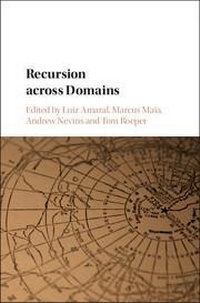
Recursion across Domains
Published on 7. June 2018
Book
Hardback
404 pages
978-1-108-41806-5 (ISBN)
Description
Recursion and self-embedding are at the heart of our ability to formulate our thoughts, articulate our imagination and share with other human beings. Nonetheless, controversy exists over the extent to which recursion is shared across all domains of syntax. A collection of 18 studies are presented here on the central linguistic property of recursion, examining a range of constructions in over a dozen languages representing great areal, typological and genetic diversity and spanning wide latitudes. The volume expands the topic to include prepositional phrases, possessives, adjectives, and relative clauses - our many vehicles to express creative thought - to provide a critical perspective on claims about how recursion connects to broader aspects of the mind. Parallel explorations across language families, literate and non-literate societies, children and adults are investigated and constitutes a new step in the generative tradition by simultaneously focusing on formal theory, acquisition and experimentation, and ecologically-sensitive fieldwork, and initiates a new community where these diverse experts collaborate.
Reviews / Votes
'In the light of recent claims according to which syntactic recursion is the defining property of natural language, this volume offers an excellent collection of contributions dealing with the issue of how to detect and define recursion across syntactic domains and different languages. Since many chapters provide a comparison between languages that have been in the focus of recent debates on recursion and indigenous languages of Brazil, the book is a 'must read' for linguists interested in the issue of recursion from a typological perspective.' Andreas Trotzke, Universitaet Konstanz, GermanyMore details
Language
English
Place of publication
Cambridge
United Kingdom
Target group
Professional and scholarly
Product notice
sewn/stitched
Cloth over boards
Illustrations
Worked examples or Exercises; 19 Tables, black and white; 1 Maps; 2 Halftones, black and white; 61 Line drawings, black and white
Dimensions
Height: 233 mm
Width: 156 mm
Thickness: 27 mm
Weight
687 gr
ISBN-13
978-1-108-41806-5 (9781108418065)
Copyright in bibliographic data and cover images is held by Nielsen Book Services Limited or by the publishers or by their respective licensors: all rights reserved.
Schweitzer Classification
Other editions
Additional editions
Luiz Amaral | Marcus Maia | Andrew Nevins
Recursion across Domains
Book
09/2020
Cambridge University Press
€49.50
Shipment within 15-20 days
Luiz Amaral
Recursion across Domains
E-Book
06/2018
Cambridge University Press
€26.99
Available for download
Luiz Amaral | Marcus Maia | Andrew Nevins
Recursion across Domains
E-Book
05/2018
Cambridge University Press
€112.99
Available for download
Persons
Luiz Amaral is Associate Professor of Hispanic Linguistics at the University of Massachusetts, Amherst. His research focuses on second language acquisition, bilingual development, language revitalization and native languages of Brazil and Mexico. He was the coordinator of the projects on Pedagogical Grammars for Indigenous Languages in Brazil (Museu do Indio/UNESCO) and Pedagogical Grammars for Otomanguean Languages in Mexico (INALI/Juan de Cordoba Library). He is currently the co-director of the Language Acquisition Research Center at University of Massachusetts, Amherst. Marcus Maia is Professor of Linguistics at the Departmente of Linguistics, Universidade Federal do Rio de Janeiro. He has published extensively on relative clauses, interrogative, evidentiality, focus and topic constructions in Brazilian Portuguese and Karaja. Andrew Nevins is Professor of Linguistics at University College London and Federal University of Rio de Janeiro. He has written and published multiple books and articles including Morphotactics (2012), Locality in Vowel Harmony (2010) and Inflectional Identity (2008), and actively works on new methods of studying underdocumented languages. Tom Roeper is Professor of Linguistics at the University of Massachusetts, Amherst. He works primarily in theoretical approaches to language acquisition and morphology. He is co-author of Diagnostic Evaluation of Language Variation (2003), co-editor of the journal Studies in Theoretical Psycholinguistics, and one of the founding editors of Language Acquisition.
Content
Introduction: a map of the theoretical and empirical issues Luiz Amaral, Marcus Maia, Andrew Nevins and Tom Roeper; Part I. Speech Reports, Theory of Mind and Evidentials: 1. False speech reports in Piraha: a comprehension experiment Uli Sauerland; 2. Indirect recursion: the importance of second-order embedding and its implications for cross-linguistic research Bart Hollebrandse; 3. Recursion in language and the development of higher order cognitive functions: an investigation with children acquiring Brazilian Portuguese Leticia M. S. Correa, Marina R. A. Augusto, Mercedes Marcilese and Clara Villarinho; 4. Embedding as a building block of evidential categories in Kotiria Kristine Stenzel; 5. Embedded imperatives in Mbya Guillaume Thomas; Part II. Recursion along the Clausal Spine: 6. Word order in control: evidence for self-embedding in Piraha Cilene Rodrigues, Raiane Salles and Filomena Sandalo; 7. Switch-reference is licensed by both kinds of coordination: novel Kisedje data Rafael Nonato; 8. Clausal recursion, predicate raising and head-finality in Tenetehara Fabio Bonfim Duarte; 9. Recursion in Tupi-Guarani languages: the cases of Tupinamba and Guarani Marcia Maria Damaso Vieira; Part III. Recursive Possession and Relative Clauses: 10. Recursive possessives in child Japanese Akikio Terunuma and Terue Nakato; 11. Recursion of possessives and locative phrases in Kawaiwete Suzi Lima and Pikuruk Kaiabi; 12. Relative clauses in Wapichana and the interpretation of multiple embedded 'uraz' constructions Luiz Amaral and Wendy Leandro; 13. Multiple embedding of relative clauses in Karitiana Luciana Storto, Karin Vivanco and Ivan Rocha; Part IV. Recursion in the PP Domain: 14. Recursion in the acquisition path for hierarchical syntactic structure Tom Roeper and Yohei Oseki; 15. Self-embedded recursive postpositional phrases in Piraha: a pilot study Filomena Sandalo, Cilene Rodrigues, Tom Roeper, Luiz Amaral, Marcus Maia and Glauber Romling da Silva; 16. Strong continuity and children's development of DP recursion Ana T. Perez-Leroux, Anny Castilla-Earls, Susana Bejar, Diane Massam and Tyler Peterson; 17. Prosody and recursion in Kuikuro: DPs vs PPs Bruna Franchetto; 18. The processing of PP embedding and coordination in Karaja and in Portuguese Marcus Maia, Aniela Franca, Aline Gesualdi, Aleria Lage, Cristiane Oliveira, Marije Soto and Juliana Gomes.