

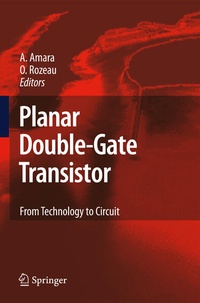
Planar Double-Gate Transistor
From technology to circuit
Published on 30. January 2009
Book
Hardback
VIII, 211 pages
978-1-4020-9327-2 (ISBN)
Description
Until the 1990s, the reduction of the minimum feature sizes used to fabricate in- grated circuits, called "scaling", has highlighted serious advantages as integration density, speed, power consumption, functionality and cost. Direct consequence was the decrease of cost-per-function, so the electronic productivity has largely progressed in this period. Another usually cited trend is the evolution of the in- gration density as expressed by the well-know Moore's Law in 1975: the number of devices per chip doubles every 2 years. This evolution has allowed improving signi?cantly the circuit complexity, offering a great computing power in the case of microprocessor, for example. However, since few years, signi?cant issues appeared such as the increase of the circuit heating, device complexity, variability and dif?culties to improve the integration density. These new trends generate an important growth in development and production costs. Though is it, since 40 years, the evolution of the microelectronics always f- lowed the Moore's law and each dif?culty has found a solution.
More details
Edition
2009 ed.
Language
English
Place of publication
Dordrecht
Netherlands
Target group
Professional and scholarly
Research
Product notice
sewn/stitched
Cloth over boards
Illustrations
VIII, 211 p.
Dimensions
Height: 234 mm
Width: 156 mm
Thickness: 14 mm
Weight
490 gr
ISBN-13
978-1-4020-9327-2 (9781402093272)
DOI
10.1007/978-1-4020-9341-8
Schweitzer Classification
Other editions
Additional editions
Book
10/2010
Springer
€160.49
Shipment within 15-20 days
E-Book
01/2009
1st Edition
Springer
€149.79
Available for download
Persons
Prof. Amara AMARA obtained his HDR (Confirmation of Leading Research Capabilities) from Evry University, a Ph.D. in computer science in 1989 and a DEA (MSc) in 1985 in microelectronics and computer science both from Paris VI University. In 1988 he joined IBM research and development laboratory at Corbeil-Essonnes where he was involved in SRAM memory design with advanced CMOS technologies. From 1989 to 1992, he was assistant professor developing microelectronics academic programs for CEMIP (Microelectronic Center of Paris Iles-de-France) and took part actively to the European Research Project ESPRIT. In 1992, he joined ISEP (Paris Institute for Electronics) in charge of the microelectronics laboratory where he headed a team involved in High Speed GaAs VLSI circuit design. Currently, his research interests are mainly focusing on Low Power circuit design techniques and on Ultra Low Voltage SOI circuits design. In 1999, he did a sabbatical at Stanford University where he joined Professor De Micheli's group. Prof. Amara is in charge of the Electronics and Telecommunications Departments at ISEP and since Marsh 2004 Director of Research. He is member of the Board of Directors of "ISEP-Enterprises" Association, member of the LETI/CEA and ICP (Catholic Institute of Paris) Scientific Committees and member of the CEMIP Executive Committee. He initiated and is General Chair of FTFC, a Low Voltage and Low Power Workshop held every two years in Paris. He is member of many Technical Program Committees, he was member of DATE'04 (Design Automation and Test in Europe) Executive Committee, Guest editor of "Annales des Telecommunications" special edition dedicated to SoC for telecommunication and member of the Microelectronics Journal Editorial Board. He will be the General Chair of ICICDT 2008 in Grenoble and ISCAS 2010 in Paris. Prof. Amara published many papers and gave many invited talks and tutorials all around the world. He is currently President-Elect of the IEEE French section, past Chair (till Marsh 2004) of the IEEE-CAS French Chapter who, under Amara's leadership, was awarded the "2004 Chapter of the Year Award". He is also Counselor of the IEEE ISEP Student Branch.
Content
Multiple Gate Technologies.- Compact Modeling of Independent Double-Gate MOSFET: A Physical Approach.- Compact Modeling of Double Gate MOSFET for IC Design.- Low Frequency Noise in Double-Gate SOI CMOS Devices.- Analog Circuit Design.- Logic Circuit Design with DGMOS Devices.- SRAM Circuit Design.