

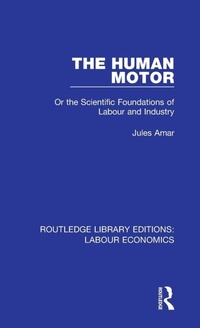
The Human Motor
Or the Scientific Foundations of Labour and Industry
1st Edition
Published on 27. November 2018
Book
Hardback
488 pages
978-0-367-02461-1 (ISBN)
Description
First published in 1920. This study examines the science of industrial work and the advances in its application to the economic life of the community. The author commences this volume with a brief explanation of the general principles of Theoretical Mechanics which have been applied in the study of the Human Motor. Space has also been devoted to the explanation of the laws of thermo-dynamics and of the Conservation of Energy. These provide the reader with the means by which muscular work and fatigue can be measured. This title will be of interest to students of economics and business.
More details
Series
Language
English
Place of publication
London
United Kingdom
Publishing group
Taylor & Francis Ltd
Target group
College/higher education
Dimensions
Height: 222 mm
Width: 145 mm
Thickness: 30 mm
Weight
742 gr
ISBN-13
978-0-367-02461-1 (9780367024611)
Copyright in bibliographic data and cover images is held by Nielsen Book Services Limited or by the publishers or by their respective licensors: all rights reserved.
Schweitzer Classification
Other editions
Additional editions
Book
12/2020
1st Edition
Routledge
€55.10
Shipment within 15-20 days
E-Book
12/2018
1st Edition
Routledge
€47.49
Available for download
E-Book
12/2018
1st Edition
Routledge
€47.49
Available for download
Person
Jules Amar
Content
Part One: The General Principles of Mechanics; 1. Statics and Kinetics 2. Dynamics and Energetics 3. Resistance of Materials; Part Two: The Human Machine; 1. The Human Structure 2. The Muscular Motor and Alimentation 3. Alimentation and the Expenditure of Energy; Part Three: Human Energy; 1. The Laws of Energetic Expenditure 2. The Yield of the Human Machine 3. The Physiological Effects of Labour-Fatigue; Part Four: Man and His Environment; 1. The Internal Environment 2. The External Environment 3. The External Environment (continued) 4. The External Environment (continued); Part Four: Experimental Methods; 1. Measurements and Instruments 2. Measurements - The Dynamic Elements of the Human Machine 3. The Measurement of Energy; Part Five: Industrial Labour; 1. The Human Body in Equilibrium and Movement - Locomotion 2. Industrial Labour and Locomotion (continued) 3. Industrial Labour - Tools 4. Industrial Work; General Conclusions