

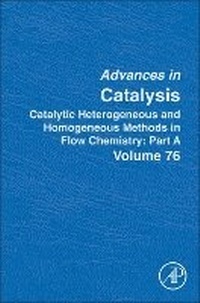
Catalytic Heterogeneous and Homogeneous Methods in Flow Chemistry: Part A: Volume 76
Part A
Published on 28. November 2025
Book
Hardback
180 pages
978-0-443-42979-8 (ISBN)
Description
Catalytic Heterogeneous and Homogeneous Methods in Flow Chemistry: Part A, Volume 76 in the Advances in Catalysis series, highlights new advances in the field, with this new volume presenting interesting chapters written by an international board of authors. Topics covered include an Introduction to flow chemistry and reactor applications, Last advances in homogeneous catalysis under continuous flow: unlocking synthetic opportunities and novel technologies, Heterogeneous catalysis in continuous flow (metal and organocatalysis), Novel methods of catalytic activation (photo-, electro-chemistry, etc.), and Technological innovations for continuous flow catalysis.
More details
Series
Language
English
Place of publication
San Diego
United States
Publishing group
Elsevier Science Publishing Co Inc
Target group
Professional and scholarly
Dimensions
Height: 229 mm
Width: 152 mm
Weight
450 gr
ISBN-13
978-0-443-42979-8 (9780443429798)
Copyright in bibliographic data and cover images is held by Nielsen Book Services Limited or by the publishers or by their respective licensors: all rights reserved.
Schweitzer Classification
Other editions
Additional editions
E-Book
11/2025
Elsevier
€175.00
Available for download
Persons
Montserrat Dieguez studied chemistry at the Rovira i Virgili University (URV) in Tarragona (Spain), where she earned her Ph.D. in 1997, working in the group of Prof. C. Claver. After completing a postdoctoral fellowship where she worked with Prof. R.H. Crabtree at Yale University, in New Haven (USA), she returned to Tarragona in 1999 and accepted a lectureship position at the URV, becoming part of the permanent staff in 2002. In 2011 she was promoted to full Professor in Inorganic Chemistry at the URV.
She has been involved in more than 60 research projects in the fields of organometallic chemistry, steroselective synthesis, and asymmetric catalysis. She is the author/co-author of more than 150 articles in SCI-indexed journals and book chapters, and of several contributions to conferences. She received distinction from the Generalitat de Catalunya for the promotion of University Research in 2004 and from the URV in 2008. She has also been awarded the ICREA Academia Prize from the Catalan Institution for Research and Advanced Studies 2009-14 and 2015-20, for research excellence, facilitating research priority dedication. Her main research interests are focused on the sustainable design, synthesis, and screening of highly active and selective chiral catalysts for reactions of interest to the biological, pharmaceutical, and organic nanotechnological industries. Her areas of interest include organometallic chemistry, stereoselective synthesis, and asymmetric catalysis, using combinatorial and biotechnological approaches. Esther Alza studied Chemistry at the Universitat Rovira i Virgili (URV), where she also obtained her Master's degree in Synthesis and Catalysis. She completed her PhD in Organic Chemistry (European Doctorate) at URV-ICIQ in 2011 under the supervision of Prof. Miquel A. Pericas.
After postdoctoral research at the University of Cambridge (UK) as a Wellcome Trust Fellow (2012-2014), where she worked in medicinal chemistry and enabling technologies for drug discovery in the areas of anticancer and antibacterial research, she returned to ICIQ to further develop her research in catalysis and flow chemistry. Between 2016 and 2021, she led the ERTFLOW Unit at ICIQ, focusing on continuous flow technologies for pharmaceutical and fine chemical applications, as well as on technology transfer and industrial collaboration.
In 2020, she co-founded Treellum Technologies and in 2022 Alza & Associates, where she currently serves as CEO. Since 2024, she is also affiliated with the Department of Physical and Inorganic Chemistry at URV. Her work spans scientific consultancy, advanced research, photochemical reactor technologies, and the development of automated and high-throughput experimental platforms.
Her research interests focus on catalysis, flow chemistry, reaction engineering, and the integration of emerging technologies into chemical processes. She has co-authored numerous scientific publications and patents and actively contributes to bridging academic research with industrial innovation.
Miquel A. Pericas was born in Palma de Mallorca (Spain) in 1951. He studied Chemical Engineering (Institut Quimic de Sarria, 1974) and Chemistry (University of Barcelona 1974) and obtained his PhD (University of Barcelona) in 1979. After postdoctoral studies at the Spanish Research Council (1979-1980), he joined the Department of Organic Chemistry of the University of Barcelona in 1980 as an Associate Professor, being promoted to Full Professor in 1991. In 2000 he was appointed as the Founding Director of the Institute of Chemical Research of Catalonia (ICIQ), a position he held until September 2020. He has been a Group Leader at ICIQ till March 2022.
He is now an "ad honorem" professor at Universitat Rovira i Virgili, a permanent academician of the Royal Academy of Sciences and Arts of Barcelona (2022), a member of Academia Europaea (2021), and a founding partner of Alza and Associates Sustainability Consulting.
The major research interests of Miquel A. Pericas have been focused on enantioselective catalysis in batch and flow with species immobilized onto polymers and magnetic nanoparticles, and on the discovery of new reactions mediated by light.
She has been involved in more than 60 research projects in the fields of organometallic chemistry, steroselective synthesis, and asymmetric catalysis. She is the author/co-author of more than 150 articles in SCI-indexed journals and book chapters, and of several contributions to conferences. She received distinction from the Generalitat de Catalunya for the promotion of University Research in 2004 and from the URV in 2008. She has also been awarded the ICREA Academia Prize from the Catalan Institution for Research and Advanced Studies 2009-14 and 2015-20, for research excellence, facilitating research priority dedication. Her main research interests are focused on the sustainable design, synthesis, and screening of highly active and selective chiral catalysts for reactions of interest to the biological, pharmaceutical, and organic nanotechnological industries. Her areas of interest include organometallic chemistry, stereoselective synthesis, and asymmetric catalysis, using combinatorial and biotechnological approaches. Esther Alza studied Chemistry at the Universitat Rovira i Virgili (URV), where she also obtained her Master's degree in Synthesis and Catalysis. She completed her PhD in Organic Chemistry (European Doctorate) at URV-ICIQ in 2011 under the supervision of Prof. Miquel A. Pericas.
After postdoctoral research at the University of Cambridge (UK) as a Wellcome Trust Fellow (2012-2014), where she worked in medicinal chemistry and enabling technologies for drug discovery in the areas of anticancer and antibacterial research, she returned to ICIQ to further develop her research in catalysis and flow chemistry. Between 2016 and 2021, she led the ERTFLOW Unit at ICIQ, focusing on continuous flow technologies for pharmaceutical and fine chemical applications, as well as on technology transfer and industrial collaboration.
In 2020, she co-founded Treellum Technologies and in 2022 Alza & Associates, where she currently serves as CEO. Since 2024, she is also affiliated with the Department of Physical and Inorganic Chemistry at URV. Her work spans scientific consultancy, advanced research, photochemical reactor technologies, and the development of automated and high-throughput experimental platforms.
Her research interests focus on catalysis, flow chemistry, reaction engineering, and the integration of emerging technologies into chemical processes. She has co-authored numerous scientific publications and patents and actively contributes to bridging academic research with industrial innovation.
Miquel A. Pericas was born in Palma de Mallorca (Spain) in 1951. He studied Chemical Engineering (Institut Quimic de Sarria, 1974) and Chemistry (University of Barcelona 1974) and obtained his PhD (University of Barcelona) in 1979. After postdoctoral studies at the Spanish Research Council (1979-1980), he joined the Department of Organic Chemistry of the University of Barcelona in 1980 as an Associate Professor, being promoted to Full Professor in 1991. In 2000 he was appointed as the Founding Director of the Institute of Chemical Research of Catalonia (ICIQ), a position he held until September 2020. He has been a Group Leader at ICIQ till March 2022.
He is now an "ad honorem" professor at Universitat Rovira i Virgili, a permanent academician of the Royal Academy of Sciences and Arts of Barcelona (2022), a member of Academia Europaea (2021), and a founding partner of Alza and Associates Sustainability Consulting.
The major research interests of Miquel A. Pericas have been focused on enantioselective catalysis in batch and flow with species immobilized onto polymers and magnetic nanoparticles, and on the discovery of new reactions mediated by light.
Volume editor
Department of Physical and Inorganic Chemistry, Universitat Rovira i Virgili (URV), Tarragona; Alza & Associates Sustainable Chemistry Consulting, S.L, Esplugues de Llobregat, Barcelona, Spain.
Departament de Quimica Fisica i Inorganica, Universitat Rovira i Virgili and Royal Academy of Sciences and Arts of Barcelona
Series Editor
Content
1. Introduction to flow chemistry and reactor applications
2. Last advances in homogeneous catalysis under continuous flow: unlocking synthetic opportunities and novel technologies
3. Heterogeneous catalysis in continuous flow (metal and organocatalysis)
4. Novel methods of catalytic activation (photo-, electro-chemistry, etc.)
5. Technological innovations for continuous flow catalysis
2. Last advances in homogeneous catalysis under continuous flow: unlocking synthetic opportunities and novel technologies
3. Heterogeneous catalysis in continuous flow (metal and organocatalysis)
4. Novel methods of catalytic activation (photo-, electro-chemistry, etc.)
5. Technological innovations for continuous flow catalysis