

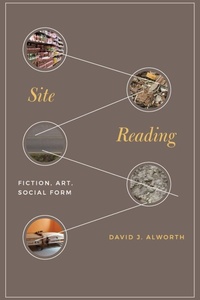
Site Reading
Fiction, Art, Social Form
Published on 20. November 2018
Book
Paperback/Softback
224 pages
978-0-691-18334-3 (ISBN)
Description
Site Reading offers a new method of literary and cultural interpretation and a new theory of narrative setting by examining five sites-supermarkets, dumps, roads, ruins, and asylums-that have been crucial to American literature and visual art since the mid-twentieth century. Against the traditional understanding of setting as a static background for narrative action and character development, David Alworth argues that sites figure in novels as social agents. Engaging a wide range of social and cultural theorists, especially Bruno Latour and Erving Goffman, Site Reading examines how the literary figuration of real, material environments reorients our sense of social relations. To read the sites of fiction, Alworth demonstrates, is to reveal literature as a profound sociological resource, one that simultaneously models and theorizes collective life.
Each chapter identifies a particular site as a point of contact for writers and artists-the supermarket for Don DeLillo and Andy Warhol; the dump for William Burroughs and Mierle Laderman Ukeles; the road for Jack Kerouac, Joan Didion, and John Chamberlain; the ruin for Thomas Pynchon and Robert Smithson; and the asylum for Ralph Ellison, Gordon Parks, and Jeff Wall-and shows how this site mediates complex interactions among humans and nonhumans. The result is an interdisciplinary study of American culture that brings together literature, visual art, and social theory to develop a new sociology of literature that emphasizes the sociology in literature.
Each chapter identifies a particular site as a point of contact for writers and artists-the supermarket for Don DeLillo and Andy Warhol; the dump for William Burroughs and Mierle Laderman Ukeles; the road for Jack Kerouac, Joan Didion, and John Chamberlain; the ruin for Thomas Pynchon and Robert Smithson; and the asylum for Ralph Ellison, Gordon Parks, and Jeff Wall-and shows how this site mediates complex interactions among humans and nonhumans. The result is an interdisciplinary study of American culture that brings together literature, visual art, and social theory to develop a new sociology of literature that emphasizes the sociology in literature.
Reviews / Votes
"Winner of the 2016 Erving Goffman Award for Outstanding Scholarship in the Ecology of Social Interaction, Media Ecology Association" "Site Reading tells the genuinely exciting story not only of postwar American fiction but also of a young scholar coming to claim a voice of his own."---Jennifer L. Fleissner, Critical Inquiry "With its antecedents placed firmly in the ecocritical tradition, Alworth's book proposes that our awareness of the world can be considerably enhanced if we set aside binarisms and appreciate the beauties of the moment, and thereby approach phenomena on their own terms free of prejudice. That process of self-discovery might be difficult but nonetheless worth pursuing."---Laurence Raw, Journal of American Culture "Alworth seeks to revive the field of literary sociology in a new key and for a new era. By treating postwar US novels as sites rather than as aesthetic objects, he frames their representations of place and setting as networks of social engagement and interaction. . . . Ingenious."---Michael Davidson, NovelMore details
Language
English
Place of publication
New Jersey
United States
Target group
College/higher education
Product notice
Paperback (trade)
Dimensions
Height: 234 mm
Width: 156 mm
Thickness: 13 mm
Weight
389 gr
ISBN-13
978-0-691-18334-3 (9780691183343)
Copyright in bibliographic data and cover images is held by Nielsen Book Services Limited or by the publishers or by their respective licensors: all rights reserved.
Schweitzer Classification
Other editions
Additional editions
E-Book
01/2016
1st Edition
Princeton University Press
€30.49
Available for download