

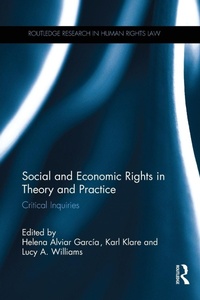
Social and Economic Rights in Theory and Practice
Critical Inquiries
1st Edition
Published on 4. August 2016
Book
Paperback/Softback
328 pages
978-1-138-24269-2 (ISBN)
Description
This book discusses a range of rights controversies from both theoretical and practical perspectives. It considers specific issues in the litigation and adjudication of social and economic rights cases from the differing standpoints of activists, lawyers, and adjudicators.
More details
Series
Language
English
Place of publication
London
United Kingdom
Publishing group
Taylor & Francis Ltd
Target group
College/higher education
Dimensions
Height: 234 mm
Width: 156 mm
Thickness: 19 mm
Weight
524 gr
ISBN-13
978-1-138-24269-2 (9781138242692)
Copyright in bibliographic data and cover images is held by Nielsen Book Services Limited or by the publishers or by their respective licensors: all rights reserved.
Schweitzer Classification
Other editions
Additional editions
Helena Alviar Garcia | Karl Klare | Lucy A. Williams
Social and Economic Rights in Theory and Practice
Critical Inquiries
E-Book
09/2014
1st Edition
Routledge
€72.49
Available for download
Helena Alviar Garcia | Karl Klare | Lucy A. Williams
Social and Economic Rights in Theory and Practice
Critical Inquiries
E-Book
09/2014
1st Edition
Routledge
€72.49
Available for download
Helena Alviar Garcia | Karl Klare | Lucy A. Williams
Social and Economic Rights in Theory and Practice
Critical Inquiries
Book
08/2014
1st Edition
Routledge
€226.50
Shipment within 15-20 days
Persons
Helena Alviar Garcia is Dean of the Faculty of Law at the Universidad de los Andes, Bogota, Colombia.
Karl Klare is the George J. & Kathleen Waters Matthews Distinguished University Professor at Northeastern University School of Law, Boston, USA. He was one of the founders of the Critical Legal Studies movement.
Lucy A. Williams is Professor of Law at Northeastern University School of Law, Boston, USA. She is a co-director of the Project on Human Rights and the Global Economy at Northeastern University School of Law and is the convener of iSERP.
Karl Klare is the George J. & Kathleen Waters Matthews Distinguished University Professor at Northeastern University School of Law, Boston, USA. He was one of the founders of the Critical Legal Studies movement.
Lucy A. Williams is Professor of Law at Northeastern University School of Law, Boston, USA. She is a co-director of the Project on Human Rights and the Global Economy at Northeastern University School of Law and is the convener of iSERP.
Content
Part I: Perspectives 1. Critical perspectives on social and economic rights, democracy and separation of powers 2. Rights-compromised or rights-savvy? The use of rights-based strategies to advance socio-economic struggles by Abahlali baseMjondolo, the South African shack-dwellers' movement 3. Resource questions in social and economic rights enforcement: A preliminary view Part II: Global social and economic rights practice: limitations and openings 2A: Latin America 4. Distribution of resources led by courts: A few words of caution 5. Latin American social constitutionalism: Courts and popular participation 6. Deliberative democracy, dialogic justice and the promise of social and economic rights 7. Between activism and deference: Social rights adjudication in the Brazilian Supreme Federal Tribunal 2B : India 8. The tension between property rights and social and economic rights: A case study of India 9. Claiming the right to safe motherhood through litigation: The Indian story 2C: South Africa 10. Democratizing the socio-economic rights-enforcement process 11. The scope of the judicial role in the enforcement of social and economic rights: Limits and possibilities viewed from the South African experience 2D: Canada 12. Inclusive interpretations: Social and economic rights and the Canadian charter Part III: Looking forward 13. Adjudicating social and economic rights: Can democratic experimentalism help? 14. The constitutionalization of social and economic rights 15. Constitutionally binding social and economic rights as a compelling idea: Reciprocating perturbations in liberal and democratic constitutional visions