

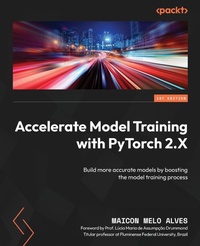
Accelerate Model Training with PyTorch 2.X
Build more accurate models by boosting the model training process
Published on 30. April 2024
Book
Paperback/Softback
230 pages
978-1-80512-010-0 (ISBN)
Description
Dramatically accelerate the building process of complex models using PyTorch to extract the best performance from any computing environment
Key Features
Reduce the model-building time by applying optimization techniques and approaches
Harness the computing power of multiple devices and machines to boost the training process
Focus on model quality by quickly evaluating different model configurations
Purchase of the print or Kindle book includes a free PDF eBook
Book DescriptionThis book, written by an HPC expert with over 25 years of experience, guides you through enhancing model training performance using PyTorch. Here you'll learn how model complexity impacts training time and discover performance tuning levels to expedite the process, as well as utilize PyTorch features, specialized libraries, and efficient data pipelines to optimize training on CPUs and accelerators. You'll also reduce model complexity, adopt mixed precision, and harness the power of multicore systems and multi-GPU environments for distributed training. By the end, you'll be equipped with techniques and strategies to speed up training and focus on building stunning models.What you will learn
Compile the model to train it faster
Use specialized libraries to optimize the training on the CPU
Build a data pipeline to boost GPU execution
Simplify the model through pruning and compression techniques
Adopt automatic mixed precision without penalizing the model's accuracy
Distribute the training step across multiple machines and devices
Who this book is forThis book is for intermediate-level data scientists who want to learn how to leverage PyTorch to speed up the training process of their machine learning models by employing a set of optimization strategies and techniques. To make the most of this book, familiarity with basic concepts of machine learning, PyTorch, and Python is essential. However, there is no obligation to have a prior understanding of distributed computing, accelerators, or multicore processors.
Key Features
Reduce the model-building time by applying optimization techniques and approaches
Harness the computing power of multiple devices and machines to boost the training process
Focus on model quality by quickly evaluating different model configurations
Purchase of the print or Kindle book includes a free PDF eBook
Book DescriptionThis book, written by an HPC expert with over 25 years of experience, guides you through enhancing model training performance using PyTorch. Here you'll learn how model complexity impacts training time and discover performance tuning levels to expedite the process, as well as utilize PyTorch features, specialized libraries, and efficient data pipelines to optimize training on CPUs and accelerators. You'll also reduce model complexity, adopt mixed precision, and harness the power of multicore systems and multi-GPU environments for distributed training. By the end, you'll be equipped with techniques and strategies to speed up training and focus on building stunning models.What you will learn
Compile the model to train it faster
Use specialized libraries to optimize the training on the CPU
Build a data pipeline to boost GPU execution
Simplify the model through pruning and compression techniques
Adopt automatic mixed precision without penalizing the model's accuracy
Distribute the training step across multiple machines and devices
Who this book is forThis book is for intermediate-level data scientists who want to learn how to leverage PyTorch to speed up the training process of their machine learning models by employing a set of optimization strategies and techniques. To make the most of this book, familiarity with basic concepts of machine learning, PyTorch, and Python is essential. However, there is no obligation to have a prior understanding of distributed computing, accelerators, or multicore processors.
More details
Language
English
Place of publication
Birmingham
United Kingdom
Target group
Professional and scholarly
US School Grade: College Graduate Student
Dimensions
Height: 235 mm
Width: 191 mm
Thickness: 13 mm
Weight
438 gr
ISBN-13
978-1-80512-010-0 (9781805120100)
Copyright in bibliographic data and cover images is held by Nielsen Book Services Limited or by the publishers or by their respective licensors: all rights reserved.
Schweitzer Classification
Other editions
Additional editions
Maicon Melo Alves
Accelerate Model Training with PyTorch 2.X
Build more accurate models by boosting the model training process
E-Book
09/2024
Packt Publishing
€26.99
Available for download
Persons
Dr. Maicon Melo Alves is a senior system analyst and academic professor specialized in High Performance Computing (HPC) systems. In the last five years, he got interested in understanding how HPC systems have been used to leverage Artificial Intelligence applications. To better understand this topic, he completed in 2021 the MBA in Data Science of Pontificia Universidade Catolica of Rio de Janeiro (PUC-RIO).
He has over 25 years of experience in IT infrastructure and, since 2006, he works with HPC systems at Petrobras, the Brazilian energy state company. He obtained his D.Sc. degree in Computer Science from the Fluminense Federal University (UFF) in 2018 and possesses three published books and publications in international journals of HPC area.
He has over 25 years of experience in IT infrastructure and, since 2006, he works with HPC systems at Petrobras, the Brazilian energy state company. He obtained his D.Sc. degree in Computer Science from the Fluminense Federal University (UFF) in 2018 and possesses three published books and publications in international journals of HPC area.
Content
Table of Contents
Deconstructing the Training Process
Training Models Faster
Compiling the Model
Using Specialized Libraries
Building an Efficient Data Pipeline
Simplifying the Model
Adopting Mixed Precision
Distributed Training at a Glance
Training with Multiple CPUs
Training with Multiple GPUs
Training with Multiple Machines
Deconstructing the Training Process
Training Models Faster
Compiling the Model
Using Specialized Libraries
Building an Efficient Data Pipeline
Simplifying the Model
Adopting Mixed Precision
Distributed Training at a Glance
Training with Multiple CPUs
Training with Multiple GPUs
Training with Multiple Machines