

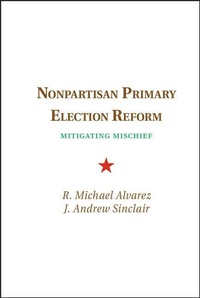
Nonpartisan Primary Election Reform
Mitigating Mischief
Published on 16. April 2015
Book
Hardback
224 pages
978-1-107-06883-4 (ISBN)
Description
Over the years, observers of American politics have noted the deleterious effects of party polarization in both the national and state legislatures. Reformers have tried to address this problem by changing primary election laws. A theory underlies these legal changes: the reformers tend to believe that 'more open' primary laws will produce more centrist, moderate, or pragmatic candidates. The 'top-two' primary, just implemented in California, represents the future of these antiparty efforts. Nonpartisan Primary Election Reform examines California's first use of the top-two primary system in 2012. R. Michael Alvarez and J. Andrew Sinclair evaluate the primary from a variety of perspectives and using several different methodologies. Although the first use of this primary system in California did not immediately reshape the state's politics, it also did not have many of the deleterious consequences that some observers had feared. This study provides the foundation for future studies of state primary systems.
More details
Language
English
Place of publication
Cambridge
United Kingdom
Target group
Professional and scholarly
College/higher education
Illustrations
3 Halftones, unspecified; 36 Line drawings, unspecified
Dimensions
Height: 235 mm
Width: 157 mm
Thickness: 17 mm
Weight
482 gr
ISBN-13
978-1-107-06883-4 (9781107068834)
Copyright in bibliographic data and cover images is held by Nielsen Book Services Limited or by the publishers or by their respective licensors: all rights reserved.
Schweitzer Classification
Other editions
Additional editions
Book
11/2015
Cambridge University Press
€48.70
Shipment within 15-20 days
E-Book
04/2015
Cambridge University Press
€21.99
Available for download
E-Book
03/2015
Cambridge University Press
€23.49
Available for download
Persons
R. Michael Alvarez is a world-renowned expert in the study of electoral behavior and election administration, as well as political methodology and survey research. In addition to publishing scores of articles in academic journals, he recently published Evaluating Elections: A Handbook of Methods and Standards (Cambridge, 2012). A Fellow of the Society for Political Methodology, he currently co-edits the Society's journal, Political Analysis. J. Andrew Sinclair completed his PhD at the California Institute of Technology in 2013 and wrote his dissertation on American primary elections. His academic research focuses on voter behavior, political institutions, and democratic accountability.
Content
1. A problem posed in Tampa; 2. Primary expectations; 3. The year and the proposition; 4. What happened in 2012?: legislative elections; 5. Primary elections and voter participation; 6. The voter's view; 7. Abandonment of weak parties; 8. Voter expectations for California's top-two primary; 9. Voting rights, representation, and the top-two primary; 10. Beyond the spatial model; 11. Conclusion.