

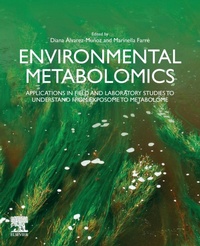
Environmental Metabolomics
Applications in field and laboratory studies to understand from exposome to metabolome
Published on 20. May 2020
Book
Paperback/Softback
368 pages
978-0-12-818196-6 (ISBN)
Description
Environmental Metabolomics Applications in Field and Laboratory Studies: From the Exposome to the Metabolome presents an overview of the current state of aquatic environments and problems caused by human pressure and daily life. The presence of contaminants in nature and their effects are evaluated, along with recommendations for preservation. This book not only shows readers how to implement techniques, it also guides them through the process. As metabolomics becomes a more routine technique for environmental studies and future perspectives, a guide for validation and globalization of current approaches is needed.
More details
Language
English
Place of publication
United States
Target group
Professional and scholarly
environmental scientists and students and toxicologists
Product notice
Paperback (trade)
Dimensions
Height: 235 mm
Width: 191 mm
Thickness: 19 mm
Weight
633 gr
ISBN-13
978-0-12-818196-6 (9780128181966)
Copyright in bibliographic data and cover images is held by Nielsen Book Services Limited or by the publishers or by their respective licensors: all rights reserved.
Schweitzer Classification
Other editions
Additional editions
Diana Alvarez-Munoz | Marinella Farre
Environmental Metabolomics
Applications in field and laboratory studies to understand from exposome to metabolome
E-Book
05/2020
Elsevier
€113.00
Available for download
Persons
Diana Alvarez-Munoz, Institute of Environmental Assessment and Water Research, Spanish National Research Council, 18 26, Calle Jordi Girona, 18-26, 08034 Barcelona, Spain. Dr. Diana Alvarez-Munoz has a Ph.D. in Marine Sciences by the University of Cadiz, Spain (Dec. 2008). She joined IDAEA-CSIC as research scientist in January 2017. She has 24 publications, including 3 book chapters. She has supervised 5 bachelor thesis, 1 Master thesis and she is co-supervisor of 1 PhD student. Her research line is focused in the study of the presence of contaminants of emerging concern in the marine environment and their interaction with marine organisms. She has collaborated in 17 projects (3 EU funded) and she is currently running the Xenometabolomic project as main researcher. Marinella Farre, CSIC - Instituto de Diagnostico Ambiental y Estudios del Agua (IDAEA), Barcelona, Spain. Dr Marinella Farre has a PhD in Chemistry from University of Barcelona (Dec.2003), and Research scientist, permanent staff at IDAEA-CSIC from (Jul. 2008). She has more than 150 scientific papers in journals of SCI (H-index of 49), 22 book chapters and she has co-Editor of a book. She has supervised 3 PhD Thesis and currently is the supervisor of 4 on-going more. She is involved in the study of the occurrence and impact of organic micropollutants in the environment by chromatography coupled to advanced mass spectrometry approaches as well as the development and applications of new biological tools such as biosensors. She was involved in 30 Research projects with national and EU funds. She was the coordinator of the EU Sea-on-a-Chip EU project and the national projects Integra-Coast and Nano-Transfer. Currently, she is involved in the projects NaToxAq (IP), Globaqua (participant), Nano-Transfer (IP) and Plas-Med (Coordinator).
Content
1. Environmental exposure to contaminants and the role of metabolomics
2. Metals
3. Legacy Persistent Organic Contaminants
4. Pesticides
5. Contaminants of industrial origin
6. Pharmaceutical and Personal Care Products
7. Nanomaterials
8. Environmental mixtures
9. Biomarkers snapshot
10. Future trends and conclusions
2. Metals
3. Legacy Persistent Organic Contaminants
4. Pesticides
5. Contaminants of industrial origin
6. Pharmaceutical and Personal Care Products
7. Nanomaterials
8. Environmental mixtures
9. Biomarkers snapshot
10. Future trends and conclusions