

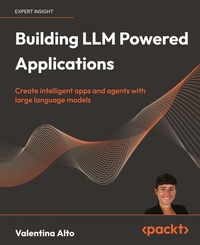
Building LLM Powered Applications
Create intelligent apps and agents with large language models
Published on 22. May 2024
Book
Paperback/Softback
342 pages
978-1-83546-231-7 (ISBN)
Description
Get hands-on with GPT 3.5, GPT 4, LangChain, Llama 2, Falcon LLM and more, to build LLM-powered sophisticated AI applications
Get With Your Book: PDF Copy, AI Assistant, and Next-Gen Reader Free
Key Features
Embed LLMs into real-world applications
Use LangChain to orchestrate LLMs and their components within applications
Grasp basic and advanced techniques of prompt engineering
Book DescriptionBuilding LLM Powered Applications delves into the fundamental concepts, cutting-edge technologies, and practical applications that LLMs offer, ultimately paving the way for the emergence of large foundation models (LFMs) that extend the boundaries of AI capabilities.
The book begins with an in-depth introduction to LLMs. We then explore various mainstream architectural frameworks, including both proprietary models (GPT 3.5/4) and open-source models (Falcon LLM), and analyze their unique strengths and differences. Moving ahead, with a focus on the Python-based, lightweight framework called LangChain, we guide you through the process of creating intelligent agents capable of retrieving information from unstructured data and engaging with structured data using LLMs and powerful toolkits. Furthermore, the book ventures into the realm of LFMs, which transcend language modeling to encompass various AI tasks and modalities, such as vision and audio.
Whether you are a seasoned AI expert or a newcomer to the field, this book is your roadmap to unlock the full potential of LLMs and forge a new era of intelligent machines.What you will learn
Explore the core components of LLM architecture, including encoder-decoder blocks and embeddings
Understand the unique features of LLMs like GPT-3.5/4, Llama 2, and Falcon LLM
Use AI orchestrators like LangChain, with Streamlit for the frontend
Get familiar with LLM components such as memory, prompts, and tools
Learn how to use non-parametric knowledge and vector databases
Understand the implications of LFMs for AI research and industry applications
Customize your LLMs with fine tuning
Learn about the ethical implications of LLM-powered applications
Who this book is for Software engineers and data scientists who want hands-on guidance for applying LLMs to build applications. The book will also appeal to technical leaders, students, and researchers interested in applied LLM topics.
We don't assume previous experience with LLM specifically. But readers should have core ML/software engineering fundamentals to understand and apply the content.
Get With Your Book: PDF Copy, AI Assistant, and Next-Gen Reader Free
Key Features
Embed LLMs into real-world applications
Use LangChain to orchestrate LLMs and their components within applications
Grasp basic and advanced techniques of prompt engineering
Book DescriptionBuilding LLM Powered Applications delves into the fundamental concepts, cutting-edge technologies, and practical applications that LLMs offer, ultimately paving the way for the emergence of large foundation models (LFMs) that extend the boundaries of AI capabilities.
The book begins with an in-depth introduction to LLMs. We then explore various mainstream architectural frameworks, including both proprietary models (GPT 3.5/4) and open-source models (Falcon LLM), and analyze their unique strengths and differences. Moving ahead, with a focus on the Python-based, lightweight framework called LangChain, we guide you through the process of creating intelligent agents capable of retrieving information from unstructured data and engaging with structured data using LLMs and powerful toolkits. Furthermore, the book ventures into the realm of LFMs, which transcend language modeling to encompass various AI tasks and modalities, such as vision and audio.
Whether you are a seasoned AI expert or a newcomer to the field, this book is your roadmap to unlock the full potential of LLMs and forge a new era of intelligent machines.What you will learn
Explore the core components of LLM architecture, including encoder-decoder blocks and embeddings
Understand the unique features of LLMs like GPT-3.5/4, Llama 2, and Falcon LLM
Use AI orchestrators like LangChain, with Streamlit for the frontend
Get familiar with LLM components such as memory, prompts, and tools
Learn how to use non-parametric knowledge and vector databases
Understand the implications of LFMs for AI research and industry applications
Customize your LLMs with fine tuning
Learn about the ethical implications of LLM-powered applications
Who this book is for Software engineers and data scientists who want hands-on guidance for applying LLMs to build applications. The book will also appeal to technical leaders, students, and researchers interested in applied LLM topics.
We don't assume previous experience with LLM specifically. But readers should have core ML/software engineering fundamentals to understand and apply the content.
More details
Language
English
Place of publication
Birmingham
United Kingdom
Dimensions
Height: 235 mm
Width: 191 mm
Thickness: 19 mm
Weight
640 gr
ISBN-13
978-1-83546-231-7 (9781835462317)
Copyright in bibliographic data and cover images is held by Nielsen Book Services Limited or by the publishers or by their respective licensors: all rights reserved.
Schweitzer Classification
Other editions
Additional editions
Valentina Alto
Building LLM Powered Applications
Create intelligent apps and agents with large language models
E-Book
09/2024
Packt Publishing
€29.99
Available for download
Person
Valentina Alto is a technical architect specializing in AI and intelligent apps at Microsoft Innovation Hub in Dubai. During her tenure at Microsoft, she covered different roles as a solution specialist, focusing on data, AI, and applications workloads within the manufacturing, pharmaceutical, and retail industries and driving customers' digital transformations in the era of AI. Valentina is an active tech author and speaker who contributes to books, articles, and events on AI and machine learning. Over the past two years, Valentina has published two books on generative AI and large language models, further establishing her expertise in the field.
Content
Table of Contents
Introduction to Large Language Models
LLMs for AI-Powered Applications
Choosing an LLM for Your Application
Prompt Engineering
Embedding LLMs within Your Applications
Building Conversational Applications
Search and Recommendation Engines with LLMs
Using LLMs with Structured Data
Working with Code
Building Multimodal Applications with LLMs
Fine-Tuning Large Language Models
Responsible AI
Emerging Trends and Innovations
Introduction to Large Language Models
LLMs for AI-Powered Applications
Choosing an LLM for Your Application
Prompt Engineering
Embedding LLMs within Your Applications
Building Conversational Applications
Search and Recommendation Engines with LLMs
Using LLMs with Structured Data
Working with Code
Building Multimodal Applications with LLMs
Fine-Tuning Large Language Models
Responsible AI
Emerging Trends and Innovations