

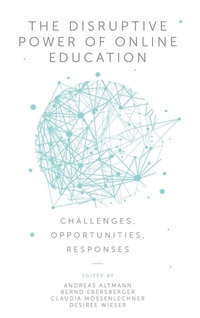
The Disruptive Power of Online Education
Challenges, Opportunities, Responses
Published on 22. November 2018
Book
Hardback
232 pages
978-1-78754-326-3 (ISBN)
Description
The higher education sector is being disrupted through the effect that technological innovations have on the educational market. As digital and mobile technologies are developing further, higher education institutions must embrace these developments to meet the needs of their learners and to not become irrelevant. In higher education, disruptive effects are mainly visible on a program/product level, with an increasing number of programs including some element of online education.
Disruptive effects also become evident on a pedagogical level, where student engagement, collaboration and social learning, gamification and serious games, competency-based learning, teacher training, and overcoming geosocial divides are high on the agenda. This book considers the effect of online elements and their design on university business models and internationalization, course design, massive open online courses (MOOCs), and the scalability of online programs. It also explores how higher education institutions across the globe respond and react to the challenges and opportunities evolving in online education.
Disruptive effects also become evident on a pedagogical level, where student engagement, collaboration and social learning, gamification and serious games, competency-based learning, teacher training, and overcoming geosocial divides are high on the agenda. This book considers the effect of online elements and their design on university business models and internationalization, course design, massive open online courses (MOOCs), and the scalability of online programs. It also explores how higher education institutions across the globe respond and react to the challenges and opportunities evolving in online education.
More details
Language
English
Place of publication
Bingley
United Kingdom
Target group
Professional and scholarly
Dimensions
Height: 235 mm
Width: 157 mm
Thickness: 17 mm
Weight
493 gr
ISBN-13
978-1-78754-326-3 (9781787543263)
Copyright in bibliographic data and cover images is held by Nielsen Book Services Limited or by the publishers or by their respective licensors: all rights reserved.
Schweitzer Classification
Other editions
Additional editions
Andreas Altmann | Bernd Ebersberger | Claudia Moessenlechner
The Disruptive Power of Online Education
Challenges, Opportunities, Responses
E-Book
11/2018
Emerald Publishing Limited
€96.49
Available for download
Persons
Andreas Altmann is the founding Director of MCI Management Center
Innsbruck, Austria. His research focuses on university regulation, governance
and management - including the competitive environment - and market behaviour
in the higher education and research sector.Bernd Ebersberger is a Professor of Management and Economics of Innovation with the MCI Management Center Innsbruck, Austria. His research
focuses on analysing innovation systems and the higher education system, the
evaluation of innovation policy, quantitative industrial economics, and the
economics of technical change and innovation.
Claudia Moessenlechner has been active in the field of teaching and
higher education for some 20 years, focusing on English as a second language,
communication skills, intercultural training and leadership. She has extensive
experience as an examiner and accreditor (European Higher Education Space) and
has coordinated 'quality in teaching' approaches at MCI, Austria.
Desiree Wieser is a Research & Teaching Assistant and PhD student at
the MCI Management Center Innsbruck, Austria. Her main research area and
publication activity focuses on higher education management, in particular on
online education and the implementation of online education in higher education
institutions.
Innsbruck, Austria. His research focuses on university regulation, governance
and management - including the competitive environment - and market behaviour
in the higher education and research sector.Bernd Ebersberger is a Professor of Management and Economics of Innovation with the MCI Management Center Innsbruck, Austria. His research
focuses on analysing innovation systems and the higher education system, the
evaluation of innovation policy, quantitative industrial economics, and the
economics of technical change and innovation.
Claudia Moessenlechner has been active in the field of teaching and
higher education for some 20 years, focusing on English as a second language,
communication skills, intercultural training and leadership. She has extensive
experience as an examiner and accreditor (European Higher Education Space) and
has coordinated 'quality in teaching' approaches at MCI, Austria.
Desiree Wieser is a Research & Teaching Assistant and PhD student at
the MCI Management Center Innsbruck, Austria. Her main research area and
publication activity focuses on higher education management, in particular on
online education and the implementation of online education in higher education
institutions.
Content
Introduction. The Disruptive Power of Online Education: Challenges,
Opportunities, Responses; Andreas Altmann, Bernd Ebersberger, Claudia Moessenlechner and Desiree WieserPart I -
Online Programs and Program Design
Chapter 1. Scaling Online Learning: The Case
for a Program Level Approach; Regina Obexer
Chapter 2. Logic
Leads LEARNing: MOOCs in the Middle East; Yusuf Sidani
Chapter 3, The Power
of Technology in Customized Executive Education; Lynette Ryals, Ruth Bender and Toby Thompson
Chapter 4. Internationalization
of Online Learning: A Double Degree Model; Charles Krusekopf
Part II - Changing
Classroom Dynamics in the Digital Teaching Space
Chapter 5. Engagement in Online Learning:
It's not all About Faculty!; Kathy Bishop, Catherine Etmanski and M. Beth Page
Chapter 6. Social Collaborative Learning
Environments: A Means to Reconceptualize Leadership Education for tomorrow's
Leaders and Universities?; Anja P. Schmitz and Jan Foelsing
Chapter 7. Online, not Distance Education:
The Merits of Collaborative Learning in Online Education; Desiree Wieser and Juergen-Matthias Seeler
Chapter 8. Disrupting Higher Education in
Alaska: Introducing the Native Teacher Certification Pathway Program; Paul
Berg, Kathryn Cruz, Tom Duening and Susan Schoenberg
Chapter 9. Academic Rigor and Video
Technology in Online Learning and Teaching: A Case Study on Digital
Storytelling in Masters-Level Assignment; Eva Malisius
Chapter 10. Game-Based Learning as Education
Method in the Digital Age; Ronald Deckert, Felix Heymann and Maren Metz
Opportunities, Responses; Andreas Altmann, Bernd Ebersberger, Claudia Moessenlechner and Desiree WieserPart I -
Online Programs and Program Design
Chapter 1. Scaling Online Learning: The Case
for a Program Level Approach; Regina Obexer
Chapter 2. Logic
Leads LEARNing: MOOCs in the Middle East; Yusuf Sidani
Chapter 3, The Power
of Technology in Customized Executive Education; Lynette Ryals, Ruth Bender and Toby Thompson
Chapter 4. Internationalization
of Online Learning: A Double Degree Model; Charles Krusekopf
Part II - Changing
Classroom Dynamics in the Digital Teaching Space
Chapter 5. Engagement in Online Learning:
It's not all About Faculty!; Kathy Bishop, Catherine Etmanski and M. Beth Page
Chapter 6. Social Collaborative Learning
Environments: A Means to Reconceptualize Leadership Education for tomorrow's
Leaders and Universities?; Anja P. Schmitz and Jan Foelsing
Chapter 7. Online, not Distance Education:
The Merits of Collaborative Learning in Online Education; Desiree Wieser and Juergen-Matthias Seeler
Chapter 8. Disrupting Higher Education in
Alaska: Introducing the Native Teacher Certification Pathway Program; Paul
Berg, Kathryn Cruz, Tom Duening and Susan Schoenberg
Chapter 9. Academic Rigor and Video
Technology in Online Learning and Teaching: A Case Study on Digital
Storytelling in Masters-Level Assignment; Eva Malisius
Chapter 10. Game-Based Learning as Education
Method in the Digital Age; Ronald Deckert, Felix Heymann and Maren Metz