

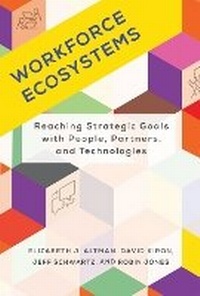
Workforce Ecosystems
Reaching Strategic Goals with People, Partners, and Technologies
Published on 11. April 2023
Book
Hardback
248 pages
978-0-262-04777-7 (ISBN)
Description
A pioneering guide to understanding and leading workforce ecosystems, which include not only traditional employees, contractors, and gig workers, but also partner and complementor organizations that work with companies to accomplish enterprise and individual goals.
Who is your workforce? This was a simple question when most organizations focused on hiring full- and part-time employees, but now organizations engage with both internal and external collaborators including subcontractors, freelancers, app developers, marketplace sellers, and others. As technology enables new, more efficient forms of working, and roles become more project- and outcomes-based, workforces are evolving into workforce ecosystems requiring updated strategies, leadership, and management practices.
Workforce Ecosystems by Elizabeth J. Altman, David Kiron, Jeff Schwartz, and Robin Jones is an essential research-driven framework for leading these complex, interconnected workforces. Drawing on case studies, worldwide surveys, and extensive interviews with C-suite executives and senior leaders from Amazon, IBM, Mayo Clinic, NASA, Nike, Roche, Unilever, the US Army, Walmart, and others, the authors explore what workforce ecosystems are and how to navigate their unique challenges and opportunities.
Practical and field-tested, Workforce Ecosystems will prepare leaders to identify distinguishing characteristics of workforce ecosystems; take advantage of their increasing relevance as the world becomes more interconnected and technology-enabled; refine business strategies to incorporate them; focus leadership, management practices, and technologies to leverage them; and traverse the ethical, societal, and public policy considerations of workforce ecosystems.
Who is your workforce? This was a simple question when most organizations focused on hiring full- and part-time employees, but now organizations engage with both internal and external collaborators including subcontractors, freelancers, app developers, marketplace sellers, and others. As technology enables new, more efficient forms of working, and roles become more project- and outcomes-based, workforces are evolving into workforce ecosystems requiring updated strategies, leadership, and management practices.
Workforce Ecosystems by Elizabeth J. Altman, David Kiron, Jeff Schwartz, and Robin Jones is an essential research-driven framework for leading these complex, interconnected workforces. Drawing on case studies, worldwide surveys, and extensive interviews with C-suite executives and senior leaders from Amazon, IBM, Mayo Clinic, NASA, Nike, Roche, Unilever, the US Army, Walmart, and others, the authors explore what workforce ecosystems are and how to navigate their unique challenges and opportunities.
Practical and field-tested, Workforce Ecosystems will prepare leaders to identify distinguishing characteristics of workforce ecosystems; take advantage of their increasing relevance as the world becomes more interconnected and technology-enabled; refine business strategies to incorporate them; focus leadership, management practices, and technologies to leverage them; and traverse the ethical, societal, and public policy considerations of workforce ecosystems.
Reviews / Votes
"The value of the book, authored by scholars Elizabeth J Altman and David Kiron, and consultants Jeff Schwartz and Robin Jones, is that it provides an instructive account of the way organizations like Salesforce are thinking about their workforce ecosystems. In turn, it invites you to consider how you will choose to engage with those ecosystems in your own career. Here are four examples from the book, taken from reports about four separate organizations...A first step, though, is to absorb the ideas in Workforce Ecosystems, either on your own, or with professional friends, or a book club. This engaging book will tell you what leading thinkers on talent management strategy are saying, and help you to stand up for your career in response."-Forbes
"I highly recommend 'Workforce ecosystems' to practitioners, as it provides valuable insights into evolving workforce structures of the modern world. It also raises points that would ben-efit from deeper scientific inquiry, to expand beyond practical applications. And, at the end of the day, it offers a valuable toolkit for all those who are seeking to leverage workforce ecosystems effectively."
-R&D Management
"Workforce Ecosystems is a thought-provoking resource for leaders and practitioners seeking to navigate the complexities of managing workforce ecosystems. The book's exploration of ecosystem dynamics, coupled with its analysis of technology, leadership, culture, and career management, can help practitioners embrace this paradigm shift successfully."
-People Matters Global
More details
Language
English
Place of publication
Cambridge (Massachusetts)
United States
Publishing group
MIT Press Ltd
Dimensions
Height: 229 mm
Width: 152 mm
ISBN-13
978-0-262-04777-7 (9780262047777)
Copyright in bibliographic data and cover images is held by Nielsen Book Services Limited or by the publishers or by their respective licensors: all rights reserved.
Schweitzer Classification
Other editions
Additional editions
Elizabeth J. Altman | David Kiron | Jeff Schwartz
Workforce Ecosystems
Reaching Strategic Goals with People, Partners, and Technologies
E-Book
10/2023
MIT Press
€28.99
Available for download
Person
Elizabeth J. Altman is Associate Professor of Management at the Manning School of Business, University of Massachusetts Lowell, and Guest Editor, Future of Workforce for MIT Sloan Management Review. She is coauthor of The Innovator's Guide to Growth.
David Kiron is the Editorial Director of Research at MIT Sloan Management Review and Program Lead for its Big Ideas research initiatives. He is coeditor of The Consumer Society and Human Well-being and Economic Goals.
Jeff Schwartz is Vice President, Insights and Impact, Gloat, and Adjunct Professor, Columbia Business School. He is the author of Work Disrupted.
Robin Jones is Principal, US Workforce Transformation Leader, Deloitte Consulting LLP.
David Kiron is the Editorial Director of Research at MIT Sloan Management Review and Program Lead for its Big Ideas research initiatives. He is coeditor of The Consumer Society and Human Well-being and Economic Goals.
Jeff Schwartz is Vice President, Insights and Impact, Gloat, and Adjunct Professor, Columbia Business School. He is the author of Work Disrupted.
Robin Jones is Principal, US Workforce Transformation Leader, Deloitte Consulting LLP.
Content
Series Foreword vii
Introduction 1
Part I: Introducing Workforce Ecosystems
1 Addressing an Extended Workforce 19
2 What Is a Workforce Ecosystem? 33
3 Strategy and Workforce Ecosystems 43
Part II: Orchestrating Workforce Ecosystems
4 A Framework for Workforce Ecosystem Orchestration 59
5 Leadership Approaches in Workforce Ecosystems 67
6 Integration Architectures for Workforce Ecosystems 87
7 Technology Enablers 103
8 Accessing Workforce Ecosystem Members 121
9 Aligning Interests with Workforce Ecosystems 135
Part III: Developing Socially Responsible Workforce Ecosystems
10 Ethics in Workforce Ecosystems 155
11 Implications for Social Responsibility 171
12 Perspectives on the Future of Workforce Ecosystems 185
Appendix A: List of Interviewees with Affiliations 197
Appendix B: Survey and Interview Data Collection Research Methodology 201
Acknowledgments 203
Notes 207
Index 221
Introduction 1
Part I: Introducing Workforce Ecosystems
1 Addressing an Extended Workforce 19
2 What Is a Workforce Ecosystem? 33
3 Strategy and Workforce Ecosystems 43
Part II: Orchestrating Workforce Ecosystems
4 A Framework for Workforce Ecosystem Orchestration 59
5 Leadership Approaches in Workforce Ecosystems 67
6 Integration Architectures for Workforce Ecosystems 87
7 Technology Enablers 103
8 Accessing Workforce Ecosystem Members 121
9 Aligning Interests with Workforce Ecosystems 135
Part III: Developing Socially Responsible Workforce Ecosystems
10 Ethics in Workforce Ecosystems 155
11 Implications for Social Responsibility 171
12 Perspectives on the Future of Workforce Ecosystems 185
Appendix A: List of Interviewees with Affiliations 197
Appendix B: Survey and Interview Data Collection Research Methodology 201
Acknowledgments 203
Notes 207
Index 221