


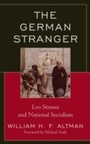
The German Stranger
Leo Strauss and National Socialism
Published on 22. November 2010
Book
Hardback
618 pages
978-0-7391-4737-5 (ISBN)
Description
Leo Strauss's connection with Martin Heidegger and Carl Schmitt suggests a troubling proximity to National Socialism but a serious critique of Strauss must begin with F. H. Jacobi. While writing his dissertation on this apparently Christian opponent of the Enlightenment, Strauss discovered the tactical principles that would characterize his lifework: writing between the lines, a faith-based critique of rationalism, the deliberate secularization of religious language for irreligious purposes, and an "all or nothing" antagonism to middling solutions. Especially the latter is distinctive of his Zionist writings in the 1920s where Strauss engaged in an ongoing polemic against Cultural Zionism, attacking it first from an orthodox, and then from an atheist's perspective. In his last Zionist article (1929), Strauss mentions "the Machiavellian Zionism of a Nordau that would not fear to use the traditional hope for a Messiah as dynamite." By the time of his "change of orientation," National Socialism was being led by a nihilistic "Messiah" while Strauss had already radicalized Schmitt's "political theology" and Heidegger's deconstruction of the ontological Tradition. Central to Strauss's advance beyond the smartest Nazis is his "Second Cave" in which he claimed modern thought is imprisoned: only by escaping Revelation can we recover "natural ignorance." By using pseudo-Platonic imagery to illustrate what anti-Semites called "Jewification," Strauss attempted to annihilate the common ground, celebrated by Hermann Cohen, between Judaism and Platonism. Unlike those who attacked Plato for devaluing nature at the expense of the transcendent Idea, the emigre Strauss effectively employed a new "Plato" who was no more a Platonist than Nietzsche or Heidegger had been. Central to Strauss's "Platonic political philosophy" is the mysterious protagonist of Plato's Laws whom Strauss accurately recognized as the kind of Socrates whose fear of death would have caused him to flee the hemlock. Any reader who recognizes the unbridgeable gap between the real Socrates and Plato's Athenian Stranger will understand why "the German Stranger" is the principal theoretician of an atheistic re-enactment of religion, of which genus National Socialism is an ultra-modern species.
Reviews / Votes
Philosophically trained and philologically inclined, Altman marshals stupendous erudition and dazzling wit in the service of what is both a necessary and a preliminary task in the pursuit of a recovery of the Platonic and biblical foundations of western humanity. Humanity is the cause for the sake of which this book was written. -- From the foreword by Michael Zank No other critic of Leo Strauss has provided such an erudite, meticulous, imaginative, and eloquent study of his writings. Friend or foe, anyone who wants to participate intelligently in the "Strauss Wars" will need to scrutinize and confront this extraordinary book. -- Peter Minowitz, author of Straussophobia: Defending Leo Strauss and Straussians against Shadia Drury and other Accusers Altman's important, richly detailed study of Strauss' life and work is likely to change many views of who he was and what he stood for, above all as concerns his complex relations with such pro-Nazi German intellectuals as Heidegger and Schmitt. -- Tom Rockmore, Duquesne University The German Stranger is a fascinating read. Altman takes up an extraordinarily difficult subject-Leo Strauss's relationship to German National Socialism-and handles it with genuine grace and insight. Unafraid to raise troubling and uncomfortable questions regarding Strauss's exoteric style of writing and its relationship to politics, Altman succeeds in providing an excellent analysis of Strauss's relation to the Western philosophical tradition as an exercise in political analysis. By looking critically at Strauss's early philosophical development as a student of Heidegger and considering his relationship to important Jewish thinkers such as Karl Loewith, Gershom Scholem, Franz Rosenzweig, and others, Altman manages to present a convincing portrait of Strauss as a thinker with deep sympathies for a National Socialist worldview. As paradoxical and shocking as this might sound, Altman manages to show how Strauss's thought was deeply influenced by National Socialist ideas and how he was able to suppress such sympathies when he later arrived in the United States. For anyone interested in deconstructing the portrait of Strauss as the spiritual forefather of the Bush-Cheney political crowd, Altman's book will prove eye opening. After reading this work, I came away with a deep appreciation for Altman's breadth of knowledge and philosophical-political insight into long-standing questions about the contradictions implicit in the Western philosophical tradition. For what Altman's project entails is nothing other than a fundamental rethinking of the Platonic and biblical foundations of Western thought. Anyone interested in the work of Strauss or Heidegger will undoubtedly find real gems of insight in this comprehensive and illuminating work. -- Charles Bambach, University of Texas at DallasMore details
Language
English
Place of publication
United States
Publishing group
Bloomsbury Publishing Plc
Target group
Professional and scholarly
Product notice
sewn/stitched
Cloth over boards
With dust jacket
Dimensions
Height: 235 mm
Width: 157 mm
Thickness: 41 mm
Weight
1141 gr
ISBN-13
978-0-7391-4737-5 (9780739147375)
Copyright in bibliographic data and cover images is held by Nielsen Book Services Limited or by the publishers or by their respective licensors: all rights reserved.
Schweitzer Classification
Other editions
Additional editions
E-Book
06/2012
1st Edition
Lexington Books
€78.49
Available for download
Persons
William H. F. Altman teaches Latin and World History at E. C. Glass, a public high school in Lynchburg, Virginia..
Content
1 Foreword 2 Preface 3 Introduction: From Weimar to Crete 4 Chapter 1. The Enduring Influence of F.H. Jacobi 5 Chapter 2. The Double Envelopment of Cultural Zionism 6 Chapter 3. The Only Great Thinker in Our Time 7 Chapter 4. A Radical Critique of Liberalism 8 Chapter 5. The Last Word in "Secularization" 9 Chapter 6. To Master the Art of Writing 10 Chapter 7. The Theological-Political Problem's Final Solution 11 Chapter 8. The Aristeia of Leo Strauss 12 Chapter 9. Ancients and Nazis 13 Conclusion: Of Enemies and Friends; A Liberal's Response