

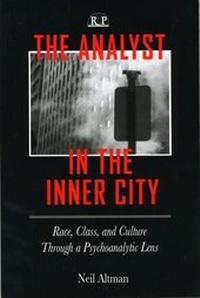
The Analyst in the Inner City
Race, Class, and Culture Through a Psychoanalytic Lens
Published on 1. October 1995
Book
Paperback/Softback
208 pages
978-0-88163-435-8 (ISBN)
Description
Psychoanalytic theory and technique have rarely addressed clinical work in inner city public clinics, much less the complex social issues revolving around race, culture, and social class that arise in this setting. In The Analyst in the Inner City, Neil Altman undertakes this challenging task. In so doing, he takes psychoanalysis to its margins: to the people excluded by traditional theory and practice, the very people made peripheral by society at large. Just as psychoanalytic treatment seeks to foster personal integration of the psychically marginal, so Altman seeks to identify, explore, and transcend the exclusionary boundaries of traditional psychoanalytic practice.
In an effort to bridge the gap between psychoanalysis and social theory, Altman argues that racial, cultural, and social-class divisions reflect the splits that accompany the consolidation of an individual sense of self. In developing a self image, that is, people construct images of a "disowned other" who is made to embody, often unconsciously, those psychic qualities unacceptable to the self. Societal polarization along racial and class lines supports this psychic process by delineating groups with which one identifies either positively or negatively. The opposition between private and public sectors further reinforces this creation of a "not me" space in which to project and the find all the unwanted aspects of self.
As Altman examines these interdigitating processes, social theory and clinical theory come together in mutually illuminating ways. In the clinical situation, for example, psychic splitting often emerges at the very time that socioeconomic differences between patient and therapist become a focus of complementary efforts to delineate notions of self and other.
In an effort to bridge the gap between psychoanalysis and social theory, Altman argues that racial, cultural, and social-class divisions reflect the splits that accompany the consolidation of an individual sense of self. In developing a self image, that is, people construct images of a "disowned other" who is made to embody, often unconsciously, those psychic qualities unacceptable to the self. Societal polarization along racial and class lines supports this psychic process by delineating groups with which one identifies either positively or negatively. The opposition between private and public sectors further reinforces this creation of a "not me" space in which to project and the find all the unwanted aspects of self.
As Altman examines these interdigitating processes, social theory and clinical theory come together in mutually illuminating ways. In the clinical situation, for example, psychic splitting often emerges at the very time that socioeconomic differences between patient and therapist become a focus of complementary efforts to delineate notions of self and other.
Reviews / Votes
"With a candor and political sophistication rare in the profession, Neil Altman challenges analysts to face issues of race, class, gender, and community in the context of the profession's history of moral concern. He does all this and, never losing his analytic focus, provides intriguing case material that demonstrates the entanglements of politics, history, and treatment, all the while giving the reader a sense of possibility and hope in these difficult times. Altman's lively prose brings to life a recent psychoanalytic idea - that of a three-person psychology - in a way that will persuade and enlighten. It is inspiring that an analyst could write such a book at this time in our nation's history. The Analyst in the Inner City will become a classic, and deservedly so."- Philip Cushman, Ph.D., author, Constructing the Self, Constructing America
"Neil Altman has written a courageous and probing book that builds on, and extends, one of the most important tendencies in psychoanalytic theory: the integration of a social theory and healing practice. Drawing on contemporary object relations theory, accompanied by compelling clinical examples from his own work in public clinics, Altman clarifies the power and pitfalls of mental health work in a postmodern and multicultural context. The Analyst in the Inner City is acutely poised between hope and despair. In showing us that psychoanalysis is not solely the prerogative of the elite, Altman argues that contemporary relational theories offer the most trenchant insights into the complexity of healing amidst poverty and affluence."
- Adrienne Harris, Ph.D., New York University
More details
Series
Language
English
Place of publication
Hillsdale
United States
Publishing group
Taylor & Francis Ltd
Target group
College/higher education
Professional and scholarly
Dimensions
Height: 229 mm
Width: 152 mm
Weight
354 gr
ISBN-13
978-0-88163-435-8 (9780881634358)
Copyright in bibliographic data and cover images is held by Nielsen Book Services Limited or by the publishers or by their respective licensors: all rights reserved.
Schweitzer Classification
Person
Neil Altman, Ph.D., is an Associate Clinical Professor in the Postdoctoral Program in Psychotherapy and Psychoanalysis at New York University, co-editor of Psychoanalytic Dialogues and co-author of Relational Child Psychotherapy. He is Past President of the Section on Social Responsibility of Division 39 of the American Psychological Association, and serves on the Board of the International Association of Relational Psychoanalysis and Psychotherapy. He is a founding board member, consultation group leader, and therapist in Fostering Connection, a program that offers pro bono psychotherapy to foster children.
Content
Clinical Experiences from a Public Clinic. Theoretical, Historical, and Sociological Background. Race, Culture, and Social Class. A Psychoanalytic Look as the Bifurcation of Public and Private Practice. Psychoanalyzing the Context: Psychoanalysis in a Public Clinic. On the Future of Psychoanalysis.