

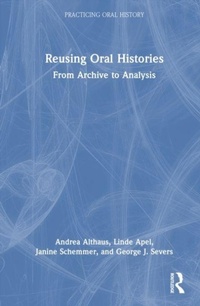
Reusing Oral Histories
From Archive to Analysis
1st Edition
Will be published approx. on 17. November 2026
Book
Hardback
176 pages
978-1-032-98956-3 (ISBN)
Description
Reusing Oral Histories is the first comprehensive guide available to scholars and students looking to analyse or reanalyse archived oral history interviews.
Oral history scholarship to date has been primarily concerned with the analysis of oral histories conducted by the interviewer, despite the proliferation of archived oral history interviews. The reuse of interviews, some of which have been in the archives for years, poses specific challenges for researchers and offers many rewards. Across four chapters, this book furnishes readers with a detailed overview of the literature on oral history reuse, as well as discussing practical, methodological and ethical considerations, and the emotional challenges involved in reusing archived interviews. Based on international case studies, the book explores relationality, narrativity, and aurality of archived interviews. Reusing Oral Histories suggests three complementary modes of analytical listening - empathetic, active and relational - in order to understand both the interviews themselves and the memories and narratives they contain.
The book provides readers with the tools, methods and theoretical frameworks to engage fully in reusing oral histories. It will be of interest to students, archivists, and other practitioners of oral history as a practical guide and theoretical companion.
Oral history scholarship to date has been primarily concerned with the analysis of oral histories conducted by the interviewer, despite the proliferation of archived oral history interviews. The reuse of interviews, some of which have been in the archives for years, poses specific challenges for researchers and offers many rewards. Across four chapters, this book furnishes readers with a detailed overview of the literature on oral history reuse, as well as discussing practical, methodological and ethical considerations, and the emotional challenges involved in reusing archived interviews. Based on international case studies, the book explores relationality, narrativity, and aurality of archived interviews. Reusing Oral Histories suggests three complementary modes of analytical listening - empathetic, active and relational - in order to understand both the interviews themselves and the memories and narratives they contain.
The book provides readers with the tools, methods and theoretical frameworks to engage fully in reusing oral histories. It will be of interest to students, archivists, and other practitioners of oral history as a practical guide and theoretical companion.
Reviews / Votes
"The book couldn't have come at a better time: web-based platforms such as Oral-History.Digital have made accessing interviews so straightforward that their use is no longer limited to experts, but is enabling many people to become practitioners of oral history. The book provides the essential basic knowledge needed to make use of these complex sources, whilst the case studies convey the fascination these sources hold once one has made the effort to listen. The book benefits greatly from the authors' dual expertise as long-standing archivists and distinguished oral historians."Almut Leh, Head of the Archive "Deutsches Gedaechtnis" at the Institute for History and Biography, FernUniversitaet in Hagen, Germany
"It is a treat to see a volume that foregrounds the importance, rewards and complexities of reusing the treasure troves of voice, experience and emotion held in oral history archives. Drawing on theory and the authors' experiences, this book will be a 'must-read' for researchers, archivists and practitioners grappling with the ethical and practical challenges of 'reusing' archived recordings. These chapters will inspire reflection and further discussion - thus making a significant contribution to the field."
Mary Stewart, Lead Curator of Oral History and Director of National Life Stories, The British Library, United Kingdom
"In a world of abundant digital sources and the constant production of new oral history projects, this timely volume offers valuable tools for comprehending already-recorded and archived interviews. It takes an ecological stance, focusing on a largely understudied field: the secondary analysis of oral accounts. With this book in hand, it is much easier to discover treasures in interview collections and be methodologically and ethically equipped to work with them. By engaging with materials created by others, we develop more vibrant connections - something desperately needed in the polarized society that keeps people apart."
Natalia Otrishchenko, Center for Urban History, Lviv, Ukraine
More details
Series
Language
English
Place of publication
London
United Kingdom
Publishing group
Taylor & Francis Ltd
Target group
College/higher education
Professional and scholarly
Postgraduate and Professional Practice & Development
Illustrations
21 s/w Photographien bzw. Rasterbilder, 21 s/w Abbildungen
21 Halftones, black and white; 21 Illustrations, black and white
Dimensions
Height: 234 mm
Width: 156 mm
ISBN-13
978-1-032-98956-3 (9781032989563)
Copyright in bibliographic data and cover images is held by Nielsen Book Services Limited or by the publishers or by their respective licensors: all rights reserved.
Schweitzer Classification
Other editions
Additional editions

Book
approx. 11/2026
1st Edition
Routledge
€52.50
Not yet published
Persons
George J. Severs is a historian at the Geneva Graduate Institute, Switzerland, where he works on histories of sexual and reproductive health. He is the author of Radical Acts: HIV/AIDS Activism in Late Twentieth-Century England (2024) and an editor of Oral History.
Andrea Althaus is a historian and collection manager at the oral history archive "Workshop of Memory" at the Research Centre for Contemporary History, Hamburg. She specialises in oral history, migration history, gender history, and German-Jewish history in the 20th and 21st centuries.
Linde Apel is the head of the 'Workshop of Memory' interview archive at the Research Centre for Contemporary History, Hamburg. She co-founded the German Oral History Network in 2014. Her research interests focus on Holocaust history, contemporary and oral history and her most recent publication is Handbuch Oral History (2026).
Janine Schemmer is a cultural anthropologist and currently a postdoc researcher in the FWF-project "Discourses and Practices of the In-Between". In her research and teaching, she focuses on memory culture and historical ethnography, narrative studies, spatial processes and social relations.
Andrea Althaus is a historian and collection manager at the oral history archive "Workshop of Memory" at the Research Centre for Contemporary History, Hamburg. She specialises in oral history, migration history, gender history, and German-Jewish history in the 20th and 21st centuries.
Linde Apel is the head of the 'Workshop of Memory' interview archive at the Research Centre for Contemporary History, Hamburg. She co-founded the German Oral History Network in 2014. Her research interests focus on Holocaust history, contemporary and oral history and her most recent publication is Handbuch Oral History (2026).
Janine Schemmer is a cultural anthropologist and currently a postdoc researcher in the FWF-project "Discourses and Practices of the In-Between". In her research and teaching, she focuses on memory culture and historical ethnography, narrative studies, spatial processes and social relations.
Content
Introduction, 1: Reusing Interviews: An Overview, 2: Embracing Complexities, 3: Engaging with "Difficult" Subjects, 4: Aurality in Reanalysis, 5: Conclusion, 6: Be prepared for surprises: Joanna Bornat in conversation with George Severs, Glossary