

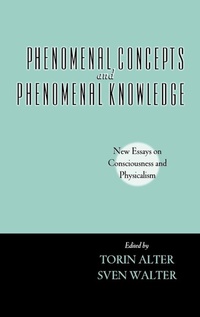
Phenomenal Concepts and Phenomenal Knowledge
New Essays on Consciousness and Physicalism
Published on 11. January 2007
Book
Hardback
360 pages
978-0-19-517165-5 (ISBN)
Description
Consciousness has long been regarded as the biggest stumbling block for the view that the mind is physical. This volume collects thirteen new papers on this problem by leading philosophers including Torin Alter, Ned Block, David Chalmers, Daniel Dennett, John Hawthorne, Frank Jackson, Janet Levin, Joseph Levine, Martine Nida-Ruemelin, Laurence Nemirow, Knut Nordby, David Papineau, and Stephen White.
Reviews / Votes
a useful book I would recommend to those who are working on consciousness and physicalism. * Istvan Aranyosi Mind *More details
Series
Language
English
Place of publication
New York
United States
Target group
College/higher education
Professional and scholarly
Illustrations
2 line drawings
Dimensions
Height: 240 mm
Width: 161 mm
Thickness: 24 mm
Weight
705 gr
ISBN-13
978-0-19-517165-5 (9780195171655)
Copyright in bibliographic data and cover images is held by Nielsen Book Services Limited or by the publishers or by their respective licensors: all rights reserved.
Schweitzer Classification
Other editions
Additional editions
Torin Alter | Sven Walter
Phenomenal Concepts and Phenomenal Knowledge
New Essays on Consciousness and Physicalism
E-Book
12/2006
1st Edition
OUP eBook
€22.99
Available for download
Torin Alter | Sven Walter
Phenomenal Concepts and Phenomenal Knowledge
New Essays on Consciousness and Physicalism
E-Book
12/2006
1st Edition
OUP eBook
€19.99
Available for download
Persons
Torin Alter is Associate Professor at the University of Alabama.
Sven Walter is Assistant Professor at the University of Bielefeld, Germany.
Sven Walter is Assistant Professor at the University of Bielefeld, Germany.
Content
Introduction
Part I: Phenomenal Knowledge
1: Daniel Dennett, Tufts University: What RoboMary Knows
2: Laurence Nemirow, Davis Graham & Stubbs Income Tax, Benefits & Estate Group: So This is What it's Like: A Defense of the Ability Hypothesis
3: Frank Jackson, Australian National University, British Academy, Australian Academy of the Social Sciences in Australia, and Fand Institut International de Philosophie: The Knowledge Argument, Diaphanousness, Representationalism
4: Torin Atler, The University of Alabama: Does Representationalism Undermine the Knowledge Argument?
5: Knut Nordby, formerly University of Oslo and Telnor Communications, Research and Development: What is This Thing You Call Color: Can a Totally Color-Blind Person Know About Color?
Part II: Phenomenal Concepts
6: Janet Levin, University of Southern California: What is a Phenomenal Concept?
7: David Papineau, King's College, Cambridge University: Phenomenal and Perceptual Concepts
8: Joseph Levine, The University of Massachusetts at Amherst: Phenomenal Concepts and the Materialist Constraint
9: David Chalmers, Australian National University: Phenomenal Concepts and the Explanatory Gap
10: John Hawthorne, Rutgers University: Direct Reference and Dancing Qualia
11: Stephen White, Tufts University: Property Dualism, Phenomenal Concepts, and the Semantic Premise
12: Ned Block, New York University: Max Black's Ojbection to Mind-Brain Identity
13: Martine Nida-Ruemelin, University of Fribourg: Grasping Phenomenal Properties
Part I: Phenomenal Knowledge
1: Daniel Dennett, Tufts University: What RoboMary Knows
2: Laurence Nemirow, Davis Graham & Stubbs Income Tax, Benefits & Estate Group: So This is What it's Like: A Defense of the Ability Hypothesis
3: Frank Jackson, Australian National University, British Academy, Australian Academy of the Social Sciences in Australia, and Fand Institut International de Philosophie: The Knowledge Argument, Diaphanousness, Representationalism
4: Torin Atler, The University of Alabama: Does Representationalism Undermine the Knowledge Argument?
5: Knut Nordby, formerly University of Oslo and Telnor Communications, Research and Development: What is This Thing You Call Color: Can a Totally Color-Blind Person Know About Color?
Part II: Phenomenal Concepts
6: Janet Levin, University of Southern California: What is a Phenomenal Concept?
7: David Papineau, King's College, Cambridge University: Phenomenal and Perceptual Concepts
8: Joseph Levine, The University of Massachusetts at Amherst: Phenomenal Concepts and the Materialist Constraint
9: David Chalmers, Australian National University: Phenomenal Concepts and the Explanatory Gap
10: John Hawthorne, Rutgers University: Direct Reference and Dancing Qualia
11: Stephen White, Tufts University: Property Dualism, Phenomenal Concepts, and the Semantic Premise
12: Ned Block, New York University: Max Black's Ojbection to Mind-Brain Identity
13: Martine Nida-Ruemelin, University of Fribourg: Grasping Phenomenal Properties