

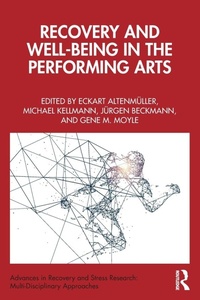
Recovery and Well-being in the Performing Arts
1st Edition
Published on 21. May 2026
Book
Paperback/Softback
316 pages
978-1-032-93636-9 (ISBN)
Description
Investigating the critical relationship between recovery, fatigue, working conditions, and societal pressures in the performing arts, this comprehensive text brings together international experts from psychology, medicine, and sport science. It highlights important research on recovery and its physiological and psychological implications for performing artists across music, dance, acting, and circus performance.
Divided into four parts, this book contextualises recovery challenges in performing arts while maintaining positive health and well-being levels essential for performance. Chapters examine recovery from both individual and organisational perspectives, and address how recovery and well-being can be induced and sustained, preventing overuse, and enabling creativity and self-efficacy. Contributors provide scientific state-of-the-art approaches answering crucial questions that also address societal and systemic challenges in the performing arts. They provide valuable insights for researchers, while offering practical guidance for anyone involved in supporting the physical and mental health of performing artists across diverse artistic disciplines.
This essential resource will be of interest to both academic communities and applied practice professionals concerned with human health and well-being in performing arts, including artistic directors, performing artists, coaches, conductors, composers, and healthcare teams working with performers.
Divided into four parts, this book contextualises recovery challenges in performing arts while maintaining positive health and well-being levels essential for performance. Chapters examine recovery from both individual and organisational perspectives, and address how recovery and well-being can be induced and sustained, preventing overuse, and enabling creativity and self-efficacy. Contributors provide scientific state-of-the-art approaches answering crucial questions that also address societal and systemic challenges in the performing arts. They provide valuable insights for researchers, while offering practical guidance for anyone involved in supporting the physical and mental health of performing artists across diverse artistic disciplines.
This essential resource will be of interest to both academic communities and applied practice professionals concerned with human health and well-being in performing arts, including artistic directors, performing artists, coaches, conductors, composers, and healthcare teams working with performers.
More details
Series
Language
English
Place of publication
London
United Kingdom
Publishing group
Taylor & Francis Ltd
Target group
College/higher education
Professional and scholarly
Academic, Postgraduate, and Professional Practice & Development
Illustrations
12 s/w Tabellen, 11 s/w Zeichnungen, 4 s/w Photographien bzw. Rasterbilder, 15 s/w Abbildungen
12 Tables, black and white; 11 Line drawings, black and white; 4 Halftones, black and white; 15 Illustrations, black and white
Dimensions
Height: 233 mm
Width: 155 mm
Thickness: 21 mm
Weight
496 gr
ISBN-13
978-1-032-93636-9 (9781032936369)
Copyright in bibliographic data and cover images is held by Nielsen Book Services Limited or by the publishers or by their respective licensors: all rights reserved.
Schweitzer Classification
Other editions
Additional editions
Eckart Altenmueller | Michael Kellmann | Juergen Beckmann
Recovery and Well-being in the Performing Arts
E-Book
05/2026
1st Edition
Routledge
€59.49
Available for download
Eckart Altenmueller | Michael Kellmann | Juergen Beckmann
Recovery and Well-being in the Performing Arts
E-Book
05/2026
1st Edition
Routledge
€59.49
Available for download
Eckart Altenmueller | Michael Kellmann | Juergen Beckmann
Recovery and Well-being in the Performing Arts
Book
05/2026
1st Edition
Routledge
€179.50
Shipment within 10-20 days
Persons
Eckart Altenmueller is a Professor Emeritus of Music Physiology and Musician's Medicine at the University of Music, Drama and Media, Hannover, Germany.
Michael Kellmann is a Professor of Sport Psychology at the Faculty of Sport Science, Ruhr University Bochum, Germany. He is also an Honorary Professor in the School of Human Movement and Nutrition Sciences, The University of Queensland, Australia.
Juergen Beckmann is Professor of Sport Psychology and Emeritus of Excellence in the School of Medicine and Health, Technical University of Munich, Germany. He is currently member of the Psycho-Cardiological Consultation Group at the German Heart Centre Munich. He is also an Honorary Professor in the School of Human Movement and Nutrition Sciences, The University of Queensland, Australia.
Gene M. Moyle is a Professor of Dance, Sport and Exercise Psychologist and Pro Vice-Chancellor (Academic Programs and Partnerships) at the Queensland University of Technology, Brisbane, Australia.
Michael Kellmann is a Professor of Sport Psychology at the Faculty of Sport Science, Ruhr University Bochum, Germany. He is also an Honorary Professor in the School of Human Movement and Nutrition Sciences, The University of Queensland, Australia.
Juergen Beckmann is Professor of Sport Psychology and Emeritus of Excellence in the School of Medicine and Health, Technical University of Munich, Germany. He is currently member of the Psycho-Cardiological Consultation Group at the German Heart Centre Munich. He is also an Honorary Professor in the School of Human Movement and Nutrition Sciences, The University of Queensland, Australia.
Gene M. Moyle is a Professor of Dance, Sport and Exercise Psychologist and Pro Vice-Chancellor (Academic Programs and Partnerships) at the Queensland University of Technology, Brisbane, Australia.
Content
Series foreword. Preface. Part I: Conceptualizing the problem. 1) Recovery concepts and diversity of approaches to recovery in the performing arts: A general introduction. 2) Societal, physical, and organizational pressures in the performing arts. 3) Developing monitoring systems for the performing arts: Theoretical and practical applications. Part II: Recovery and well-being of performing artists. 4) Managing the practice load: Recovery-stress balance and injury risk in performing arts. 5) Mindfulness as a tool for enhancing recovery in the performing arts. 6) Recovery in professional musicians. 7) Dance injury: Psychological and psychosocial factors in prevention, recovery and return to performance. 8) Recovery of the singers voice. 9) Optimizing recovery: Supporting artists to flourish in circus, and in life. Part III: Inside an organization: Complex challenges for recovery and well-being. 10) Musicians in classical orchestras: Challenges and employer responsibilities. 11) Managing mental and physical fatigue in a professional ballet company. 12) Creating magic on and off the stage: Cirque du Soleil contextual recovery and well-being approaches. Part IV: Performing arts as a resource for recovery in our society. 13) Music and arts interventions for well-being and healthy brain ageing. 14) Recovery approaches in music-based interventions and music therapy. 15) Dance - A lifeline for holistic recovery and creative aging. 16) The reparative artist: CoActive therapeutic theater in service of recovery. 17) Music as a resource for health and well-being: Epidemiological and big data studies. 18) Towards implementing scientifically based recovery strategies in the performing arts.