

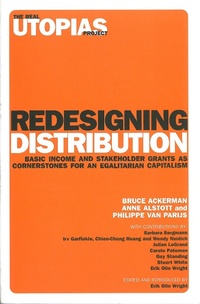
Redesigning Distribution
Basic Income and Stakeholder Grants as Cornerstones for an Egalitarian Capitalism
Published on 17. February 2006
Book
Paperback/Softback
228 pages
978-1-84467-517-3 (ISBN)
Description
Volume V in the acclaimed Real Utopias Project series, edited by Erik Olin Wright.
Are there ways that contemporary capitalism can be rendered a dramatically more egalitarian economic system without destroying its productivity and capacity for growth?
This book explores two proposals, unconditional basic income and stakeholder grants, that attempt just that. In a system of basic income, as elaborated by Philippe van Parijs, all citizens are given a monthly stipend sufficient to provide them with a no-frills but adequate standard of living. This monthly income is universal rather than means-tested, and it is unconditional - receiving the basic income does not depend upon performing any labor services or satisfying other conditions. It affirms the idea that as a matter of basic rights, no one should live in poverty in an affluent society. In a system of stakeholder grants, as discussed by Bruce Ackerman and Anne Alstott, all citizens upon reaching the age of early adulthood receive a substantial one-time lump-sum grant sufficiently large so that all young adults would be significant wealth holders. Ackerman and Alstott propose that this grant be in the vicinity of $80,000 and be financed by an annual wealth tax of roughly 2 percent. A system of stakeholder grants, they argue, "expresses a fundamental responsibility: every American has an obligation to contribute to a fair starting point for all."
Are there ways that contemporary capitalism can be rendered a dramatically more egalitarian economic system without destroying its productivity and capacity for growth?
This book explores two proposals, unconditional basic income and stakeholder grants, that attempt just that. In a system of basic income, as elaborated by Philippe van Parijs, all citizens are given a monthly stipend sufficient to provide them with a no-frills but adequate standard of living. This monthly income is universal rather than means-tested, and it is unconditional - receiving the basic income does not depend upon performing any labor services or satisfying other conditions. It affirms the idea that as a matter of basic rights, no one should live in poverty in an affluent society. In a system of stakeholder grants, as discussed by Bruce Ackerman and Anne Alstott, all citizens upon reaching the age of early adulthood receive a substantial one-time lump-sum grant sufficiently large so that all young adults would be significant wealth holders. Ackerman and Alstott propose that this grant be in the vicinity of $80,000 and be financed by an annual wealth tax of roughly 2 percent. A system of stakeholder grants, they argue, "expresses a fundamental responsibility: every American has an obligation to contribute to a fair starting point for all."
More details
Series
Language
English
Place of publication
London
United Kingdom
Product notice
Paperback (trade)
Unsewn / adhesive bound
Dimensions
Height: 236 mm
Width: 156 mm
Thickness: 19 mm
Weight
411 gr
ISBN-13
978-1-84467-517-3 (9781844675173)
Copyright in bibliographic data and cover images is held by Nielsen Book Services Limited or by the publishers or by their respective licensors: all rights reserved.
Schweitzer Classification
Other editions
Additional editions
Anne Alstott | Bruce Ackerman | Philippe Van Parijs
Redesigning Distribution
Basic Income and Stakeholder Grants as Cornerstones for an Egalitarian Capitalism
E-Book
05/2020
Verso Books
€24.49
Available for download
Previous edition
Anne Alstott | Bruce Ackerman | Philippe Van Parijs
Redesigning Distribution
Basic Income and Stakeholder Grants as Cornerstones for an Egalitarian Capitalism
Book
02/2006
Verso Books
€75.71
Article exhausted; check for reprint
Persons
Guy Standing is director of the Socio-Economic Programme of the International Labour Organisation. He directed the ILO's technical programme in Eastern Europe in the early 1990s and was an advisor to the South African government in 1995-96. He has written extensively on labour market and social policy issues.
Erik Olin Wright is Vilas Distinguished Professor of Sociology at the University of Wisconsin. He is the author of many books, including Classes, Interrogating Inequality, Class Counts, Deepening Democracy (with Archon Fung), and Envisioning Real Utopias. For more information on Envisioning Real Utopias and the Real Utopias project, and to access book content, please visit realutopias.org (site in progress).
Erik Olin Wright is Vilas Distinguished Professor of Sociology at the University of Wisconsin. He is the author of many books, including Classes, Interrogating Inequality, Class Counts, Deepening Democracy (with Archon Fung), and Envisioning Real Utopias. For more information on Envisioning Real Utopias and the Real Utopias project, and to access book content, please visit realutopias.org (site in progress).