

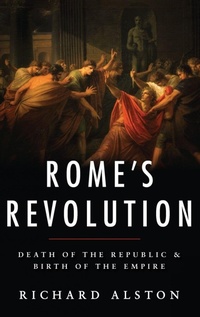
Rome's Revolution
Death of the Republic & Birth of the Empire
Published on 23. July 2015
Book
Hardback
408 pages
978-0-19-973976-9 (ISBN)
Description
Novelized, televised, and endlessly scrutinized by scholars, the fall of the Roman Republic marks one of history's great turning points. Historians have studied the descent of the Republic into civil war as a great political tragedy, a warning from the past about the unsustainability of empires; political scientists have labeled it a parable about militarism, populism, moral decay, or the inevitable corruption of political systems. Yet the familiar story of the Roman Republic's downfall continues to be the story of its elites. What if we started thinking about Roman politics not from the perspectives of Caesar and Cicero, but from the point of view of the soldier, the peasant, or the pauper? In an original account of what he calls Rome's revolution, Richard Alston reinscribes these humble protagonists into their tumultuous era. They, like the ruthless aristocrats they swore allegiance to, were political agents, negotiating their positions in the context of a "failed state."
Rome's Revolution blends riveting historical narrative with socio-economic analysis, restoring a rich context to the cataclysmic violence of the period. In addition to chronicling the drama of aristocratic rivalries, the book digs beneath the high politics of Cicero, Caesar, Antony and Octavian to examine the problems of making a living in first-century BC Italy. Portraying the revolution as the crisis of a violent society--both among the citizenry and among a ruling class whose legitimacy was dwindling--Rome's Revolution provides new insight into the motivations that drove men to march on their capital city and slaughter their compatriots.
Rome's Revolution blends riveting historical narrative with socio-economic analysis, restoring a rich context to the cataclysmic violence of the period. In addition to chronicling the drama of aristocratic rivalries, the book digs beneath the high politics of Cicero, Caesar, Antony and Octavian to examine the problems of making a living in first-century BC Italy. Portraying the revolution as the crisis of a violent society--both among the citizenry and among a ruling class whose legitimacy was dwindling--Rome's Revolution provides new insight into the motivations that drove men to march on their capital city and slaughter their compatriots.
Reviews / Votes
A very pleasant read and highly recommended for both specialists and fans of Roman history. * Andrei Pogacias, Ancient Warfare * Well written and engaging, ideal for students and scholars, but also accessible for non-specialists. * Mark Merrony, Minerva * this book, written in straightforward, accessible, English, is recommended as a knowledgeable guide to, and with a fresh 'take' on, an enthralling period of Roman history. * Antony Spawforth, Classics for All *More details
Series
Language
English
Place of publication
New York
United States
Dimensions
Height: 240 mm
Width: 161 mm
Thickness: 26 mm
Weight
772 gr
ISBN-13
978-0-19-973976-9 (9780199739769)
Copyright in bibliographic data and cover images is held by Nielsen Book Services Limited or by the publishers or by their respective licensors: all rights reserved.
Schweitzer Classification
Other editions
Additional editions
E-Book
05/2015
1st Edition
OUP eBook
€8.49
Available for download
E-Book
01/2015
1st Edition
Oxford University Press, USA
€8.49
Available for download
Person
Richard Alston is Professor of Roman History at Royal Holloway, University of London, and the author or editor of over a dozen books on ancient Rome and antiquity.
Content
Acknowledgements ; Preface ; The Historian's Problem ; Death of a Dictator ; The Crisis of the Republic ; Caesar and Pompey ; Mutina: The Last Battle of the Republic ; A Victory Lost: The Defeat of the Senate ; The Revolution Begins ; Death in Rome ; The Revolution Complete: From Philippi to Perusia ; The Triumviral Wars ; Antony and Cleopatra: Love and its Enemies ; The Invention of Augustus ; The Augustan Republic ; Anarchy and Power ; The Imperial Order ; The Conquest of the World ; Buying Rome: Empire, Money, and Power in the Augustan Regime ; Death of an Emperor ; Epilogue: Tiberius the Emperor ; Bibliography ; Index