

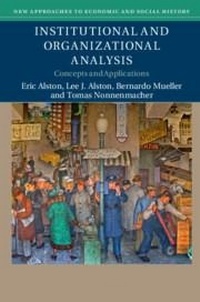
Institutional and Organizational Analysis
Concepts and Applications
Published on 23. August 2018
Book
Hardback
406 pages
978-1-107-08637-1 (ISBN)
Description
What explains the great variability in economic growth and political development across countries? Institutional and organizational analysis has developed since the 1970s into a powerful toolkit, which argues that institutions and norms rather than geography, culture, or technology are the primary causes of sustainable development. Institutions are rules that recognized authorities create and enforce. Norms are rules created by long-standing patterns of behavior, shared by people in a society or organization. They combine to play a role in all organizations, including governments, firms, churches, universities, gangs, and even families. This introduction to the concepts and applications of institutional and organizational analysis uses economic history, economics, law, and political science to inform its theoretical framework. Institutional and organizational analysis becomes the basis to show why the economic and political performance of countries worldwide have not converged, and reveals the lessons to be learned from it for business, law, and public policy.
Reviews / Votes
'These four intrepid authors develop a theory of institutional and organizational analysis of enormous ambition. Influenced by Buchanan, Coase, North and Ostrom, and Williamson, they work on a broad tapestry that crosses continents, spans centuries, and yet always maintains its focus on which set of arrangements flourish and which flounder.' Richard A. Epstein, New York University, The Hoover Institution and University of Chicago 'As a rule you can only synthesize an academic field when it is moribund. This book is the exception that proves the rule; it manages to bring together the most important ideas in institutional economics in a way which not only shows how intellectually vibrant it is, but which also opens up new research agendas. There is no better introduction.' James A. Robinson, University of Chicago 'This comprehensive introduction to the study of institutions and organizations approaches the question I have long considered in my own work: which set of institutions are most conducive to economic development? These authors provide an excellent synthesis of this essential field of study for students and scholars alike.' Hernando de Soto, Institute for Liberty and Democracy 'This is the book we've been waiting for - a comprehensive, comparative, interdisciplinary tour of the key concepts and most significant arguments that define modern political economy. The authors have assembled a remarkable volume of scope and content. It belongs on every scholar's shelf and in every student's hands.' Kenneth A. Shepsle, Harvard University 'This is a wonderful book - broad in scope (institutions, norms, organizations, and contracts), in disciplines (economics, political science, law, and history), and in methodologies (classic informal arguments, summaries of recent formal models, and incisive case studies). So many problems of collective action, productivity, development, and growth find almost no expression (not to mention solution) in neoclassical analyses of markets; Institutional and Organizational Analysis offers a way forward.' Robert Gibbons, Sloan School of Management, Massachusetts Institute of TechnologyMore details
Series
Language
English
Place of publication
Cambridge
United Kingdom
Target group
College/higher education
Professional and scholarly
Product notice
sewn/stitched
Cloth over boards
Illustrations
19 Line drawings, black and white
Dimensions
Height: 246 mm
Width: 159 mm
Thickness: 4 mm
Weight
665 gr
ISBN-13
978-1-107-08637-1 (9781107086371)
Copyright in bibliographic data and cover images is held by Nielsen Book Services Limited or by the publishers or by their respective licensors: all rights reserved.
Schweitzer Classification
Other editions
Additional editions
Eric Alston | Lee J. Alston | Bernardo Mueller
Institutional and Organizational Analysis
Concepts and Applications
Book
08/2018
Cambridge University Press
€48.00
Shipment within 15-20 days
E-Book
08/2018
Cambridge University Press
€24.49
Available for download
Eric Alston | Lee J. Alston | Bernardo Mueller
Institutional and Organizational Analysis
Concepts and Applications
E-Book
08/2018
Cambridge University Press
€29.49
Available for download
Persons
Eric Alston is a Scholar in Residence in the Finance Division and the Faculty Director of the Hernando de Soto Capital Markets Program in the Leeds School of Business at the University of Colorado Boulder. He also serves as a Research Associate with the Comparative Constitutions Project. Lee J. Alston is the Ostrom Chair, Professor of Economics and Law, and Director of the Ostrom Workshop at Indiana University. He is a Research Associate at the NBER. Alston is Past-President of the International Society for New Institutional Economics, and the Economic History Association. Bernardo Mueller is a lecturer at the Department of Economics at the University of Brasilia. He is the co-author of Brazil in Transition: Beliefs, Leadership, and Institutional Change (2016), along with Lee J. Alston, Marcus Andre Melo, and Carlos Pereira. Tomas Nonnenmacher is the Patricia Bush Tippie Chair of Economics and the Co-director of the Center for Business and Economics at Allegheny College, Pennsylvania. He is an affiliated faculty member at the Ostrom Workshop.
Content
Introduction; Part I. From Institutions to Economic Outcomes: 1. Institutions and property rights; 2. Property rights and transaction costs; 3. Organizations and contracts; Part II. From Economic Outcomes to Political Performance: 4. Special interests and citizens; 5. The legislature and executive; 6. Bureaucracies; 7. The judicial system; Part III. The Dynamics of Economic and Political Development: 8. Developmental trajectories: institutional deepening and critical transitions; 9. Case studies of critical transitions: Argentina, Brazil, Ecuador, and the United States; Conclusion.