

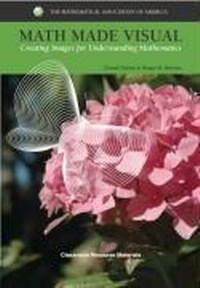
Math Made Visual
Creating Images for Understanding Mathematics
Published on 6. July 2006
Book
Hardback
190 pages
978-0-88385-746-5 (ISBN)
Description
The object of this book is to show how visualization techniques may be employed to produce pictures that have interest for the creation, communication and teaching of mathematics. Mathematical drawings related to proofs have been produced since antiquity in China, Arabia, Greece and India but only in the last thirty years has there been a growing interest in so-called 'proofs without words.' In this book the authors show that behind most of the pictures 'proving' mathematical relations are some well-understood methods. The first part of the book consists of twenty short chapters, each one describing a method to visualize some mathematical idea (a proof, a concept, an operation,.) and several applications to concrete cases. Following this the book examines general pedagogical considerations concerning the development of visual thinking, practical approaches for making visualizations in the classroom and a discussion of the role that hands-on material plays in this process.
More details
Content
Introduction; Part I. Visualizing Mathematics by Creating Pictures: 1. Representing numbers by graphical elements; 2. Representing numbers by lengths of segments; 3. Representing numbers by areas of plane figures; 4. Representing numbers by volumes of bodies; 5. Identifying key elements; 6. Employing isometry; 7. Employing similarity; 8. Area preserving transformations; 9. Escaping from the plane; 10. Overlaying tiles; 11. Playing with several copies; 12. Sequential frames; 13. Geometric dissections; 14. Moving frames; 15. Iterative procedures; 16. Introducing colors; 17. Visualization by inclusion; 18. Ingenuity in 3D; 19. Using 3D models; 20. Combining techniques; Part II. Visualization in the Classroom; Part III. Hints and Solutions to the Challenges; References; Index.