

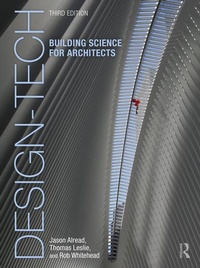
Design-Tech: Building Science for Architects
3rd Edition
Published on 18. March 2025
Book
Hardback
450 pages
978-1-032-44285-3 (ISBN)
Description
The third edition of Design-Tech provides an indispensable, holistic resource for integrating building technologies into critically designed, performance-based architectural projects. The book's format follows the developmental stages of a typical architectural project; it provides a step-by-step process for addressing and integrating building sciences from first principles of human comfort, materials, structures, and environmental systems to advanced construction systems and measures of building performance. Short chapters incorporate easy-to-understand information with hundreds of useful illustrations, tables, and references that explain the why as well as the how of building science. The content focuses on what designers need to know in the studio to create sustainably designed, integrated buildings, and it prepares them for future discussions with engineers, contractors, and consultants.
The updated format builds a coherent framework for integrated project design studio development, necessary for all contemporary accredited schools of architecture. Chapters build upon critical project information from schematics toward technical integration. New chapters emphasize performance-based design strategies including sustainable design values, critical schematic planning, enhanced building envelope design strategies, and advanced performance systems. Enhanced visualization of schematic design strategies helps explain sustainable design standards, code compliance, and structural schematics, and throughout, the third edition focuses on contemporary issues such as embodied carbon, heavy timber construction, life cycle costs, and long-term performance.
This will be a must-read for all architecture students looking for an accessible guide to building science.
The updated format builds a coherent framework for integrated project design studio development, necessary for all contemporary accredited schools of architecture. Chapters build upon critical project information from schematics toward technical integration. New chapters emphasize performance-based design strategies including sustainable design values, critical schematic planning, enhanced building envelope design strategies, and advanced performance systems. Enhanced visualization of schematic design strategies helps explain sustainable design standards, code compliance, and structural schematics, and throughout, the third edition focuses on contemporary issues such as embodied carbon, heavy timber construction, life cycle costs, and long-term performance.
This will be a must-read for all architecture students looking for an accessible guide to building science.
More details
Edition
3rd edition
Language
English
Place of publication
London
United Kingdom
Publishing group
Taylor & Francis Ltd
Target group
College/higher education
Undergraduate
Product notice
sewn/stitched
Cloth over boards
Illustrations
475 s/w Abbildungen, 174 s/w Photographien bzw. Rasterbilder, 301 s/w Zeichnungen, 11 s/w Tabellen
11 Tables, black and white; 301 Line drawings, black and white; 174 Halftones, black and white; 475 Illustrations, black and white
Dimensions
Height: 280 mm
Width: 210 mm
Weight
1760 gr
ISBN-13
978-1-032-44285-3 (9781032442853)
Copyright in bibliographic data and cover images is held by Nielsen Book Services Limited or by the publishers or by their respective licensors: all rights reserved.
Schweitzer Classification
Other editions
Additional editions
Jason Alread | Thomas Leslie | Rob Whitehead
Design-Tech: Building Science for Architects
E-Book
03/2025
3rd Edition
Routledge
€74.99
Available for download
Jason Alread | Thomas Leslie | Rob Whitehead
Design-Tech: Building Science for Architects
E-Book
03/2025
3rd Edition
Routledge
€74.99
Available for download
Jason Alread | Thomas Leslie | Rob Whitehead
Design-Tech: Building Science for Architects
Book
03/2025
3rd Edition
Routledge
€70.50
Shipment within 10-20 days
Previous edition

Book
02/2014
2nd Edition
Routledge
€282.26
Article exhausted; check for reprint
Persons
Jason Alread, AIA, LEED AP, is a Professor and the former Director of the School of Architecture at the University of Florida. He was educated at UF and Yale University and has been a registered architect in professional practice for over 30 years. His teaching and research focus on the integration of craft and technology, building performance, design methodologies, and professional practice.
Thomas Leslie, FAIA, teaches building design, history, and technology at the University of Illinois, Urbana-Champaign. Leslie received degrees in architecture from Illinois and Columbia and spent seven years with Norman Foster + Partners, London, and San Francisco. He has written extensively on the history of building arts and sciences.
Rob Whitehead, FAIA, LEED AP, is a licensed architect, an Associate Professor of Architecture, and an Associate Dean at Iowa State University's College of Design. His teaching experience includes integrated design studios, design-build courses, and an award-winning structural design course sequence at Iowa State University. His book Structures by Design: Thinking, Making, Breaking has been adopted worldwide.
Thomas Leslie, FAIA, teaches building design, history, and technology at the University of Illinois, Urbana-Champaign. Leslie received degrees in architecture from Illinois and Columbia and spent seven years with Norman Foster + Partners, London, and San Francisco. He has written extensively on the history of building arts and sciences.
Rob Whitehead, FAIA, LEED AP, is a licensed architect, an Associate Professor of Architecture, and an Associate Dean at Iowa State University's College of Design. His teaching experience includes integrated design studios, design-build courses, and an award-winning structural design course sequence at Iowa State University. His book Structures by Design: Thinking, Making, Breaking has been adopted worldwide.
Content
Section 1: Pre-Design: First Principles of Integrating Design Technology 1.0. Design Values and Purposeful Integration of Building Technology 1.1. Design for People: Anthropomorphics and Comfort 1.2. Design for Place: Climatology, Solar Geometry, Site Ecology, and Site Analysis 1.3. Design with Materials: Properties, Assessment, Selection, Planning, and Sustainability Section 2: Schematic Design: Planning and Priorities 2.0. Schematic Design, Planning, and Priorities for Integrating Technology 2.1. Programming, Zoning, and Parti 2.2. Building Relationship to Environment: Passive Ventilation and Daylighting 2.3. Material Properties: Timber, Masonry, Metal, Glass, Concrete, and Composites 2.4. Structural Schematics: Shaping Form, Space, and Order 2.5. Structural Systems: Principles of Support, Framing, and Force Flow 2.6. Circulation: Life Safety, Accessibility, and Vertical Transport Section 3: Design Development: Putting It Together 3.0. Strategies for Integrated Development 3.1. Evaluating Structures: Understanding Strength, Stiffness, Suitability, and Stability 3.2. Structural Materials and Assemblies: Load Grounders, Collectors, and Stabilizers 3.3. Building Enclosure: Envelope and Curtain Walls 3.4. Interior Finish Materials: Walls, Ceilings, and Floors 3.5. Mechanical, Electrical, and Plumbing Systems 3.6. Sensory Environments: Acoustics and Lighting Section 4: Advanced Integration: Designing for Performance 4.0. Performance and Integration 4.1. Detailing: Fit, Organization, Consistency, Robustness, Durability, and Finish 4.2. Long-Span Structures: Trusses, Shells, and Lightweight Structural Systems 4.3. High Rise Structures 4.4. High-Performance Buildings: Principles of Passive House and Net-Zero Design