

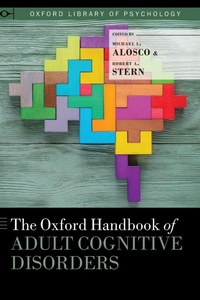
The Oxford Handbook of Adult Cognitive Disorders
Published on 20. June 2019
Book
Hardback
946 pages
978-0-19-066412-1 (ISBN)
Description
The prevalence of adult cognitive disorders will dramatically rise over the next 25 years due to the aging population. Clinical research on adult cognitive disorders has rapidly evolved, including evidence of new adult cognitive disorders and greater insight into the clinical presentation, mechanism, diagnosis, and treatment of established diseases.
The Oxford Handbook of Adult Cognitive Disorders is an up-to-date, scholarly, and comprehensive volume covering most diseases, conditions, and injuries resulting in impairments in cognitive function in adults. Topics covered include normal cognitive and brain aging, the impact of medical disorders and psychiatric illnesses on cognitive function, adult neurodevelopmental disorders, and various neurological conditions. This Handbook also provides a section on unique perspectives and special considerations for clinicians and clinical researchers, covering topics such as cognitive reserve, genetics, diversity, and neuroethics. Readers will be able to draw upon this volume to facilitate clinical practice (including differential diagnosis, treatment recommendations, assessment practices), and to obtain an in-depth review of current research across a wide spectrum of disorders, provided by leaders in their fields. The Oxford Handbook of Adult Cognitive Disorders is a one-of a kind resource appropriate for both clinicians and clinical researchers, from advanced trainees to seasoned professionals.
The Oxford Handbook of Adult Cognitive Disorders is an up-to-date, scholarly, and comprehensive volume covering most diseases, conditions, and injuries resulting in impairments in cognitive function in adults. Topics covered include normal cognitive and brain aging, the impact of medical disorders and psychiatric illnesses on cognitive function, adult neurodevelopmental disorders, and various neurological conditions. This Handbook also provides a section on unique perspectives and special considerations for clinicians and clinical researchers, covering topics such as cognitive reserve, genetics, diversity, and neuroethics. Readers will be able to draw upon this volume to facilitate clinical practice (including differential diagnosis, treatment recommendations, assessment practices), and to obtain an in-depth review of current research across a wide spectrum of disorders, provided by leaders in their fields. The Oxford Handbook of Adult Cognitive Disorders is a one-of a kind resource appropriate for both clinicians and clinical researchers, from advanced trainees to seasoned professionals.
Reviews / Votes
This is as close to an exhaustive treatise on adult cognitive disorders as seems possible. Each chapter outlines what is known about the discussed disorder as well as its etiology, symptoms and treatmentsthe result is a veritable diagnostic and treatment manual specific to adult cognitive disorders. The work concludes with a seven-chapter section on perspectives and considerations for the clinical researcher; these chapters should lead to many future directions in the research surrounding these disorders. Highly recommended for professionals and practitioners. * CHOICE * This is a comprehensive look at adult cognitive disorders, written by an international collection of experts in the field. Clinical psychologists, neuropsychologists, and researchers will benefit greatly from this book - 5 Stars! * Gary B Kaniuk, Psy.D.(Cermak Health Services), Doody's * This unique book will serve as a useful resource for trainees as well as seasoned clinicians and researchers interested in brain-behavior relationships across the spectrum of adult neuromedical conditions. * C. Munro Cullum, PhD, ABPP, Professor of Psychiatry, Neurology, and Neurological Surgery, University of Texas Southwestern Medical Center * Drs. Alosco and Stern have produced a tour-de-force of a handbook that should be within easy reach of every clinician and researcher who deals with cognitive disorders. Each chapter, written by an expert in the field, is self-contained but also forms part of a whole that is indispensable for students, clinicians, and researchers. Nowhere else can you get all this information in a single volume. * Andrew E. Budson, MD, Professor of Neurology, Boston University School of Medicine & Author of Seven Steps to Managing Your Memory: What's Normal, What's Not, and What to Do About It. *More details
Series
Language
English
Place of publication
New York
United States
Target group
Professional and scholarly
College/higher education
Dimensions
Height: 260 mm
Width: 183 mm
Thickness: 55 mm
Weight
1936 gr
ISBN-13
978-0-19-066412-1 (9780190664121)
Copyright in bibliographic data and cover images is held by Nielsen Book Services Limited or by the publishers or by their respective licensors: all rights reserved.
Schweitzer Classification
Other editions
Additional editions
Michael L. Alosco | Robert A. Stern
The Oxford Handbook of Adult Cognitive Disorders
E-Book
05/2019
1st Edition
OUP eBook
€207.99
Available for download
Michael L. Alosco | Robert A. Stern
The Oxford Handbook of Adult Cognitive Disorders
E-Book
05/2019
1st Edition
OUP eBook
€207.99
Available for download
Persons
Michael L. Alosco, PhD, is a licensed clinical neuropsychologist and an Assistant Professor of Neurology at the Boston University School of Medicine. Dr. Alosco has more than 110 peer-reviewed publications, numerous book chapters, has received several federal and non-federal grants, is the recipient of a National Institutes of Health K23 Career Development Award, has received multiple awards from international professional organizations, and has been clinically trained in adult neuropsychology at some of the leading institutions across the country. His clinical experiences with adult cognitive disorders are diverse, ranging from outpatient memory clinics to inpatient psychiatry, and forensic settings.
Robert A. Stern, PhD, is a licensed clinical neuropsychologist and a Professor of Neurology, Neurosurgery, and Anatomy & Neurobiology, at Boston University (BU) School of Medicine, where he is also the Clinical Core Director of the BU Alzheimer's Disease Center and Co-Founder and Director
of Clinical Research for the BU CTE Center. Dr. Stern is an international leader in neuropsychology and clinical neuroscience and has an extensive publication record. He has had continuous grant support for over 25 years, and has developed widely used neuropsychological instruments, including the Neuropsychological Assessment Battery (NAB). He is also a pioneer clinical researcher in the field of chronic traumatic encephalopathy (CTE) and has received several grants from National Institutes of Health, the Department of Defense, and private industry to develop methods for detecting and diagnosing CTE during life.
Robert A. Stern, PhD, is a licensed clinical neuropsychologist and a Professor of Neurology, Neurosurgery, and Anatomy & Neurobiology, at Boston University (BU) School of Medicine, where he is also the Clinical Core Director of the BU Alzheimer's Disease Center and Co-Founder and Director
of Clinical Research for the BU CTE Center. Dr. Stern is an international leader in neuropsychology and clinical neuroscience and has an extensive publication record. He has had continuous grant support for over 25 years, and has developed widely used neuropsychological instruments, including the Neuropsychological Assessment Battery (NAB). He is also a pioneer clinical researcher in the field of chronic traumatic encephalopathy (CTE) and has received several grants from National Institutes of Health, the Department of Defense, and private industry to develop methods for detecting and diagnosing CTE during life.
Content
- Part I. INTRODUCTION
- 1. Overview of the Oxford Handbook of Adult Cognitive Disorders
- Michael L. Alosco and Robert A. Stern
- 2. Normal Cognitive and Brain Aging
- Stephanie L. Leal and Michael A. Yassa
- PART II. THE SPECTRUM OF ADULT COGNITIVE DISORDERS
- Medical Disorders and Neurocognition
- 3. HIV-Associated Neurocognitive Disorders (HAND)
- Jennifer E. Iudicello, Erin E. Morgan, Mariam A. Hussain, C. Wei-Ming Watson, and Robert K. Heaton
- 4. Cancer and Cancer Treatment Related Cognitive Impairment
- James C. Root, Elizabeth Ryan, and Tim A. Ahles
- 5. Effects of Cardiovascular Disease and Related Risk Factors on Neurocognition
- Spencer W. Liebel and Lawrence H. Sweet
- 6. Type 1 and Type 2 Diabetes and the Brain
- Olga Neyman and Tamara Hershey
- 7. Chronic Kidney Disease and Neurocognition
- David A. Drew and Daniel E. Weiner
- 8. Cognitive Impairment in Liver Disease
- Ganesh Pantham and Kevin D. Mullen
- 9. Pulmonary Disorders
- Sachelle Ruickbie, Charles Sharp, and James W. Dodd
- 10. Neurocognition in Menopause and Reproductive Disorders
- Kelly N. Morgan, Kejal Kantarci, Sanjay Asthana, and Cary E. Gleason
- 11. Neurotoxicant Exposures
- Roberta F. White, Caitlin Brand, Birgit Claus Henn, and Patricia A. Janulewicz
- Psychiatric Disorders and Neurocognition
- 12. Cognitive Function in Mood and Anxiety Disorders
- Hannah R. Snyder and Benjamin L. Hankin
- 13. Neuropsychology of PTSD
- Jennifer J. Vasterling and Gabriel S. Walt
- 14. Cognition in Schizophrenia-Spectrum and Other Psychotic Disorders
- Martin Strassnig and Philip D. Harvey
- 15. Alcohol Use Disorder: Permanent and Transient Effects on the Brain and Neuropsychological Functions
- Anne-Pascale Le Berre, Alice Laniepce, Shailendra Segobin, Anne-Lise Pitel, and Edith V. Sullivan
- 16. Sleep Disorders and Neurocognition
- Alexandra M. Villagran and Michael K. Scullin
- Adult Neurodevelopmental Disorders
- 17. Autism Spectrum Disorders in Adults
- Charlotte M. Pretzsch, James L. Findon, and Prof. Declan G. Murphy
- 18. Cognition, Aging and the Development of Dementia in Down Syndrome
- Allison Caban-Holt, David K. Powell, Amelia J. Anderson-Mooney, William Robertson, Donita Lightner, Frederick A. Schmitt, and Elizabeth Head
- 19. Adult Attention Deficit Hyperactivity Disorder (ADHD)
- Beth Krone, Amanda Kirschenbaum, Thomas Yang, Amy Glick, Alexander Newcorn, and Jeffrey H. Newcorn
- Neurological Disorders
- 20. Cognitive Functions in Patients with Brain Tumors
- Denise D. Correa
- 21. Hydrocephalus
- Aamir A. Khan, David Solomon, and Abhay R. Moghekar
- 22. Seizure Disorders
- Danny M. Tam and William B. Barr
- 23. Multiple Sclerosis
- Brian M. Sandroff and John DeLuca
- 24. Traumatic Brain Injury
- Irene Cristofori and Jordan Grafman
- 25. Concussion
- Breton M. Asken and Michael A. McCrea
- 26. Alzheimer's Disease
- Dorene M. Rentz, Irina Orlovsky, Emily Kilpatrick, and Kathryn V. Papp
- 27. The Spectrum of Cerebrovascular Disease and Associated Cognitive Decline
- Victoria J. Williams, Steven E. Arnold, and David H. Salat
- 28. Parkinson's Disease and Parkinson-Plus Syndromes
- Alice Cronin-Golomb, Gretchen O. Reynolds, Robert D. Salazar, and Marie-Hélène Saint-Hilaire
- 29. Chronic Traumatic Encephalopathy
- Jason W. Adams, Ian Mahar, and Ann C. McKee
- 30. Huntington Disease
- Jane S. Paulsen
- 31. Frontotemporal Dementia
- Andrea G. Alioto, Christie C. Mead, Alicia B. Vanden Bussche, Adam M. Staffaroni, and Joel H. Kramer
- 32. Rapidly Progressive Dementia: Human Prion Diseases and An Approach for Evaluating Non-Prion Etiologies
- David N. Soleimani-Meigooni and Michael D. Geschwind
- 33. Alcohol Dementia, Wernicke's Encephalopathy, and Korsakoff's Syndrome
- Marlene Oscar-Berman and Nasim Maleki
- PART III: PERSPECTIVES AND CONSIDERATIONS FOR THE CLINICAL RESEARCHER IN ADULT COGNITIVE DISORDERS
- 34. Overview of the Reserve Concept in the Context of Cognitive Aging
- Preeti Sunderaraman and Yaakov Stern
- 35. Overview of the Reserve Concept in the Context of Cognitive Aging
- Robin C. Hilsabeck and Beth C. Arredondo
- 36. Genetics of Adult Cognitive Disorders
- Laney Evers, Courtney Verscaj, and Jesse Mez
- 37. Applications of Neuropathological Examination in Adult Cognitive Disorders
- Thor D. Stein, Victor E. Alvarez, and Bertrand R. Huber
- 38. Considerations for Translational Research in the Study of Adult Cognitive Disorders
- Erich S. Franz, Sarah E. Rind, and Lee E. Goldstein
- 39. Issues of Diversity in Cognitive Aging: A Focus on Older African Americans
- Lisa L. Barnes
- 40. Ethical Issues in Adult Cognitive Disorders
- Andrea Horwege, Thomas Hammeke, Anita Sue Jwa, and Allyson C. Rose