

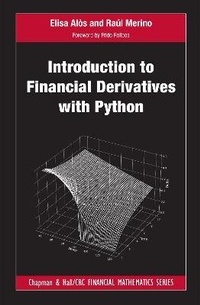
Introduction to Financial Derivatives with Python
1st Edition
Published on 15. December 2022
Book
Hardback
228 pages
978-1-032-21103-9 (ISBN)
Description
Introduction to Financial Derivatives with Python is an ideal textbook for an undergraduate course on derivatives, whether on a finance, economics, or financial mathematics programme. As well as covering all of the essential topics one would expect to be covered, the book also includes the basis of the numerical techniques most used in the financial industry, and their implementation in Python.
Features
Connected to a Github repository with the codes in the book. The repository can be accessed at https://bit.ly/3bllnuf
Suitable for undergraduate students, as well as anyone who wants a gentle introduction to the principles of quantitative finance
No pre-requisites required for programming or advanced mathematics beyond basic calculus
Features
Connected to a Github repository with the codes in the book. The repository can be accessed at https://bit.ly/3bllnuf
Suitable for undergraduate students, as well as anyone who wants a gentle introduction to the principles of quantitative finance
No pre-requisites required for programming or advanced mathematics beyond basic calculus
More details
Series
Language
English
Place of publication
Oxford
United Kingdom
Publishing group
Taylor & Francis Ltd
Target group
College/higher education
Academic
Illustrations
91 s/w Zeichnungen, 91 s/w Abbildungen
91 Line drawings, black and white; 91 Illustrations, black and white
Dimensions
Height: 234 mm
Width: 156 mm
Weight
526 gr
ISBN-13
978-1-032-21103-9 (9781032211039)
Copyright in bibliographic data and cover images is held by Nielsen Book Services Limited or by the publishers or by their respective licensors: all rights reserved.
Schweitzer Classification
Other editions
Additional editions
Elisa Alos | Raul Merino
Introduction to Financial Derivatives with Python
E-Book
12/2022
1st Edition
Chapman & Hall/CRC
€115.99
Available for download
Elisa Alos | Raul Merino
Introduction to Financial Derivatives with Python
E-Book
12/2022
1st Edition
Chapman & Hall/CRC
€115.99
Available for download
Persons
Elisa Alos holds a Ph.D. in Mathematics from the University of Barcelona. She is an Associate Professor in the Department of Economics and Business at Universitat Pompeu Fabra (UPF) and a Barcelona GSE Affiliated Professor. Her research focus has been on the applications of the Malliavin calculus and the fractional Brownian motion in mathematical finance and volatility modelling since he past fourteen years.
Raul Merino has been working full-time in the industry as Risk Quant since 2008. He is also an Associate Professor at Pompeu Fabra University (UPF) where he teaches the course "Financial Derivatives and Risk Management". Raul holds a Ph.D. in Mathematics from the University of Barcelona. In his Ph.D. he studied the use of decomposition formulas in stochastic volatility models. His research interests are stochastic analysis and applied mathematics, with a special focus on applications to mathematical finance.
Raul Merino has been working full-time in the industry as Risk Quant since 2008. He is also an Associate Professor at Pompeu Fabra University (UPF) where he teaches the course "Financial Derivatives and Risk Management". Raul holds a Ph.D. in Mathematics from the University of Barcelona. In his Ph.D. he studied the use of decomposition formulas in stochastic volatility models. His research interests are stochastic analysis and applied mathematics, with a special focus on applications to mathematical finance.
Content
1. Introduction. 1.1. Financial Markets. 1.2. Derivatives. 1.3. Time has a Value. 1.4. No-Arbitrage Principle. 1.5. Chapter's Digest. 1.6. Exercises. 2. Futures and Forwards. 2.1. Forward Contracts: Definitions. 2.2. Futures. 2.3. Why to use Forwards and Futures? 2.4. The Fair Delivery Price: The Forward Price. 2.5. Chapter's Digest. 2.6. Exercises. 3. Options. 3.1. Call and Put Options. 3.2. The Intrinsic Value of an Option. 3.3. Some Properties of Option Prices. 3.4. Speculation with Options. 3.5. Some Classical Strategies. 3.6. Draw your Strategy with Python. 3.7. Chapter's Digest. 3.8. Exercises. 4. Exotic Options. 4.1. Binary Options. 4.2. Forward Start Options. 4.3. Path-Dependent Options. 4.4. Spread and Basket Options. 4.5. Bermuda Options. 4.6. Chapter's Digest. 4.7. Exercises. 5. The Binomial Model. 5.1. The Single-Period Binomial Model. 5.2. The Multi-Period Binomial Model. 5.3. The Greeks in the Binomial Model. 5.4. Coding the Binomial Model. 5.5. Chapter's Digest. 5.6. Exercises. 6. A Continuous-Time Pricing Model. 6.1. Creating Some Intuition. 6.2. The Black-Scholes-Merton Framework. 6.3. THE BLACK-SCHOLES-MERTON EQUATION. 6.4. The Black-Scholes-Merton Formula. 6.5. The Black-Scholes-Merton Model from a Probabilistic Perspective. 6.6. The Black-Scholes-Merton Price and the Binomial Price. 6.7. The Greeks in the Black-Scholes-Merton Model. 6.8. Other Assets. 6.9. Drawbacks of the Black-Scholes-Merton Model. 6.10. Chapter's Digest. 6.11. Exercises. 7. Monte Carlo Methods. 7.1. The Need of General Option Pricing Tools. 7.2. Mathematical Foundations of Monte Carlo Methods. 7.3. Option Pricing with Monte Carlo Methods. 7.4. European Options that Depend on the Final Price of Two Assets. 7.5. Chapter's Digest. 7.6. Exercises. 8. The Volatility. 8.1. Historical Volatilities. 8.2. The Spot Volatility. 8.3. The Implied Volatility. 8.4. Chapter's Digest. 8.5. Exercises. 9. Replicating Portfolios. 9.1. Replicating Portfolios for the Binomial Model. 9.2. Replicating Portfolios for the Black-Scholes-Merton Model. 9.3. Chapter's Digest. 9.4. Exercises.