

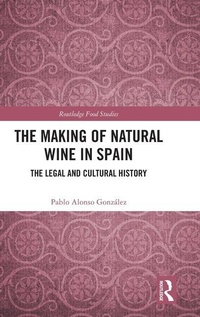
The Making of Natural Wine in Spain
The Legal and Cultural History
1st Edition
Will be published approx. on 9. July 2026
Book
Hardback
176 pages
978-1-041-31222-2 (ISBN)
Description
This book explains how "natural wine" was made and not discovered by Spanish lawmakers, chemists, merchants, and theologians, showing how Spain consolidated a legal construct that normalised specific technical interventions while preserving the label natural.
The book argues that wine labelled as "natural" was not the preservation of a traditional product, but the product of a legal fiction that allowed wines with additives to be normalized and protected under law. In doing so, the book explores the emergence and changing meanings of natural wine. Rather than providing a fixed definition, it analyzes how the boundaries of "natural" shifted from period to period. It shows how natural wine ended up being used in the historical-legal sense that crystallised in late-nineteenth- and early-twentieth-century Spain and culminated in 1932. Through detailed archival research, the book explores debates around adulteration, chemistry, purity, and authenticity, using historical food studies and legal analysis as its framework. It introduces the Spanish case as a significant but overlooked moment in the broader European shift toward legally codified standards of food authenticity and quality. Drawing primarily on the work of Alessandro Stanziani and influenced by Bruno Latour's perspective on scientific authority and socio-technical networks, the book bridges the fields of legal history, enology, and cultural politics. This historical analysis sheds light on contemporary controversies surrounding wine regulation, appellation systems, and the global natural wine movement.
The book will be of great interest to students and scholars of food and wine studies, legal and economic history, anthropology, science and technology studies and European agrarian history.
The book argues that wine labelled as "natural" was not the preservation of a traditional product, but the product of a legal fiction that allowed wines with additives to be normalized and protected under law. In doing so, the book explores the emergence and changing meanings of natural wine. Rather than providing a fixed definition, it analyzes how the boundaries of "natural" shifted from period to period. It shows how natural wine ended up being used in the historical-legal sense that crystallised in late-nineteenth- and early-twentieth-century Spain and culminated in 1932. Through detailed archival research, the book explores debates around adulteration, chemistry, purity, and authenticity, using historical food studies and legal analysis as its framework. It introduces the Spanish case as a significant but overlooked moment in the broader European shift toward legally codified standards of food authenticity and quality. Drawing primarily on the work of Alessandro Stanziani and influenced by Bruno Latour's perspective on scientific authority and socio-technical networks, the book bridges the fields of legal history, enology, and cultural politics. This historical analysis sheds light on contemporary controversies surrounding wine regulation, appellation systems, and the global natural wine movement.
The book will be of great interest to students and scholars of food and wine studies, legal and economic history, anthropology, science and technology studies and European agrarian history.
Reviews / Votes
"The Making of Natural Wine in Spain reveals that today's 'natural wine' debate is anything but new. Through meticulous research, Pablo Alonso traces its legal and cultural roots back more than 150 years, transforming a contemporary controversy into a compelling modern history of wine, authenticity, and regulation."Clara Isamat, Sommelier and natural wine communicator
"In Pablo Alonso Gonzalez's capable hands, the question of natural wine emerges as a question about nature itself. A meticulously but engagingly told story."
Michael Herzfeld, Ernest E. Monrad Professor of the Social Sciences Emeritus in the Department of Anthropology at Harvard University Preface
"This volume marks the brilliant culmination of Gonzalez's indefatigable study of natural wine, seamlessly interweaving historical, anthropological, legal, and cultural strands. The insights drawn from Gonzalez's nuanced treatment of Spain, showcased here, will be of broad interest to scholars of wine history across regions and traditions."
Kevin D. Goldberg, Historian, contributor to The Wine Atlas of Germany
More details
Series
Language
English
Place of publication
London
United Kingdom
Publishing group
Taylor & Francis Ltd
Target group
College/higher education
Professional and scholarly
Academic, Postgraduate, and Undergraduate Advanced
Illustrations
8 s/w Photographien bzw. Rasterbilder, 8 s/w Abbildungen
8 Halftones, black and white; 8 Illustrations, black and white
Dimensions
Height: 234 mm
Width: 156 mm
ISBN-13
978-1-041-31222-2 (9781041312222)
Copyright in bibliographic data and cover images is held by Nielsen Book Services Limited or by the publishers or by their respective licensors: all rights reserved.
Schweitzer Classification
Other editions
Additional editions
E-Book
approx. 07/2026
Routledge
€60.49
Available for download
E-Book
approx. 07/2026
Routledge
€60.49
Available for download
Person
Pablo Alonso Gonzalez is Senior Researcher at the Spanish National Research Council (IPNA-CSIC), where he leads the Social Sciences, Heritage and Food Research Group (SOCIALPAT). He specialises in wine history, food regulation and cultural heritage, and is the author of Uncorked: Negotiating Science and Belief in the Natural Wine Movement (2025). He has been awarded a prestigious Consolidator Grant by the European Research Council and is member of the Spanish Science Academy (AJE).
Content
1. Introduction 2. From Protectionism to Free Trade (And to Enological Awakening): The Redefinition of Wine 'Adulteration' (1849-1860) 3. The Rise of Artificial Wine in Spain and the Paradigm of Public Health (1860-1890) 4. Artificial Wine is Prohibited. Long Live Artificial Wine! The 1890-1895 Debate 5. What Madrid Drinks: Wines, Fraud and Public Health 6. Legislating Authenticity: Wine, Science and the State in Spain (1895-1915) 7. Resistance to Artifice: Vitalism and the Defense of Natural Wine 'Without Additives' 8. Natural by Law: The Politics of Industrial Wine in Spain, 1915-1932 9. Conclusion