

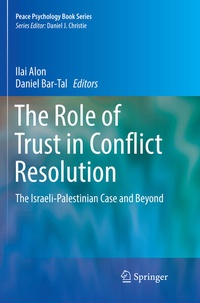
The Role of Trust in Conflict Resolution
The Israeli-Palestinian Case and Beyond
Published on 12. July 2018
Book
Paperback/Softback
XXVI, 345 pages
978-3-319-82800-8 (ISBN)
Description
Built on the premise that trust is one of the most important factors in intergroup relations, conflict management and resolution at large, this volume explores trust and its mechanisms and operations especially in the Israeli-Palestinian conflict. Significantly, this volume focuses not only on the nature of trust and distrust in the Israeli-Palestinian conflict, but it also explores how it is possible to build and increase trust on both sides in the conflict, a necessity in order to advance the stalled peace process.
As trust is a concept that is interdisciplinary by nature, so are this volume's contributors: sociologists, philosophers, sociologists, social psychologists, political scientists, as well as experts in the Middle East, Islam, Judaism and the Israeli-Palestinian conflict bring together real multidisciplinary perspectives that complement each other and then provide a comprehensive picture about the nature of trust and distrust and its ramification and implications for the Israeli-Palestinian conflict. Divided into five thematic parts, the volume begins with by examining the theoretical basis of trust research from multiple perspectives. Then, it presents chapters on trust, distrust, and trust-building in other conflicts around the world. The third part is a unique feature of this volume as it takes a contextual approach: it emphasizes the importance of particular cultural and religious considerations on both sides of the conflict. The thrust of the book is examined in the next section. Part IV discusses and analyses various aspects of trust, and specifically distrust, in the context of the Israeli-Palestinian conflict. Significantly, the chapters of this part take the perspectives of the participants in the conflict: Israeli Jews, Palestinians and Israeli Arabs.
Finally, the volume concludes by providing an integrative conceptual perspective based on the principles of social andpolitical psychology. An important goal of this volume is to not only explore trust and distrust in an intractable conflict, but also to provide practical multi-disciplinary outlooks and implications to advance trust building in two conflict ridden societies-Israeli and Palestinian, and other societies around the world.
As trust is a concept that is interdisciplinary by nature, so are this volume's contributors: sociologists, philosophers, sociologists, social psychologists, political scientists, as well as experts in the Middle East, Islam, Judaism and the Israeli-Palestinian conflict bring together real multidisciplinary perspectives that complement each other and then provide a comprehensive picture about the nature of trust and distrust and its ramification and implications for the Israeli-Palestinian conflict. Divided into five thematic parts, the volume begins with by examining the theoretical basis of trust research from multiple perspectives. Then, it presents chapters on trust, distrust, and trust-building in other conflicts around the world. The third part is a unique feature of this volume as it takes a contextual approach: it emphasizes the importance of particular cultural and religious considerations on both sides of the conflict. The thrust of the book is examined in the next section. Part IV discusses and analyses various aspects of trust, and specifically distrust, in the context of the Israeli-Palestinian conflict. Significantly, the chapters of this part take the perspectives of the participants in the conflict: Israeli Jews, Palestinians and Israeli Arabs.
Finally, the volume concludes by providing an integrative conceptual perspective based on the principles of social andpolitical psychology. An important goal of this volume is to not only explore trust and distrust in an intractable conflict, but also to provide practical multi-disciplinary outlooks and implications to advance trust building in two conflict ridden societies-Israeli and Palestinian, and other societies around the world.
More details
Series
Edition
Softcover reprint of the original 1st ed. 2016
Language
English
Place of publication
Cham
Switzerland
Publishing group
Springer International Publishing
Target group
Professional and scholarly
Illustrations
3 s/w Abbildungen, 9 farbige Abbildungen
XXVI, 345 p. 12 illus., 9 illus. in color.
Dimensions
Height: 235 mm
Width: 155 mm
Thickness: 21 mm
Weight
563 gr
ISBN-13
978-3-319-82800-8 (9783319828008)
DOI
10.1007/978-3-319-43355-4
Schweitzer Classification
Other editions
Additional editions
Ilai Alon | Daniel Bar-Tal
The Role of Trust in Conflict Resolution
The Israeli-Palestinian Case and Beyond
Book
03/2017
Springer
€106.99
Shipment within 10-15 days
Persons
Dr. Ilai Alon is a retired associate professor at Tel Aviv University's departmet of philosophy. Education at the Hebrew University and Oxford University, Wolfosn College (1968-1970.) The major topics - (1) Arabic language and literature; (2) Philosophy. He served as a visiting researcher at Stanford University, and as a visiting professor at Princeton, Harvard, Lehigh (Pennsylvania,) Carlton (Ottawa.)
Dr. Daniel Bar-Tal is Branco Weiss Professor of Research in Child Development and Education at the School of Education, Tel Aviv University. His research interest is in political and social psychology studying socio-psychological foundations of intractable conflicts and peace building, as well as development of political understanding among children and peace education.
Dr. Daniel Bar-Tal is Branco Weiss Professor of Research in Child Development and Education at the School of Education, Tel Aviv University. His research interest is in political and social psychology studying socio-psychological foundations of intractable conflicts and peace building, as well as development of political understanding among children and peace education.
Content
Trust and Distrust: Introduction Alon, Ilai and Bar-Tal, Daniel Part I - Theoretical Aspects: Trust in Conflict Resolution1. The Philosophy of TrustAgassi, Joseph 2. Two Theoretical Approaches to Trust - Their Implications for the Resolution of Intergroup ConflictSztompka, Piotr 3. Effects of Expectations, Type of Relationship and Prior Injustice on Trust Honoring: A Strategic-Experimental ApproachSuleiman, Ramzi Part II - the Comparative Aspect: How was Trust been reached in other Conflicts.4. Lessons learned on Trust Building in Northern IrelandFitzduff, Mari 5. Determinants of Post-Conflict Trust: The Role of Ethnic Identity, Personal and Collective Victimization and Intergroup EmotionsCorkalo Biruski, Dinka Part III - the Cultural-Religious Aspect: Trust in Islam and Judaism6. Some Comments on Language as A Barrier to Trust in Arabic-Speaking IslamAlon, Ilai 7. Usual Suspects: On Trust, Doubt and Ethnicity in the MishnahRosen-Zvi, Ishay Part IV - Trust in the Israeli - Palestinian Conflict8. Trust and Mistrust in Israeli Peace-MakingGolan, Galia 9. The Role of Trust in the Arab-Israeli ConflictYuchtman-Yaar, Ephraim 10. Trust and Negotiations: Israel and the Palestinians, 2009-2016Tzoreff, Yohanan 11. Lay Psychology of Trust/Distrust and beyond in the Context of an Intractable Conflict: the Case of Israeli JewsBar-Tal, Daniel; Amiram Raviv, Paz Shapira, and Dennis Kahn12. Lack of Trust as a Barrier to Reconciliation in the Israeli-Palestinian Conflict: Attitudes of Israeli (Jewish) Elite Members toward Reconciliation with the PalestiniansAuerbach, Yehudith 13. Historical Narratives and the Issue of TrustSusser, Asher 14. Trust and Confidence Building in the Israeli Palestinian Peace NegotiationsSalem, Walid 15. Trust, Ethics andIntentionality in Conflict Transformation and ReconciliationJamal, Amal 16. Distrust and Discord on the Israeli-Arab Conflict between Arabs and Jews in IsraelSmooha, Sammy Part V - Lessons and ConclusionsSocio-Psychological Approach to Trust (or Distrust): Concluding Comments Bar-Tal, Daniel and Alon, Ilai