

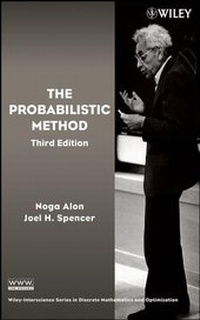
The Probabilistic Method
3rd Edition
Published on 22. August 2008
Book
Hardback
376 pages
978-0-470-17020-5 (ISBN)
Description
Praise for the Second Edition:
"Serious researchers in combinatorics or algorithm design will wish to read the book in its entirety...the book may also be enjoyed on a lighter level since the different chapters are largely independent and so it is possible to pick out gems in one's own area..."
-Formal Aspects of Computing
This Third Edition of The Probabilistic Method reflects the most recent developments in the field while maintaining the standard of excellence that established this book as the leading reference on probabilistic methods in combinatorics. Maintaining its clear writing style, illustrative examples, and practical exercises, this new edition emphasizes methodology, enabling readers to use probabilistic techniques for solving problems in such fields as theoretical computer science, mathematics, and statistical physics.
The book begins with a description of tools applied in probabilistic arguments, including basic techniques that use expectation and variance as well as the more recent applications of martingales and correlation inequalities. Next, the authors examine where probabilistic techniques have been applied successfully, exploring such topics as discrepancy and random graphs, circuit complexity, computational geometry, and derandomization of randomized algorithms. Sections labeled "The Probabilistic Lens" offer additional insights into the application of the probabilistic approach, and the appendix has been updated to include methodologies for finding lower bounds for Large Deviations.
The Third Edition also features:
* A new chapter on graph property testing, which is a current topic that incorporates combinatorial, probabilistic, and algorithmic techniques
* An elementary approach using probabilistic techniques to the powerful Szemerédi Regularity Lemma and its applications
* New sections devoted to percolation and liar games
* A new chapter that provides a modern treatment of the Erdös-Rényi phase transition in the Random Graph Process
Written by two leading authorities in the field, The Probabilistic Method, Third Edition is an ideal reference for researchers in combinatorics and algorithm design who would like to better understand the use of probabilistic methods. The book's numerous exercises and examples also make it an excellent textbook for graduate-level courses in mathematics and computer science.
"Serious researchers in combinatorics or algorithm design will wish to read the book in its entirety...the book may also be enjoyed on a lighter level since the different chapters are largely independent and so it is possible to pick out gems in one's own area..."
-Formal Aspects of Computing
This Third Edition of The Probabilistic Method reflects the most recent developments in the field while maintaining the standard of excellence that established this book as the leading reference on probabilistic methods in combinatorics. Maintaining its clear writing style, illustrative examples, and practical exercises, this new edition emphasizes methodology, enabling readers to use probabilistic techniques for solving problems in such fields as theoretical computer science, mathematics, and statistical physics.
The book begins with a description of tools applied in probabilistic arguments, including basic techniques that use expectation and variance as well as the more recent applications of martingales and correlation inequalities. Next, the authors examine where probabilistic techniques have been applied successfully, exploring such topics as discrepancy and random graphs, circuit complexity, computational geometry, and derandomization of randomized algorithms. Sections labeled "The Probabilistic Lens" offer additional insights into the application of the probabilistic approach, and the appendix has been updated to include methodologies for finding lower bounds for Large Deviations.
The Third Edition also features:
* A new chapter on graph property testing, which is a current topic that incorporates combinatorial, probabilistic, and algorithmic techniques
* An elementary approach using probabilistic techniques to the powerful Szemerédi Regularity Lemma and its applications
* New sections devoted to percolation and liar games
* A new chapter that provides a modern treatment of the Erdös-Rényi phase transition in the Random Graph Process
Written by two leading authorities in the field, The Probabilistic Method, Third Edition is an ideal reference for researchers in combinatorics and algorithm design who would like to better understand the use of probabilistic methods. The book's numerous exercises and examples also make it an excellent textbook for graduate-level courses in mathematics and computer science.
More details
Series
Edition
3. Auflage
Language
English
Place of publication
Hoboken
United Kingdom
Publishing group
John Wiley and Sons Ltd
Target group
Professional and scholarly
Edition type
Revised edition
Illustrations
Illustrations
Dimensions
Height: 23.7 cm
Width: 16.3 cm
Thickness: 2.1 cm
Weight
619 gr
ISBN-13
978-0-470-17020-5 (9780470170205)
Schweitzer Classification
Other editions
New editions
Noga Alon | Joel H. Spencer
The Probabilistic Method
Book
03/2016
4th Edition
Wiley
€122.50
Shipment within 15-20 days
Previous edition

Noga Alon | Joel H. Spencer
The Probabilistic Method
Book
08/2000
2nd Edition
Wiley
€94.90
Article exhausted; check for reprint
Persons
NOGA ALON, PhD, is Baumritter Professor of Mathematics and Computer Science at Tel Aviv University, Israel. A member of the Israel National Academy of Sciences, Dr. Alon has written over 400 published papers, mostly in the areas of combinatorics and theoretical computer science. He is the recipient of numerous honors in the field, including the Erdös Prize (1989), the Pólya Prize (2000), the Landau Prize (2005), and the Gödel Prize (2005).
JOEL H. SPENCER, PhD, is Professor of Mathematics and Computer Science at the Courant Institute of Mathematical Sciences at New York University and is the cofounder and coeditor of the journal Random Structures and Algorithms. Dr. Spencer has written over 150 published articles and is the coauthor of Ramsey Theory, Second Edition, also published by Wiley.
JOEL H. SPENCER, PhD, is Professor of Mathematics and Computer Science at the Courant Institute of Mathematical Sciences at New York University and is the cofounder and coeditor of the journal Random Structures and Algorithms. Dr. Spencer has written over 150 published articles and is the coauthor of Ramsey Theory, Second Edition, also published by Wiley.
Content
Dedication.
Preface.
Acknowledgments.
PART I. METHODS.
1. The Basic Method.
The Probabilistic Lens: The Erd" osKoRado Theorem.
2. Linearity of Expectation.
The Probabilistic Lens: Brégman's Theorem.
3. Alterations.
The Probabilistic Lens: High Girth and High Chromatic Number.
4. The Second Moment.
The Probabilistic Lens: Hamiltonian Paths.
5. The Local Lemma.
The Probabilistic Lens: Directed Cycles.
6. Correlation Inequalities.
and Daykin.
The Probabilistic Lens: Turán's Theorem.
7. Martingales and Tight Concentration.
The Probabilistic Lens: Weierstrass Approximation Theorem.
8. The Poisson Paradigm.
The Probabilistic Lens: Local Coloring.
9. Pseudorandomness.
The Probabilistic Lens: Random Walks.
PART II. TOPICS.
10 Random Graphs.
The Probabilistic Lens: Counting Subgraphs.
11. The Erd" osR.
'enyi Phase Transition.
The Probabilistic Lens: The Rich Get Richer.
12. Circuit Complexity.
The Probabilistic Lens: Maximal Antichains.
13. Discrepancy.
The Probabilistic Lens: Unbalancing Lights.
14. Geometry.
The Probabilistic Lens: Efficient Packing.
15. Codes, Games and Entropy.
The Probabilistic Lens: An Extremal Graph.
16. Derandomization.
The Probabilistic Lens: Crossing Numbers, Incidences, Sums and Products.
17. Graph Property Testing.
The Probabilistic Lens: Tur?an Numbers and Dependent Random Choice.
Appendix A: Bounding of Large Deviations.
The Probabilistic Lens: Trianglefree Graphs Have Large Independence Numbers.
Appendix B: Paul Erd" os.
References.
Subject Index.
Author Index.
Preface.
Acknowledgments.
PART I. METHODS.
1. The Basic Method.
The Probabilistic Lens: The Erd" osKoRado Theorem.
2. Linearity of Expectation.
The Probabilistic Lens: Brégman's Theorem.
3. Alterations.
The Probabilistic Lens: High Girth and High Chromatic Number.
4. The Second Moment.
The Probabilistic Lens: Hamiltonian Paths.
5. The Local Lemma.
The Probabilistic Lens: Directed Cycles.
6. Correlation Inequalities.
and Daykin.
The Probabilistic Lens: Turán's Theorem.
7. Martingales and Tight Concentration.
The Probabilistic Lens: Weierstrass Approximation Theorem.
8. The Poisson Paradigm.
The Probabilistic Lens: Local Coloring.
9. Pseudorandomness.
The Probabilistic Lens: Random Walks.
PART II. TOPICS.
10 Random Graphs.
The Probabilistic Lens: Counting Subgraphs.
11. The Erd" osR.
'enyi Phase Transition.
The Probabilistic Lens: The Rich Get Richer.
12. Circuit Complexity.
The Probabilistic Lens: Maximal Antichains.
13. Discrepancy.
The Probabilistic Lens: Unbalancing Lights.
14. Geometry.
The Probabilistic Lens: Efficient Packing.
15. Codes, Games and Entropy.
The Probabilistic Lens: An Extremal Graph.
16. Derandomization.
The Probabilistic Lens: Crossing Numbers, Incidences, Sums and Products.
17. Graph Property Testing.
The Probabilistic Lens: Tur?an Numbers and Dependent Random Choice.
Appendix A: Bounding of Large Deviations.
The Probabilistic Lens: Trianglefree Graphs Have Large Independence Numbers.
Appendix B: Paul Erd" os.
References.
Subject Index.
Author Index.