

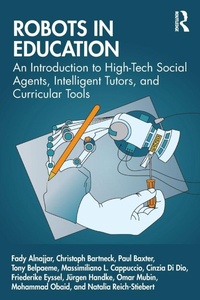
Robots in Education
An Introduction to High-Tech Social Agents, Intelligent Tutors, and Curricular Tools
1st Edition
Published on 30. July 2021
Book
Paperback/Softback
226 pages
978-0-367-65539-6 (ISBN)
Description
Robots in Education is an accessible introduction to the use of robotics in formal learning, encompassing pedagogical and psychological theories as well as implementation in curricula. Today, a variety of communities across education are increasingly using robots as general classroom tutors, tools in STEM projects, and subjects of study. This volume explores how the unique physical and social-interactive capabilities of educational robots can generate bonds with students while freeing instructors to focus on their individualized approaches to teaching and learning. Authored by a uniquely interdisciplinary team of scholars, the book covers the basics of robotics and their supporting technologies; attitudes toward and ethical implications of robots in learning; research methods relevant to extending our knowledge of the field; and more.
Reviews / Votes
"Authors differentiate between robots-as-tools and social robots, who are "intended to interact and communicate with humans," as opposed to human teachers, who "have skills and abilities that go well beyond those of robots." In recognition of the challenges inherent in societal attitudes toward robots and technology acceptance and ethical concerns about educational technology, the text concludes with an introduction to pertinent research methods in educational robotics."-D. L. Stoloff, Eastern Connecticut State University, CHOICE
More details
Language
English
Place of publication
London
United Kingdom
Publishing group
Taylor & Francis Ltd
Target group
College/higher education
Illustrations
49 s/w Abbildungen, 47 s/w Photographien bzw. Rasterbilder, 2 s/w Zeichnungen, 1 s/w Tabelle
1 Tables, black and white; 2 Line drawings, black and white; 47 Halftones, black and white; 49 Illustrations, black and white
Dimensions
Height: 229 mm
Width: 152 mm
Thickness: 13 mm
Weight
354 gr
ISBN-13
978-0-367-65539-6 (9780367655396)
Copyright in bibliographic data and cover images is held by Nielsen Book Services Limited or by the publishers or by their respective licensors: all rights reserved.
Schweitzer Classification
Other editions
Additional editions
Fady Alnajjar | Christoph Bartneck | Paul Baxter
Robots in Education
An Introduction to High-Tech Social Agents, Intelligent Tutors, and Curricular Tools
Book
07/2021
1st Edition
Routledge
€206.40
Shipment within 15-20 days
Fady Alnajjar | Christoph Bartneck | Paul Baxter
Robots in Education
An Introduction to High-Tech Social Agents, Intelligent Tutors, and Curricular Tools
E-Book
07/2021
1st Edition
Routledge
€55.49
Available for download
Fady Alnajjar | Christoph Bartneck | Paul Baxter
Robots in Education
An Introduction to High-Tech Social Agents, Intelligent Tutors, and Curricular Tools
E-Book
07/2021
1st Edition
Routledge
€55.49
Available for download
Persons
Fady Alnajjar is Associate Professor in the Department of Computer Science and Software Engineering in the College of Information Technology at United Arab Emirates University, UAE.
Christoph Bartneck is Associate Professor and Director of Postgraduate Studies in the HIT Lab NZ at the University of Canterbury, New Zealand.
Paul Baxter is Senior Lecturer in Computer Science (Autonomous Systems) and Founding and Steering Group member of the Autism Research and Innovation Centre (ARIC) at the University of Lincoln, UK.
Tony Belpaeme is Professor in the Faculty of Engineering and Architecture at Ghent University, Belgium, and Full Professor in Cognitive Systems and Robotics at Plymouth University, UK.
Massimiliano L. Cappuccio is Senior Researcher in the School of Engineering and Information Technology at the University of New South Wales Canberra, Australia.
Cinzia Di Dio is Researcher in the Faculty of Education in the Department of Psychology at Universita Cattolica del Sacro Cuore, Italy.
Friederike Eyssel is Full Professor and Head of the Applied Social Psychology and Gender Research Lab at Bielefeld University, Germany.
Juergen Handke is Professor in the Department of English and American Studies at the Philipps University of Marburg, Germany.
Omar Mubin is Senior Lecturer in Human Computer Interaction in the School of Computer, Data, and Mathematical Sciences at Western Sydney University, Australia.
Mohammad Obaid is Associate Professor of Human-Computer Interaction and Head of the Interaction Design Unit in the Department of Computer Science and Engineering at Chalmers University of Technology, Sweden.
Natalia Reich-Stiebert is Research Fellow at the Department of Social Psychology at the University of Hagen, Germany.
Christoph Bartneck is Associate Professor and Director of Postgraduate Studies in the HIT Lab NZ at the University of Canterbury, New Zealand.
Paul Baxter is Senior Lecturer in Computer Science (Autonomous Systems) and Founding and Steering Group member of the Autism Research and Innovation Centre (ARIC) at the University of Lincoln, UK.
Tony Belpaeme is Professor in the Faculty of Engineering and Architecture at Ghent University, Belgium, and Full Professor in Cognitive Systems and Robotics at Plymouth University, UK.
Massimiliano L. Cappuccio is Senior Researcher in the School of Engineering and Information Technology at the University of New South Wales Canberra, Australia.
Cinzia Di Dio is Researcher in the Faculty of Education in the Department of Psychology at Universita Cattolica del Sacro Cuore, Italy.
Friederike Eyssel is Full Professor and Head of the Applied Social Psychology and Gender Research Lab at Bielefeld University, Germany.
Juergen Handke is Professor in the Department of English and American Studies at the Philipps University of Marburg, Germany.
Omar Mubin is Senior Lecturer in Human Computer Interaction in the School of Computer, Data, and Mathematical Sciences at Western Sydney University, Australia.
Mohammad Obaid is Associate Professor of Human-Computer Interaction and Head of the Interaction Design Unit in the Department of Computer Science and Engineering at Chalmers University of Technology, Sweden.
Natalia Reich-Stiebert is Research Fellow at the Department of Social Psychology at the University of Hagen, Germany.
Content
1. Introduction 2. Theories of Learning 3. The Interactive Mind 4. What Makes a Robot? 5. The Robot as a Tool 6. The Robot as a Social Agent 7. Deployment Requirements 8. Applications 9. Attitudes Towards Robots 10. Ethics 11. Research Methods in Educational Robotics