

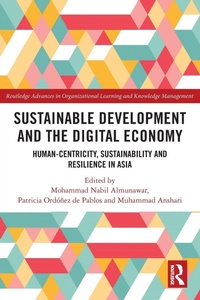
Sustainable Development and the Digital Economy
Human-centricity, Sustainability and Resilience in Asia
1st Edition
Published on 30. January 2025
Book
Paperback/Softback
268 pages
978-1-032-48386-3 (ISBN)
Description
The advancement of technology, such as data analytics and artificial intelligence (AI), has led to the birth of Industry 4.0, in which technology seems to be the centre of development. However, as the Covid-19 pandemic created havoc, the entire world production chain has been seriously affected, highlighting that machines alone, although fully connected and automated, cannot function without people. This book addresses the pillars of moving towards Industry 5.0 for sustainable development, drawing on examples from Asia.
As Asian nations are moving fast toward the digital economy, this edited collection offers new perspectives on understanding emerging business opportunities as well as the challenges faced. Chapters span the three pillars of Industry 5.0, human centricity, sustainability and resilience, and includes topics related to people management for creating wealth, technology advancements in supporting creativity, resilience and agility of organisations, as well as the important issue of sustainability in future industrial development.
With rich, empirical studies from leading researchers, this book will be a reference for academics and scholars across business disciplines, including information, technology and innovation management, organisational and strategic management, as well as those interested in industrial development and sustainability.
As Asian nations are moving fast toward the digital economy, this edited collection offers new perspectives on understanding emerging business opportunities as well as the challenges faced. Chapters span the three pillars of Industry 5.0, human centricity, sustainability and resilience, and includes topics related to people management for creating wealth, technology advancements in supporting creativity, resilience and agility of organisations, as well as the important issue of sustainability in future industrial development.
With rich, empirical studies from leading researchers, this book will be a reference for academics and scholars across business disciplines, including information, technology and innovation management, organisational and strategic management, as well as those interested in industrial development and sustainability.
More details
Series
Language
English
Place of publication
London
United Kingdom
Publishing group
Taylor & Francis Ltd
Target group
College/higher education
Postgraduate
Illustrations
42 s/w Abbildungen, 4 s/w Photographien bzw. Rasterbilder, 38 s/w Zeichnungen, 36 s/w Tabellen
36 Tables, black and white; 38 Line drawings, black and white; 4 Halftones, black and white; 42 Illustrations, black and white
Dimensions
Height: 234 mm
Width: 156 mm
Thickness: 16 mm
Weight
447 gr
ISBN-13
978-1-032-48386-3 (9781032483863)
Copyright in bibliographic data and cover images is held by Nielsen Book Services Limited or by the publishers or by their respective licensors: all rights reserved.
Schweitzer Classification
Other editions
Additional editions
Mohammad Nabil Almunawar | Patricia Ordonez De Pablos | Muhammad Anshari
Sustainable Development and the Digital Economy
Human-centricity, Sustainability and Resilience in Asia
E-Book
10/2023
1st Edition
Routledge
€55.49
Available for download
Mohammad Nabil Almunawar | Patricia Ordonez De Pablos | Muhammad Anshari
Sustainable Development and the Digital Economy
Human-centricity, Sustainability and Resilience in Asia
Book
10/2023
1st Edition
Routledge
€206.70
Shipment within 10-20 days
Mohammad Nabil Almunawar | Patricia Ordonez De Pablos | Muhammad Anshari
Sustainable Development and the Digital Economy
Human-centricity, Sustainability and Resilience in Asia
E-Book
10/2023
1st Edition
Routledge
€55.49
Available for download
Persons
Mohammad Nabil Almunawar is currently an associate professor at the School of Business and Economics, Universiti Brunei Darussalam, Brunei Darussalam. His overall research interests include applications of IT in management, e-business/commerce, digital marketplace/platform, digital transformation, digital business ecosystem, health informatics, information security and cloud computing. Currently, he focuses his research on digital platforms and the digital business ecosystem. He is Editor in Chief International Journal of E-Business Research (IJEBR), an associate editor of International Journal of Asian Business and Information Management (IJABIM) and a member of many editorial boards of international journals.
Patricia Ordonez de Pablos is a full professor in the Department of Business Administration in the Faculty of Business and Economics at the University of Oviedo, Spain. She serves as Editor in Chief of Routledge book series Advances on Organizational Learning and Knowledge Management and Editor in Chief of IGI Global's International Journal of Asian Business and Information Management (IJABIM) and Editor in Chief Inderscience's International Journal of Learning and Intellectual Capital (IJLIC).
Muhammad Anshari is a researcher and academic staff at the School of Business and Economics, Universiti Brunei Darussalam (UBD), Brunei Darussalam, and currently serves as Deputy Director Institute of Policy Studies at the same university. He received his BMIS (Hons) from International Islamic University, Malaysia, his Master of IT (E-Business) from James Cook University, Australia, and his PhD from UBD. His current research interests include business information systems, knowledge management systems, Industry 4.0, big data in business, FinTech and healthcare information systems.
Patricia Ordonez de Pablos is a full professor in the Department of Business Administration in the Faculty of Business and Economics at the University of Oviedo, Spain. She serves as Editor in Chief of Routledge book series Advances on Organizational Learning and Knowledge Management and Editor in Chief of IGI Global's International Journal of Asian Business and Information Management (IJABIM) and Editor in Chief Inderscience's International Journal of Learning and Intellectual Capital (IJLIC).
Muhammad Anshari is a researcher and academic staff at the School of Business and Economics, Universiti Brunei Darussalam (UBD), Brunei Darussalam, and currently serves as Deputy Director Institute of Policy Studies at the same university. He received his BMIS (Hons) from International Islamic University, Malaysia, his Master of IT (E-Business) from James Cook University, Australia, and his PhD from UBD. His current research interests include business information systems, knowledge management systems, Industry 4.0, big data in business, FinTech and healthcare information systems.
Content
Chapter 1: Talent management in the digital era. Chapter 2: Digital Talent Management in Indonesia. Chapter 3: Digital Inclusion and Micro and Small Enterprises: The Indonesia Story. Chapter 4: Collaborative Management in Value Creation: Cases of SMEs. Chapter 5: Collaborative Youth Action to Alleviate Digital Inequality in Rural Areas in Indonesia. Chapter 6: Home Robots and Their Role in the Owners' Well-Being and Family Structure: A Netnographic study with Japanese People. Chapter 7: Technology Support for Circular Economy. Chapter 8: Technological change: Solar Coin and green revolution of the oil and gas industry. Chapter 9: Featuring Digital Twins in Healthcare Information Systems. Chapter 10: The Digital Economy and Anthropocentric Sustainable Development: The Environmental Resilience of the Asian Continent. Chapter 11: Social Media Exposure and COVID-19 Pandemic toward Sustainable Consumption Behaviour: An Investigation from the Perspective of Indonesian Consumers. Chapter 12: Smart Urban Governance: Implementation and Challenges in Southeast Asia. Chapter 13: How (Islamic) Smart Cities 2.0 are Driving Inclusive Growth Opportunities and Fighting Climate Change: Evidence from Asia-9. Chapter 14: Korea's Citizen Centric Smart City Development by Adopting Methodologies of Living Labs and Design Thinking and its Implications for the ASEAN Countries