

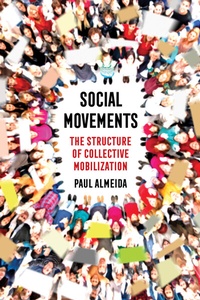
Social Movements
The Structure of Collective Mobilization
Published on 5. March 2019
Book
Paperback/Softback
240 pages
978-0-520-29091-4 (ISBN)
Description
Social Movements cleverly translates the art of collective action and mobilization by excluded groups to facilitate understanding social change from below. Students learn the core components of social movements, the theory and methods used to study them, and the conditions under which they can lead to political and social transformation.
This fully class-tested book is the first to be organized along the lines of the major subfields of social movement scholarship-framing, movement emergence, recruitment, and outcomes-to provide comprehensive coverage in a single core text.
Features include:
use of real data collected in the U.S. and around the world
the emphasis on student learning outcomes
case studies that bring social movements to life
examples of cultural repertoires used by movements (flyers, pamphlets, event data on activist websites, illustrations by activist musicians) to mobilize a group
topics such as immigrant rights, transnational movement for climate justice, Women's Marches, Fight for $15, Occupy Wall Street, Gun Violence, Black Lives Matter, and the mobilization of popular movements in the global South on issues of authoritarian rule and neoliberalism
With this book, students deepen their understanding of movement dynamics, methods of investigation, and dominant theoretical perspectives, all while being challenged to consider their own place in relation to social movements.
This fully class-tested book is the first to be organized along the lines of the major subfields of social movement scholarship-framing, movement emergence, recruitment, and outcomes-to provide comprehensive coverage in a single core text.
Features include:
use of real data collected in the U.S. and around the world
the emphasis on student learning outcomes
case studies that bring social movements to life
examples of cultural repertoires used by movements (flyers, pamphlets, event data on activist websites, illustrations by activist musicians) to mobilize a group
topics such as immigrant rights, transnational movement for climate justice, Women's Marches, Fight for $15, Occupy Wall Street, Gun Violence, Black Lives Matter, and the mobilization of popular movements in the global South on issues of authoritarian rule and neoliberalism
With this book, students deepen their understanding of movement dynamics, methods of investigation, and dominant theoretical perspectives, all while being challenged to consider their own place in relation to social movements.
Reviews / Votes
"Easy to read, this extensive review of social movements will benefit new scholars to the field as well as seasoned scholars interested in the organization of more recent movements." * American Ethnologist * "The book is well written and should be accessible to most readers new to the social movements field; Almeida is adept at explaining the sometimes confusing jargon that pervades the academic literature on movements." * Social Forces * "This book is a welcome addition to the academic resources available in social work education, specifically community-based social work." * Journal of Sociology & Social Welfare * "For scholars of social movements in Latin America, this is a refreshing and valuable new textbook." * Latin American Politics and Society *More details
Language
English
Place of publication
Berkerley
United States
Target group
Professional and scholarly
Product notice
Paperback (trade)
Illustrations
25 bw images
Dimensions
Height: 229 mm
Width: 152 mm
Thickness: 13 mm
Weight
363 gr
ISBN-13
978-0-520-29091-4 (9780520290914)
Copyright in bibliographic data and cover images is held by Nielsen Book Services Limited or by the publishers or by their respective licensors: all rights reserved.
Schweitzer Classification
Other editions
Additional editions
E-Book
03/2019
1st Edition
Naval Institute Press
€20.49
Available for download
Person
Paul Almeida is Professor and Chair of Sociology at the University of California, Merced. He is a two-time Fulbright Fellowship Recipient and received the 2015 Distinguished Scholarship Award from the Pacific Sociological Association.
Content
List of Illustrations
Acknowledgments
1. Social Movements: The Structure of Collective Action
2. How to Study Social Movements: Classification and Methods
3. Theories of Social Movement Mobilization
4. Social Movement Emergence: Interests, Resource Infrastructures, and Identities
5. The Framing Process
6. Individual Recruitment and Participation
7. Movement Outcomes
8. Pushing the Limits: Social Movements in the Global South
Conclusion: Mounting Crises and the Pathway Forward
Notes
References
Index
Acknowledgments
1. Social Movements: The Structure of Collective Action
2. How to Study Social Movements: Classification and Methods
3. Theories of Social Movement Mobilization
4. Social Movement Emergence: Interests, Resource Infrastructures, and Identities
5. The Framing Process
6. Individual Recruitment and Participation
7. Movement Outcomes
8. Pushing the Limits: Social Movements in the Global South
Conclusion: Mounting Crises and the Pathway Forward
Notes
References
Index