

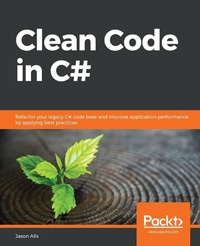
Clean Code in C#
Refactor your legacy C# code base and improve application performance by applying best practices
Published on 17. July 2020
Book
Paperback/Softback
500 pages
978-1-83898-297-3 (ISBN)
Description
Develop your programming skills by exploring essential topics such as code reviews, implementing TDD and BDD, and designing APIs to overcome code inefficiency, redundancy, and other problems arising from bad code
Key Features
Write code that cleanly integrates with other systems while maintaining well-defined software boundaries
Understand how coding principles and standards enhance software quality
Learn how to avoid common errors while implementing concurrency or threading
Book DescriptionTraditionally associated with developing Windows desktop applications and games, C# is now used in a wide variety of domains, such as web and cloud apps, and has become increasingly popular for mobile development. Despite its extensive coding features, professionals experience problems related to efficiency, scalability, and maintainability because of bad code. Clean Code in C# will help you identify these problems and solve them using coding best practices.
The book starts with a comparison of good and bad code, helping you understand the importance of coding standards, principles, and methodologies. You'll then get to grips with code reviews and their role in improving your code while ensuring that you adhere to industry-recognized coding standards. This C# book covers unit testing, delves into test-driven development, and addresses cross-cutting concerns. You'll explore good programming practices for objects, data structures, exception handling, and other aspects of writing C# computer programs. Once you've studied API design and discovered tools for improving code quality, you'll look at examples of bad code and understand which coding practices you should avoid.
By the end of this clean code book, you'll have the developed skills you need in order to apply industry-approved coding practices to write clean, readable, extendable, and maintainable C# code.
What you will learn
Write code that allows software to be modified and adapted over time
Implement the fail-pass-refactor methodology using a sample C# console application
Address cross-cutting concerns with the help of software design patterns
Write custom C# exceptions that provide meaningful information
Identify poor quality C# code that needs to be refactored
Secure APIs with API keys and protect data using Azure Key Vault
Improve your code's performance by using tools for profiling and refactoring
Who this book is forThis coding book is for C# developers, team leads, senior software engineers, and software architects who want to improve the efficiency of their legacy systems. A strong understanding of C# programming is required.
Key Features
Write code that cleanly integrates with other systems while maintaining well-defined software boundaries
Understand how coding principles and standards enhance software quality
Learn how to avoid common errors while implementing concurrency or threading
Book DescriptionTraditionally associated with developing Windows desktop applications and games, C# is now used in a wide variety of domains, such as web and cloud apps, and has become increasingly popular for mobile development. Despite its extensive coding features, professionals experience problems related to efficiency, scalability, and maintainability because of bad code. Clean Code in C# will help you identify these problems and solve them using coding best practices.
The book starts with a comparison of good and bad code, helping you understand the importance of coding standards, principles, and methodologies. You'll then get to grips with code reviews and their role in improving your code while ensuring that you adhere to industry-recognized coding standards. This C# book covers unit testing, delves into test-driven development, and addresses cross-cutting concerns. You'll explore good programming practices for objects, data structures, exception handling, and other aspects of writing C# computer programs. Once you've studied API design and discovered tools for improving code quality, you'll look at examples of bad code and understand which coding practices you should avoid.
By the end of this clean code book, you'll have the developed skills you need in order to apply industry-approved coding practices to write clean, readable, extendable, and maintainable C# code.
What you will learn
Write code that allows software to be modified and adapted over time
Implement the fail-pass-refactor methodology using a sample C# console application
Address cross-cutting concerns with the help of software design patterns
Write custom C# exceptions that provide meaningful information
Identify poor quality C# code that needs to be refactored
Secure APIs with API keys and protect data using Azure Key Vault
Improve your code's performance by using tools for profiling and refactoring
Who this book is forThis coding book is for C# developers, team leads, senior software engineers, and software architects who want to improve the efficiency of their legacy systems. A strong understanding of C# programming is required.
More details
Language
English
Place of publication
Birmingham
United Kingdom
Target group
Professional and scholarly
Dimensions
Height: 235 mm
Width: 191 mm
Thickness: 27 mm
Weight
924 gr
ISBN-13
978-1-83898-297-3 (9781838982973)
Copyright in bibliographic data and cover images is held by Nielsen Book Services Limited or by the publishers or by their respective licensors: all rights reserved.
Schweitzer Classification
Other editions
Additional editions
Jason Alls
Clean Code in C#
Refactor your legacy C# code base and improve application performance by applying best practices
E-Book
06/2024
1st Edition
Packt Publishing Limited
€29.49
Available for download
Previous edition
Jason Alls
Clean Code with C#
Refactor your legacy C# code base and improve application performance using best practices
Book
12/2023
2nd Edition
Packt Publishing
€47.03
Article exhausted; check for reprint
Person
Jason Alls has been programming for over 21 years using Microsoft technologies. Working with an Australasian company, he started his career developing call center management reporting software used by global clients including telecom providers, banks, airlines, and the police. He then moved on to develop GIS marketing applications and worked in the banking sector performing data migrations between Oracle and SQL Server. Certified as an MCAD in C# since 2005, he has been involved in the development of various desktop, web, and mobile applications. Currently employed by a globally recognized leader in the educational software sector, he develops and supports dyslexia testing and assessment software written in ASP.NET, Angular, and C#.
Content
Table of Contents
Coding Standards and Principles in C#
Code Review - Process and Importance
Classes, Objects, and Data Structures
Writing Clean Functions
Exception Handling
Unit Testing
End-to-End System Testing
Threading and Concurrency
Designing and Developing APIs
Securing APIs with API Keys and Azure Key Vault
Addressing Cross-Cutting Concerns
Using Tools to Improve Code
Refactoring C# Code - Identifying Code Smells
Refactoring C# Code - Implementing Design Patterns
Coding Standards and Principles in C#
Code Review - Process and Importance
Classes, Objects, and Data Structures
Writing Clean Functions
Exception Handling
Unit Testing
End-to-End System Testing
Threading and Concurrency
Designing and Developing APIs
Securing APIs with API Keys and Azure Key Vault
Addressing Cross-Cutting Concerns
Using Tools to Improve Code
Refactoring C# Code - Identifying Code Smells
Refactoring C# Code - Implementing Design Patterns