

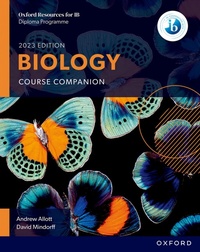
Oxford Resources for IB DP Biology: Course Book
Published on 9. February 2023
Book
Paperback/Softback
816 pages
978-1-382-01633-9 (ISBN)
Description
Featuring a wealth of engaging content, this concept-based Course Book has been developed in cooperation with the IB to provide the most comprehensive support for the DP Biology specification, for first teaching from September 2023. Created by experienced IB authors, examiners and teachers, it is packed with activities, questions, and opportunities to regularly practice, plus extensive assessment preparation support.
Use this print Course Book alongside the digital course on Oxford's Kerboodle platform for the best teaching and learning experience. Oxford's DP Science offer brings together the IB curriculum and future-facing functionality, enabling success in DP and beyond.
Use this print Course Book alongside the digital course on Oxford's Kerboodle platform for the best teaching and learning experience. Oxford's DP Science offer brings together the IB curriculum and future-facing functionality, enabling success in DP and beyond.
More details
Series
Edition
1
Language
English
Place of publication
Oxford
United Kingdom
Target group
Primary & secondary/elementary & high school
Dimensions
Height: 276 mm
Width: 221 mm
Thickness: 32 mm
Weight
2128 gr
ISBN-13
978-1-382-01633-9 (9781382016339)
Copyright in bibliographic data and cover images is held by Nielsen Book Services Limited or by the publishers or by their respective licensors: all rights reserved.
Schweitzer Classification
Other editions
Previous edition
Andrew Allott | David Mindorff
Oxford IB Diploma Programme: Biology Course Companion
For the IB diploma: 2014 edition
Book
02/2014
Oxford University Press
€71.79
Article exhausted; check for reprint
Content
A Unity and diversity 1 Molecules A1.1 Water A1.2 Nucleic acids Theory of knowledge End of chapter questions 2 Cells A2.1 Origins of cells A2.2 Cell structure A2.3 Viruses Theory of knowledge End of chapter questions 3 Organisms A3.1 Diversity of organisms A3.2 Classification and cladistics Theory of knowledge End of chapter questions 4 Ecosystems A4.1 Evolution and speciation A4.2 Conservation of biodiversity Theory of knowledge End of chapter questions B Form and function 1 Molecules B1.1 Carbohydrates and lipids B1.2 Proteins Theory of knowledge End of chapter questions 2 Cells B2.1 Membranes and membrane transport B2.2 Organelles and compartmentalization B2.3 Cell specialization Theory of knowledge End of chapter questions 3 Organisms B3.1 Gas exchange B3.2 Transport B3.3 Muscle and motility Theory of knowledge End of chapter questions 4 Ecosystems B4.1 Adaptation to environment B4.2 Ecological niches Theory of knowledge End of chapter questions C Interaction and interdependence 1 Molecules C1.1 Enzymes and metabolism C1.2 Cell respiration C1.3 Photosynthesis Theory of knowledge End of chapter questions 2 Cells C2.1 Chemical signalling C2.2 Neural signalling Theory of knowledge End of chapter questions 3 Organisms C3.1 Integration of body systems C3.2 Defence against disease Theory of knowledge End of chapter questions 4 Ecosystems C4.1 Populations and communities C4.2 Transfers of energy and matter Theory of knowledge End of chapter questions D Continuity and change 1 Molecules D1.1 DNA replication D1.2 Protein synthesis D1.3 Mutation and gene editing Theory of knowledge End of chapter questions 2 Cells D2.1 Cell and nuclear division D2.2 Gene expression D2.3 Water potential Theory of knowledge End of chapter questions 3 Organisms D3.1 Reproduction D3.2 Inheritance D3.3 Homeostasis Theory of knowledge End of chapter questions 4 Ecosystems D4.1 Natural selection D4.2 Stability and change D4.3 Climate change Theory of knowledge End of chapter questions Internal assessment: The scientific investigation Index Answers